

Guadalajara — Alejandro Velasco was 11 years old when he crossed a Brazilian national team training session in the Mexican city of Guanajuato and hugged Pelé. In 1970, Mexico was buzzing with World Cup excitement.
The Mexican boy, taken by his journalist uncle to watch the preparation of Mário Jorge Lobo Zagallo's team, could never have imagined that, more than five decades later, he would be responsible for immortalizing the greatest player in the history of football in a 10-meter-high sculpture. "For me it was the ultimate. I hugged Pelé in Guanajuato. And now I was able to sculpt him," says Velasco, in an interview with NeoFeed .
Velasco became an architect, foundry worker, and sculptor. Months after the last World Cup, he received a phone call from his representative in Guadalajara with a proposal to create a sculpture of Pelé to be placed in front of the Jalisco Stadium, in the heart of the city where Brazil won its third world championship (this year's games are being played at the newly built Akron Stadium).
It was the venue for five of the Brazilian national team's six matches. Brazil defeated Czechoslovakia, England, Romania, Peru, and Uruguay (Pelé scored against Czechoslovakia and Romania) before definitively winning the Jules Rimet trophy with a 4-1 victory over Italy at the Azteca Stadium in Mexico City.
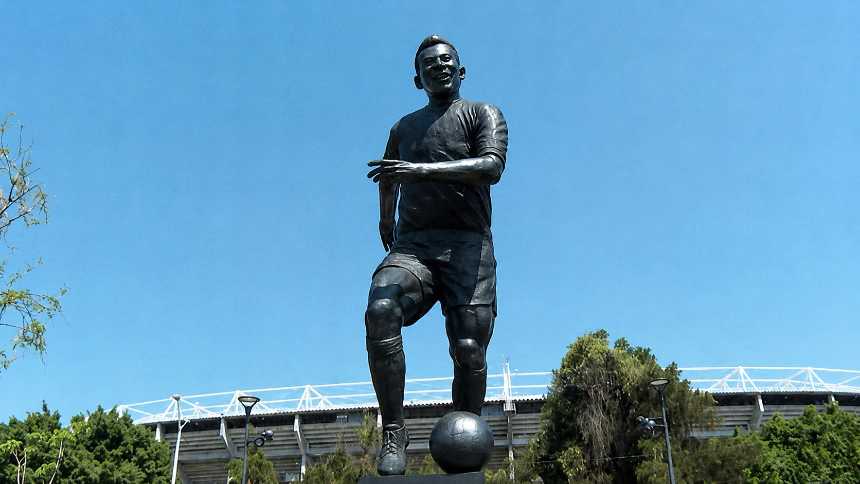
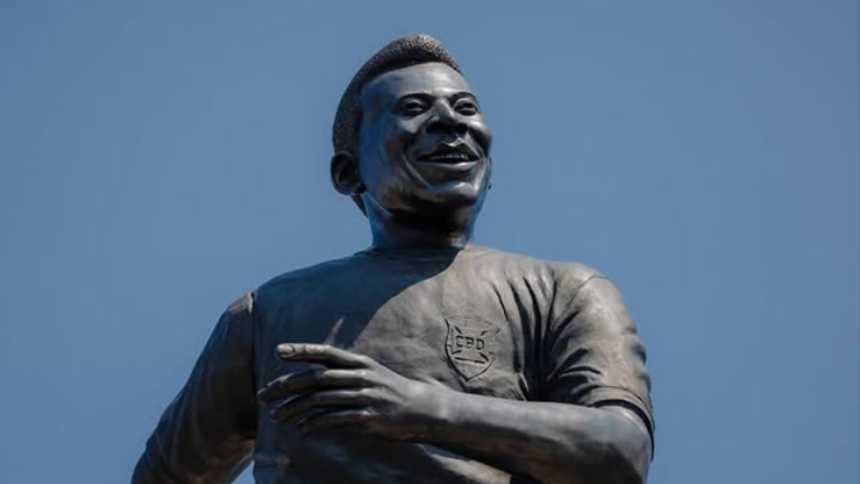
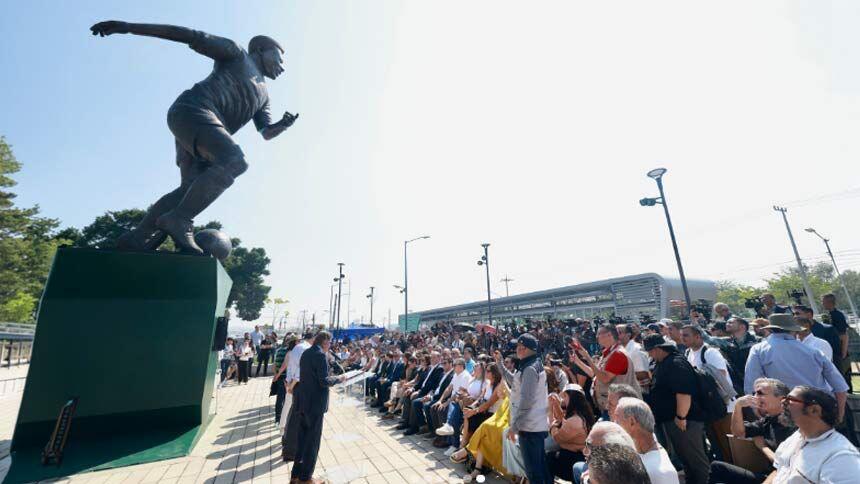
In the outskirts of Jalisco, Pelé can now be seen in the distance dribbling the ball, muscles tense, head held high and a discreet smile on his face.
The sculpture, unveiled shortly before the start of the 2026 World Cup, seeks to capture exactly what impressed Velasco most as a child. "Pelé dribbled the ball with a joy that you never forgot. I very rarely saw him serious when he had the ball. He was happy playing. And it was exactly that movement that I wanted to capture," he says.
The sculptor dared not to choose the most obvious image. In Três Corações, Pelé's hometown, a 1.75-meter monument depicts the King's traditional celebration, with his fist raised after scoring goals.
The "punch in the air" is an image representing each of the 1,283 goals scored by the King of Football. But in Guadalajara, the chosen moment was his run, when Pelé made every opponent tremble with everything he was capable of doing with the ball. And being near the statue gives one a sense of the magnitude of what he represented for world football.
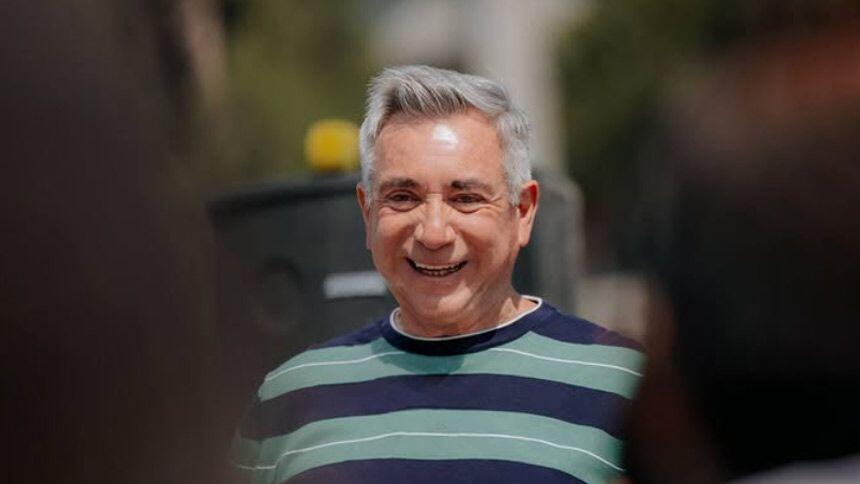
Trained as an architect, Velasco inherited the Fundición Artística Velasco from his father, founded in 1948, and spent decades working alongside great Mexican artists such as Leonora Carrington, José Luis Cuevas, and Vicente Rojo.
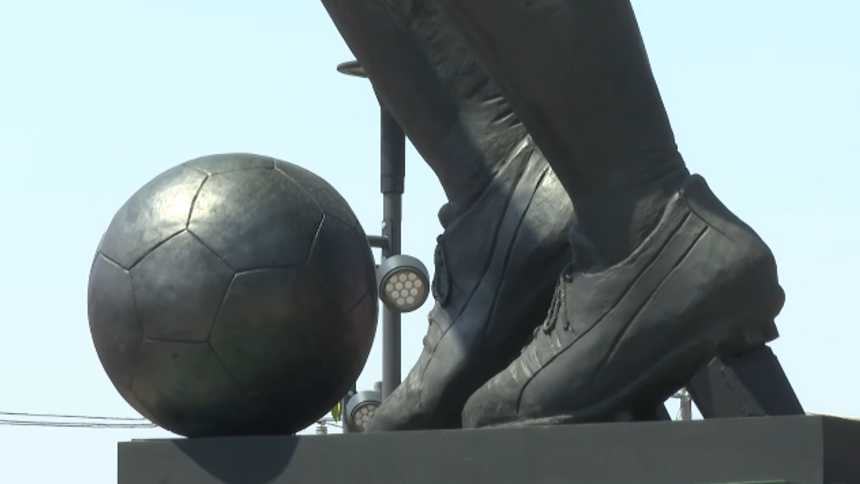
This combination gave shape to the challenge of the Pelé monument: a moving, imposing figure in cast bronze. Velasco says he immersed himself in old videos and photographs to find the right gesture. He didn't want a static Pelé, in a trophy pose.
His wish was to recreate a "living Pelé," running towards the goal, his foot touching the ball and his body leaning forward, with happy eyes, he recalls.
The chosen pose was familiar to any Mexican child from the 1970s. "When we played soccer in the street, everyone wanted to be Pelé. Everyone imitated that sprint with the ball. And that's what I put into the sculpture," says Velasco.
The process began with a maquette. Then came the plaster cast for the body, which was molded directly in the material, while the head, hands, and feet were detailed using plastiline (similar to modeling clay). Finally, the bronze was cast.
The base has an important detail that refers to the Brazilian national team's third World Cup victory. The pedestal was created with a geometric structure inspired by the lines of the Jules Rimet trophy, which Brazil won at the Azteca Stadium in front of more than 107,000 spectators.
The king and the boy
Velasco is passionate about football. He played professionally in Mexico, in the third division. He grew up watching the Brazilian national team, and the final match of that World Cup is forever etched in his memory.
He recalls the pitch invasion, the fans carrying Pelé on their shoulders, the crowd trying to tear away any memento of the King.
"I was at home, watching on television, thrilled. When Brazil won, people went to the stadium and tried to get as much as they could from Pelé, his boots, anything," he recalls.
For the sculpture, Velasco sought out that same Pelé from his own memories. He followed Rivelino, Tostão, the generation he calls "the most unforgettable national team that ever existed." But, to this day, the artist has never had contact with Pelé's family—although he harbors that desire.
"I would very much like to meet someone from the family, shake their hand, and hear what they think of the sculpture. If it is worthy of what Pelé was. I tried to make it as professional as possible, so that this sculpture would be worthy of a player of his level. And for Brazil, of course. Always for Brazil."
Plaza Brasil
The sculpture of Pelé is located in Plaza Brasil, in front of the Jalisco building, named in honor of Brazilian football. It is permanent, and Velasco believes it will outlast any political administration.
"The square is called Brazil. It will always exist to celebrate football in Brazil and throughout Latin America. I want it to be an icon, where people come to celebrate, as a meeting point, a place for festivities, for triumph," he says.
For the sculptor, the monument carries something greater than a tribute to a player. It is a symbol of the relationship between Mexico and Brazil, two countries that, in his view, became closer brothers after 1970.
"Brazil is very well-liked here [in Mexico] . It always has been. Brazilian players are welcomed as if they were from here. And this relationship has only grown," he says.
In the artist's vision, Plaza Brasil could become a landmark of Guadalajara, like Plaza de la Minerva, one of the city's main postcards.
His next challenge could be as big as immortalizing Pelé. Although he's still working on it informally, there's a possibility he could create a sculpture of Hugo Sánchez, the greatest Mexican player of all time.
"It would be fabulous for me to have a Mexican player. It always strengthens the bonds with the fans. But for now, it's just talk, nothing concrete," he says.
For now, Velasco has enough to be proud of: a "table" in the form of a sculpture of the King of Football with his signature.
*The journalist traveled at the invitation of Binance.