

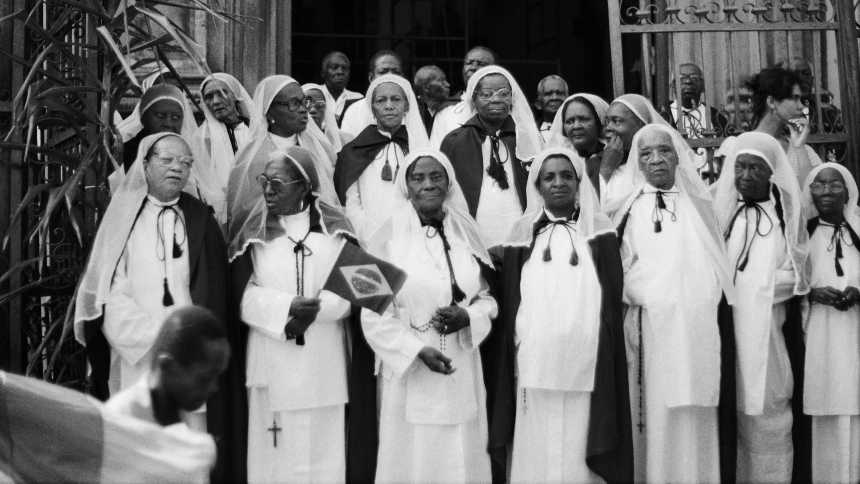
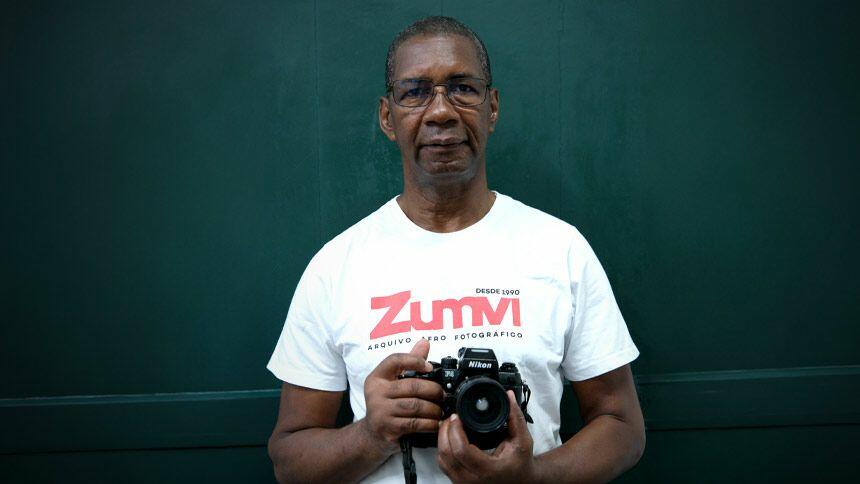
While conversing with curators Hélio Menezes and Ariana Nuala, Lázaro Roberto interrupted an interview to attend to a young man who had lost his father and was searching for a photograph of him. The photographer mentioned the name, went to the archive, and returned with a portrait of a worker from the São Joaquim Fair in Salvador.
“When I started photographing the workers, I wondered if I was going to sell those photos to white people,” Lázaro Roberto tells NeoFeed . To gain the trust of the market vendors, he spent a year frequenting the São Joaquim Market, moved out of the union, and shared beers with them on Sundays. “I think that, over time, they understood what we were doing,” he says.
What Lázaro, 68, built with his photos was a different way of seeing. Instead of the fleeting and exoticizing gaze of so many photographers who arrived at the fair to produce a photo shoot and never returned, he captured people with whom he shared bonds and a sense of belonging.
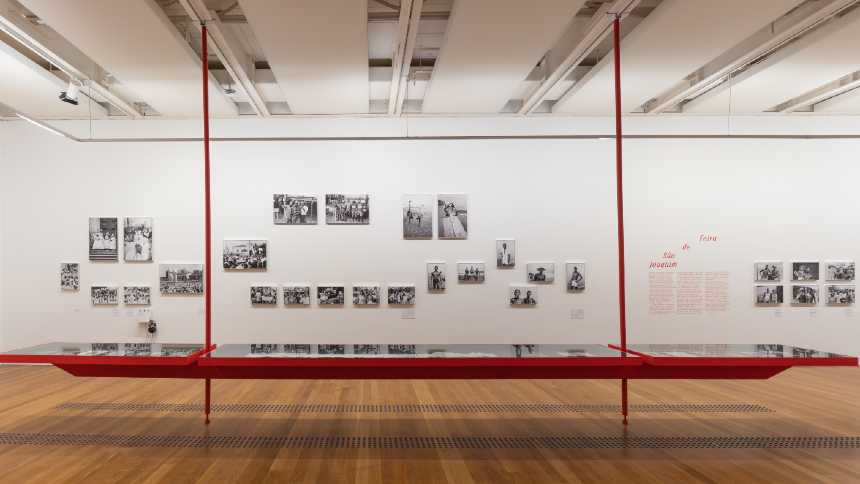
These images were part of the exhibition Zumví Afro Photographic Archive , on display at the Instituto Moreira Salles until August 23. The exhibition presents approximately 400 photographs from the archive founded in Salvador in 1990 by Lázaro Roberto, Aldemar Marques, and Raimundo Monteiro.
Zumví is one of the most important photographic collections in the country and a key piece for understanding both the history of Brazilian photography and that of Black movements. Its name combines the Portuguese word " zoom " with the idea of testimony — "vi".
The archive was born from a commitment to document Black life in Bahia from the perspective of those who lived it, at a time when Black people rarely produced and preserved their own images. For its founders, photography was a way to get closer and bear witness.
In the early 1990s, Lázaro enrolled in a photography course at Senac. It was there that he met Aldemar and Raimundo, with whom he shared similar concerns. "I felt the need to create a group to talk about my photography. Until then, I didn't know any photographers whose work resonated with mine," says Lázaro.
The power of the image
The photographer, son of laundress Valdelice and stevedore José Ferreira dos Santos, grew up in Fazenda Grande do Retiro, in the northern part of Salvador. Art entered his life through the least predictable door: that of the church.
An Italian priest named Paulo opened up the religious space for young people to form a theater group and hold art and political education events. "Father Paulo arrived there and revolutionized things," he recalls.
It was then that Lázaro discovered that art could be a powerful tool for political and racial awareness. At one of the festivals promoted by the church, he saw a documentary essay by photographer Antonio Olavo and understood that photography was also a way of positioning oneself in the world.
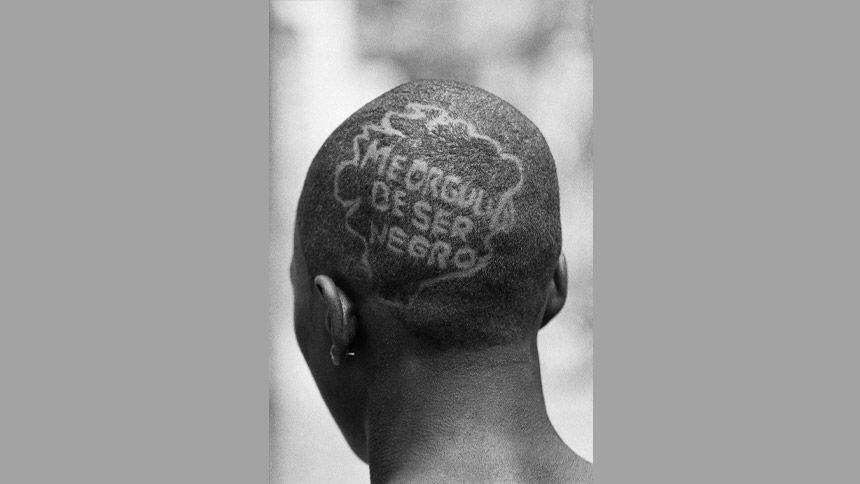
Determined to learn, he sought guidance from Jeremiah, one of the few members of the group who owned a professional camera.
During that time, he worked at the church's printing shop, where he printed pamphlets, posters, and banners for social movements. Gradually, he saved money to buy his first camera, a Minolta with a fixed lens.
After work, he left the printing presses and went out into the streets, documenting the same marches, assemblies, and demonstrations for which he had just printed the promotional material.
"There was no internet. At the print shop, I knew about the movements that were going to happen with the washerwomen, the unions, the neighborhood movements. Usually the demonstrations were in the late afternoon. I worked and then went to photograph," he recalls.
One event, three points of view.
When they brought their collections together, Aldemir, Lázaro, and Raimundo realized that they had often documented the same events without ever being found. Nelson Mandela's visit to Salvador in 1991, for example, had been photographed by all three, each from a different angle.
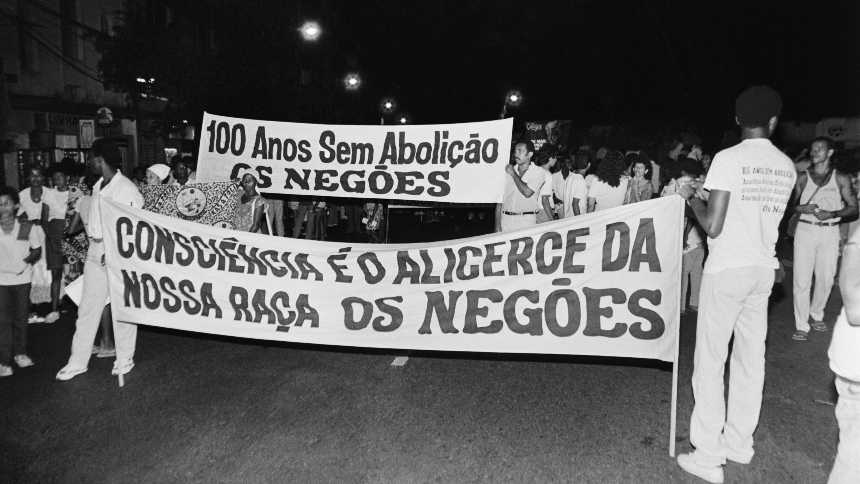
These photos are presented in the first section of the exhibition and show Zumví's close connection with Brazilian Black movements. They are images produced by photographers who were also activists, educators, and cultural agents, present at events such as the Centennial of Abolition protest in 1988 and the commemorations of the 300th anniversary of the death of Zumbi dos Palmares in 1995.
Another subject of interest to the photographers were the carnival groups dedicated to Afro tradition, such as Ilê Aiyê and Filhos de Gandhy. By traveling through peripheral neighborhoods, popular festivals, and political mobilizations, Lázaro began to see the city in a different way.
"That's when I realized Salvador was a Black city. Before that, I confess I didn't see that dimension. It's that thing: you see it, but you don't realize it. When I became aware of it, I started documenting that presence," she says.
The urgency of the collective didn't just come from the streets. Lázaro also saw a Black population systematically excluded from shop windows and on Mother's Day, Father's Day, or Valentine's Day cards. "Normally, these cards only feature white people," he says. "I've never been one to give speeches. As an activist in the Black movement, I've always tried to respond with my photography."
Her response was to produce other images. In essays featuring Black people in scenes of affection, dignity, and pride, she hand-printed and pasted greeting cards and notebook covers. "It was a way I found to balance racial injustices through images. It showed our concern about this," she explains.
The trio were together for five years. When Aldemar and Raimundo left photography, they entrusted their collection to Lázaro's care. Today, Zumví defines itself as a visual quilombo, bringing together the work of seven Black photographers and around 50,000 images produced over 35 years.
"When I started taking photographs, nobody noticed me, nobody invited me to anything," he recalls. "So I said to myself: 'I'm going to photograph today for tomorrow.'" Tomorrow arrived.