


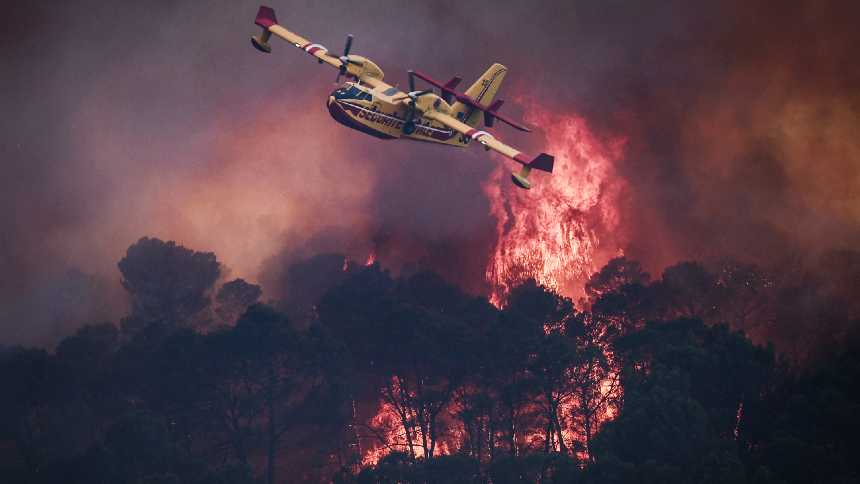
Paris — Wildfires in southwestern France have already destroyed more than 40,000 hectares in the Gironde department and are approaching Bordeaux, raising alarm bells in one of the most symbolic sectors of the French economy and cultural heritage: wine. Even with the main vineyards spared by the flames so far, the biggest threat to the 2026 harvest is not the fire. It's the smoke.
Kilometers away from the fires, grapes can absorb volatile compounds released by the burning vegetation, in a phenomenon known as goût de fumée — "smoky taste." The problem is that the effects of this exposure are not immediately noticeable.
In a technical note, the French Institute of Vine and Wine (IFV) explains: when it occurs, contamination tends to manifest itself only during the winemaking process, when the aromas and flavors of the beverage begin to be defined.
To neutralize foreign chemical compounds, the grapevine binds the molecules responsible for the burnt smell to the sugars in the fruit. At this point, the combination has neither aroma nor taste. Later, however, during fermentation or aging of the beverage, these substances can be released. That's when the wine acquires the smell and taste of smoke.
If the grapes are still green, the risk is lower, since there is more time for the fruit to complete its development and for some of the absorbed compounds to be metabolized, IFV points out.
The ripening phase is considered crucial in the contamination process: if the vineyard is affected shortly before harvest, when the berries are most susceptible, the danger increases. This phenomenon is already known to producers and experts, especially after the fires that hit wine-growing areas of Bordeaux in 2022 and similar episodes recorded in California and Australia in recent years.
The grape harvest in Bordeaux is expected to begin between the end of August and the beginning of September, depending on the region and the grape variety. At this time, the fruit goes through the color change phase — from green to reddish tones in red grapes and golden-yellow in white grapes.
“Unfortunately, we now have some experience with forest fires, which allows us to approach the situation calmly,” says Marine Martin, spokesperson for the Bordeaux Interprofessional Wine Council (CIVB), in an interview with NeoFeed . “Currently, the areas affected by the fire are not wine-growing regions and no impact on the quality of the grapes has been observed. In July, there is still time until the harvest.”
Studies indicate that the risk of contamination increases mainly when fires are very close to the vineyards, generally less than 500 meters away, explains Martin. "The current fires are 15 or 20 kilometers from the vines," he emphasizes.
Experts point out that several factors influence the risk of smoky taste in wine: the proximity of the fires, the direction and duration of the winds, the density of the smoke reaching the vineyards, the exposure time of the grapes, and the stage of fruit development.
The great red wines of the Médoc, including some of the most emblematic names in Bordeaux, such as Château Margaux, Château Latour and Château Lafite Rothschild, would not be at risk of presenting a smoky taste in their vintages, according to Philippe Castéja, president of the council that brings together the vineyards classified as premier crus classés , speaking to the specialized website Vitisphere .
Major crisis
While some downplay the risk, others await answers. Wineries in the region and other parts of France are conducting technical analyses on the grapes to check for possible signs of contamination.
The owner of Château Haut-Bacalan in Pessac, Bordeaux, is one of the least optimistic: his property is less than ten kilometers from the fire's epicenter and was affected by the smoke for three days.
In southern France, several winegrowers have had a large portion of their vineyards burned. In some cases, the vines had been there for decades. The direct losses are still being assessed. With less than two weeks until the start of the harvest, they fear a possible "smoky taste" in their produce.
In Languedoc-Roussillon, an online platform was created to allow producers to visualize the degree of exposure of their land to smoke from wildfires and, in this way, map the potential risk of contamination. If the risk is intermediate, the grapes can be treated with activated charcoal to eliminate the ash aroma. If it is high, it is not even worth harvesting.
The Burgundy region was not spared from the fires either. Earlier this month, several fires broke out near the vineyards. The flames did not reach the crops, but the fear of the "taste of smoke" is great.
The fires are exacerbating the crisis in the French wine industry, with a drop in domestic consumption, especially of red wines, and a reduction in exports. While producers try to protect their land, the French state has been funding programs since 2023 to remove some vineyards in different areas of the country to adapt production to a shrinking market.
At the end of 2025, the government released €130 million for a new phase of the project, which foresees the definitive suspension of an additional 30,000 hectares by 2026, equivalent to three times the area of Paris, with compensation for winegrowers to reduce their planted areas.
In total, France could lose 10% of its vineyard area in three years, with 75,000 hectares eliminated. Even so, with 740,000 hectares, the country has the second largest vineyard area in the world, behind only Spain.
The French wine sector is facing a structural crisis: wine consumption in the country has fallen by almost 70% since the 1960s, according to France AgriMer, which is linked to the Ministry of Agriculture.
The decline is particularly pronounced among young people, who prefer other drinks, such as beer. The wine market in the country has contracted every year. By 2025, the drop was projected at 3.2%, according to the International Organisation of Vine and Wine.
French authorities have reported that 70% of the fires this summer were started deliberately. According to the Ministry of the Interior, 275 people have already been arrested.