

Brazil faces a rare paradox: it is an agricultural powerhouse that depends on foreign countries to guarantee its own production. In the case of nitrogen fertilizers , this vulnerability is evident—approximately 80% of the urea consumed in the country comes from abroad, mainly from Russia, China, and the Middle East.
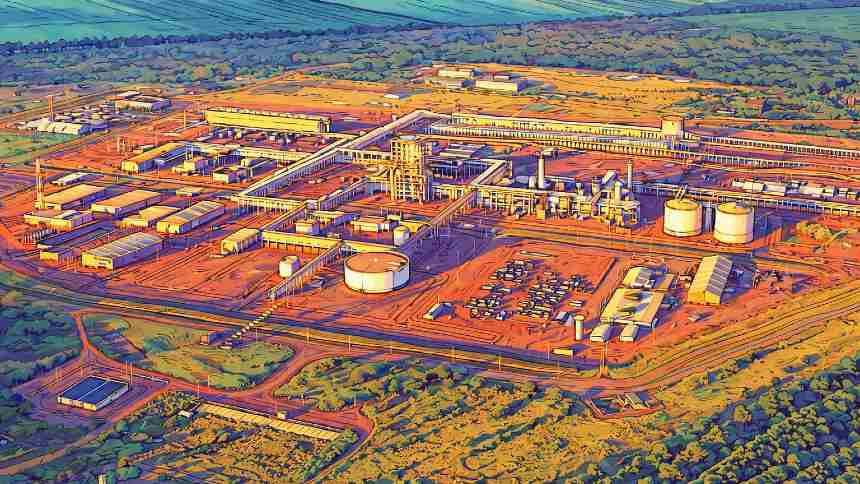
The war in Ukraine, price shocks, and logistical volatility have made it clear that this dependence comes at a high cost. It is in this context that Petrobras decided to resume construction of the Nitrogen Fertilizer Unit III (UFN-III) in Três Lagoas (MS).
For agribusiness , the resumption of UFN-III would initially be good news. Currently, Brazil depends almost entirely on the import of urea, the main source of nitrogen used in agriculture. The fertilizer is applied to crops such as corn, sugarcane, wheat, rice, and coffee, helping in plant growth and grain formation.
For the government, in turn, the promise to supply 15% of the national demand for urea represents yet another initiative to reinforce the current administration's discourse of sovereignty and food security in an election year.
With investments exceeding R$ 5 billion, support from the new PAC (Growth Acceleration Program), and a projected nominal capacity of 3,600 tons per day of urea and 2,200 tons per day of ammonia, the project, which began in 2011, had its construction interrupted in 2014. The company expects to deliver the plant between the end of 2028 and the beginning of 2029.
Magda Chambriard, president of Petrobras, explained that Petrobras' strategy is to double its fertilizer production capacity in Brazil through its own units, in a move aligned with the objectives of the National Fertilizer Plan.
"We are considering the possibility of doubling the size of all our factories, whether it's Ansa, Fafens, or UFN-III, in the Midwest," the executive stated during the unit's relaunch event on Thursday, June 25th.
The resumption of the project also opens a debate that goes beyond economics: the future of fertilizers. UFN-III was conceived 15 years ago, based on natural gas and traditional ammonia and urea production processes — technologies that the world is beginning to replace with low-carbon alternatives, such as green ammonia produced from renewable hydrogen.
The discussion of whether it would be worthwhile to resume construction of the unit with a view to transitioning to green ammonia – which would determine whether the Três Lagoas unit will be modern or obsolete in a few years – was addressed by experts consulted by NeoFeed .
The conclusion is that the resumption of urea production by Petrobras is superficially positive news, but it masks significant structural challenges that go beyond the option of green ammonia.
The viability and real impact on agribusiness, for example, depend entirely on the competitiveness of the product's price, which in turn is tied to the cost of natural gas in Brazil — currently much higher than that of international competitors.
Without a solution to lower the price of natural gas or the creation of subsidies, the power plant will only be competitive in scenarios of extremely high international prices, not structurally resolving Brazil's dependence on imported fertilizers. In other words, the rural producer, pressured by costs and restricted credit, will continue to prioritize price over sustainable alternatives or more expensive domestic production.
Accelerating this transition, in turn, also faces insurmountable difficulties. The renewable option, made from green hydrogen , does not depend on natural gas, but rather on water and electricity. But, again, the cost of adopting it is even higher, since the transition is still in its early stages, with the possibility of being adopted on a large scale from 2030-2040 onwards.
The agricultural dilemma
Marcelo Soto, head of operations and supply intelligence at SCA – a company specializing in agribusiness, focused on the commercialization of biofuels (ethanol and biodiesel), market intelligence, and group purchasing – gets straight to the point.
“Natural gas represents between 60% and 80% of the cost of urea production,” says Soto. He states that, to compete with major global producers such as Russia, Iran, and Qatar, the cost of gas in Brazil would need to be around US$3 per million BTUs.
“Currently, the cost on the domestic market can reach US$15, making Brazilian production unfeasible without subsidies or a drastic reduction in the price of gas,” he adds. According to him, the proximity of the new plant, located in the Midwest, to the Bolivian gas pipeline (Gasbol) generates an expectation of competitive costs, but this is still uncertain.
In this sense, the adoption of sustainable technologies, which are generally more expensive, will only be considered if it does not negatively impact the financial viability of the crop.
Another factor deepens the dilemma between the traditional and sustainable versions and, incidentally, the viability of buying Petrobras' production. The market doesn't depend solely on urea – the farmer chooses between different nitrogen sources, seeking the lowest price. This is because other nitrogen sources exist, such as ammonium sulfate (mostly from China) and ammonium nitrate (from Russia). The farmer switches the nutrient source according to what is cheapest on the market.
“For Petrobras urea to be sold, it needs to have a competitive price not only against imported urea, but also against these other alternative sources of nitrogen,” says Soto. According to him, Petrobras' production has historically been unstable and operates on a "spot" basis – a punctual supply when the plant is operating and the price is favorable.
“This lack of continuity prevents distributors and producers from relying on domestic supply to secure annual contracts, forcing them to depend on the import market to guarantee supply,” says Soto, undermining part of the government's argument that activating domestic production would be enough to lower demand.
Contacted for comment, Petrobras did not respond to a request for a statement regarding how much the company estimates it could reduce the cost of inputs for Brazilian farmers and whether it is considering adapting the Três Lagoas plant to clean technologies.
Luiz Viga, president of the Board of Directors of the Brazilian Association of the Green Hydrogen Industry ( ABIHV ), contextualizes the government's decision to resume production at Petrobras' Três Lagoas plant within the global geopolitical scenario, highlighting disruptions in the fertilizer supply chain, with the war in Ukraine and, more recently, in Iran.
“The most expensive fertilizer is the one you don’t have,” he states. The executive argues that, although the initial cost is higher, green hydrogen is a competitive long-term solution for fertilizers in Brazil, as it depends on water and electricity, resources that are abundant in the country.
“The main risk to the success of this transition in Brazil is not the technology, but the threat to the competitive cost of electricity,” he states. “The rise in electricity costs, such as CDE charges and auctions with low discounts, threatens the viability not only of the hydrogen industry, but of the entire electrification of the economy.”
According to him, the cost of green hydrogen has been falling significantly. Viga mentions that green ammonia, previously between US$2,000 and US$3,000 per ton, already has projects in India and China in the US$700 range.
With China adopting green hydrogen as a national strategy, the drop in costs is expected to accelerate globally, as has happened with solar panels and batteries. "Brazil needs to develop its own hubs, such as the one at the Pecém Complex (Ceará), to take advantage of this trend," he says.
Viga cites Profert, a federal program that grants tax incentives and credit to expand national fertilizer production, as a step forward. "The goal is to reduce external dependence and strengthen the entire Brazilian agricultural input supply chain."
He says he is optimistic about investment decisions in green fertilizer projects until 2028, with the first plants operating by 2030. "I expect that, between 2030 and 2040, green fertilizer will already have a significant presence in the national market, even if it may not be dominant," adds Viga.