

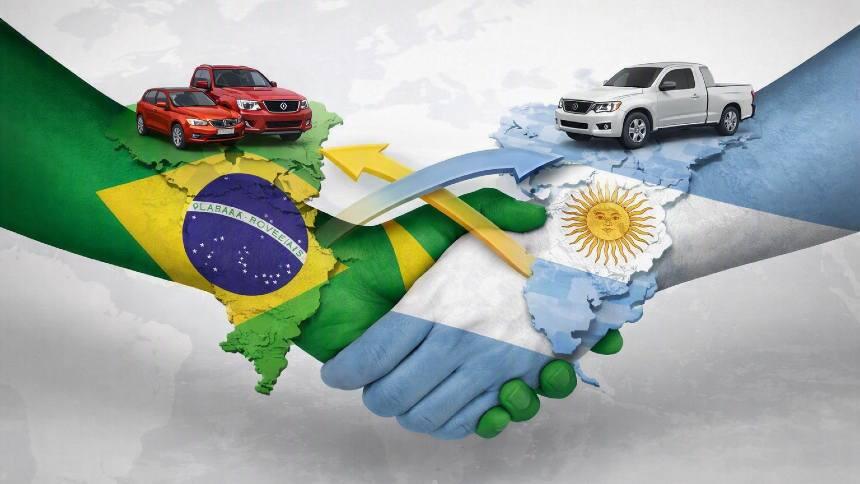
The diplomatic crisis between Brazil and Argentina , unprecedented in the history of bilateral relations, has sounded an alarm in the automotive sector of both countries, whose production chains are deeply integrated and generate more than US$ 5 billion per year.
Approximately 60% of cars sold in the Argentinian market are manufactured in the country, while 67% of vehicles exported by Argentina are destined for Brazil. If the crisis escalates into the commercial sphere, it is this sector, including auto parts, that tends to suffer first – and with asymmetrical damage to the detriment of Argentina.
Argentina is currently Brazil's third largest trading partner (US$31 billion in 2025), although well behind China (US$171 billion) and the United States (US$83 billion).
Brazil accounts for 14.5% of all Argentine exports , significantly more than in the reverse direction – the neighboring country's share of Brazilian exports reached 5.2% last year, the highest level since 2018.
Data from the Ministry of Development, Industry, Trade and Services (MDIC) shows that, in total, Brazilian exports to Argentina reached US$18.1 billion in 2025, a growth of 31.4% compared to the previous year. Besides the automotive sector, bilateral trade also includes machinery, equipment, chemical products, and commodities.
Since Brazil and Argentina have an automotive agreement that benefits both industries, most of the exports from both countries involve cars, trucks, and auto parts.
In this sense, the recent diplomatic crisis has caused a new layer of concern – both the Argentine and Brazilian automotive industries were already suffering from another major problem: the influx of Chinese electric cars.
Diplomats and business leaders from both countries, as well as experts interviewed by NeoFeed , however, say that the exchange of diplomatic barbs is likely to have limited economic repercussions in the short term, especially since both governments indicate a desire to keep their disagreements in the political arena.
Frederico Favacho , a partner at the law firm Santos Neto Advogados and a specialist in International Law, observes that President Javier Milei's criticisms of President Luiz Inácio Lula da Silva and Supreme Court Justice Alexandre de Moraes were not supported by Argentine business leaders.
“It is essential not to give undue importance to this diplomatic incident; the current moment is interesting because it shows the importance of one country to the other,” says Favacho. “The automotive sector of both countries is interdependent, and both face Chinese competition that goes beyond cars and auto parts, also encompassing agricultural machinery.”
"The China Factor"
In practice, the so-called "China factor" worries the automotive industries of Brazil and Argentina more than bilateral diplomatic skirmishes.
In aggregate, Brazilian exports to Argentina (all sectors) fell by 19.4% in the first half of this year compared to the same period in 2025, but the automotive sector was the most affected - Brazilian exports of passenger vehicles to Argentina fell by 28.2% from January to June of this year.
Furthermore, exports of auto parts to the Argentinian market—which make up another significant part of the automotive supply chain—plummeted 22.7% during the same period. Argentina accounts for approximately 30% of Brazilian auto parts exports, amplifying the impact of this decline.
This drop is linked to the sharp contraction in the Argentine automotive industry, whose production fell by 19.3% in the first half of the year.
Part of this decline is attributed to the opening of imports by the Milei government, which created a quota of 50,000 units per year for the entry of electric and hybrid vehicles with zero tariffs from abroad, half of which can come from Chinese brands. The government also facilitated the entry of auto parts without the need for extra validation of safety and environmental labels.
Despite the Chinese advance, Andrés Civetta, an economist at the Argentinian consulting firm Abeceb , also does not believe that the diplomatic spat will affect trade flows in the automotive sector between the two countries.
“Brazil is and will continue to be Argentina’s main partner in the automotive sector,” Civetta assured NeoFeed . According to him, outside of this quota of electric vehicles, the Argentine automotive sector does not believe there will be a greater influx of vehicles of Chinese origin displacing the Brazilian supply.
"There may be a slight loss of market share for Brazilian vehicles in Argentina, but this is not due to diplomatic conditions or the relationship between the two countries, but rather to a market issue," Civetta adds.