

Brazil needs to connect the various rail networks scattered across the country, most of which have many inoperative sections and are therefore isolated, and encourage multimodal integration to reduce logistics costs, which are close to 15% of GDP.
In an interview with NeoFeed , Minister George Santoro – the secretary-general who took over the ministry in April, replacing Renan Filho – admits that rail transport has been the biggest challenge for the Ministry of Transport in the current administration.
According to him, Brazil needs to reduce its dependence on road transport, which accounts for 60% of the country's freight transport and has higher freight costs. To achieve this, it is necessary to make up for lost time due to the neglect of the railway network in recent decades.
To give an idea of the challenge, he says that, of the approximately 35,000 kilometers (km) of railway network, about 25,000 km are abandoned or without regular traffic.
The federal government has been renegotiating concessions, created the railway authorization model, which allows a company to operate and exploit sections of railways without the need for a concession, and defined a pipeline of greenfield railways to be built in the coming years, a plan that will require significant resources and planning to come to fruition.
“The railway infrastructure in Brazil has been vertically integrated, with each concessionaire carrying only its own cargo – Vale only carries ore; Rumo, the grains of its investors – the only railway line with more cargo diversity is the Ferrovia Centro-Atlântico (FCA),” says Santoro.
To correct this distortion, the government proposes self-regulation among concessionaires to establish communication standards, aiming for a model similar to open access , which ensures right of way. "Although the rules already exist, practical application was lacking, and this is now a process of gradual cultural change," he states.
Multimodal integration, in turn, is crucial for reducing logistics costs . "The plan aims to develop export logistics corridors integrating highways , railways, andwaterways to reduce dependence on road transport and lower logistics costs from approximately 15% of GDP to 6%."
Among the priority infrastructure projects for connectivity, Santoro lists as an example the Southeast Railway Arc, still on paper, which starts in Cariacica (ES), runs through Rio de Janeiro and connects with the Southeast Regional Network (MRS). With a length of 1,643 km, the MRS runs through the states of Rio de Janeiro, São Paulo and Minas Gerais.
“This project creates an arc that provides access to 15 ports,” says Santoro. “By connecting this arc, along with the completion of the São Paulo Rail Ring and its link to the Western Network, I connect Corumbá to Espírito Santo, that is, we connect all the main railway network centers in the country.”
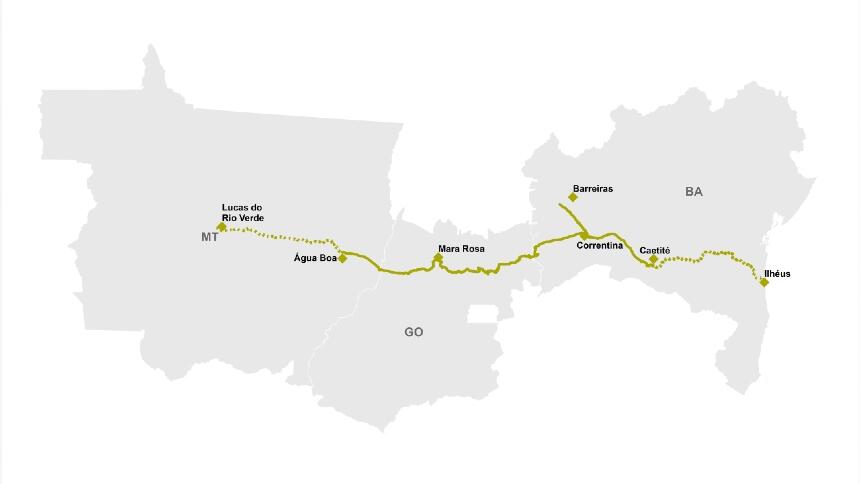
Further up, the minister lists the Fico-Fiol corridor – which runs from Ilhéus (BA) to Lucas do Rio Verde (GO) –, the North-South Railway and the Transnordestina Railway as another important connecting axis.
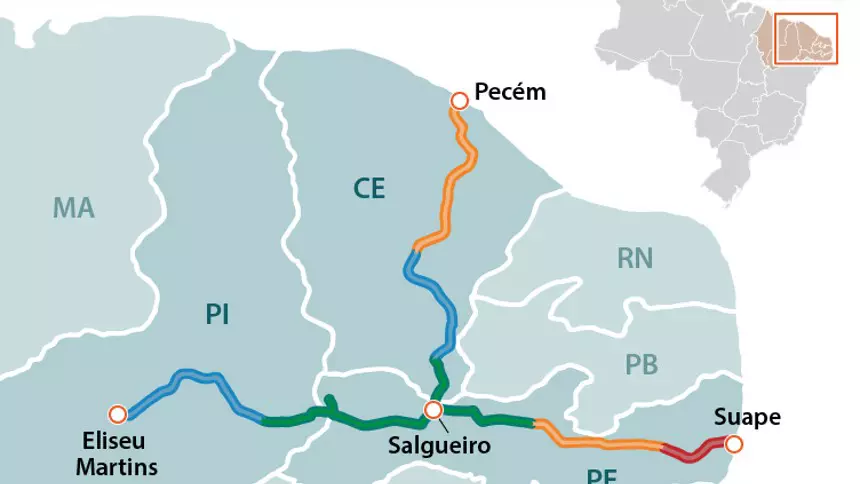
"The Transnordestina is the largest railway project in the country, employing 5,000 workers, and there isn't a single section without construction. We've already invested R$ 6 billion and should deliver the route from Eliseu Martins (PI) to the port of Pecém (CE) next year," he states.
The government plans include a greenfield project of approximately 600 km to connect Eliseu Martins (PI) to the North-South Railway, reinforcing the integration of the northeastern rail network.
Logistics options
According to Santoro, the government's haste in getting projects off the ground is due to decades of delays in transportation infrastructure. "The National Logistics Plan (PNL) projects tripling production for export in 10-15 years; having flexible logistics options is crucial to facing risks such as droughts and geopolitical shocks."
The Minister of Transport acknowledges two bottlenecks in the rail sector. One of them is the reconstruction of existing networks. "The Western Network needs to be completely rebuilt after years of neglect, and the Southern Network requires rehabilitation to compete with highways," he says, reinforcing the commitment to creating three integrated logistics axes to connect the Southern and Western networks and strategic ports.
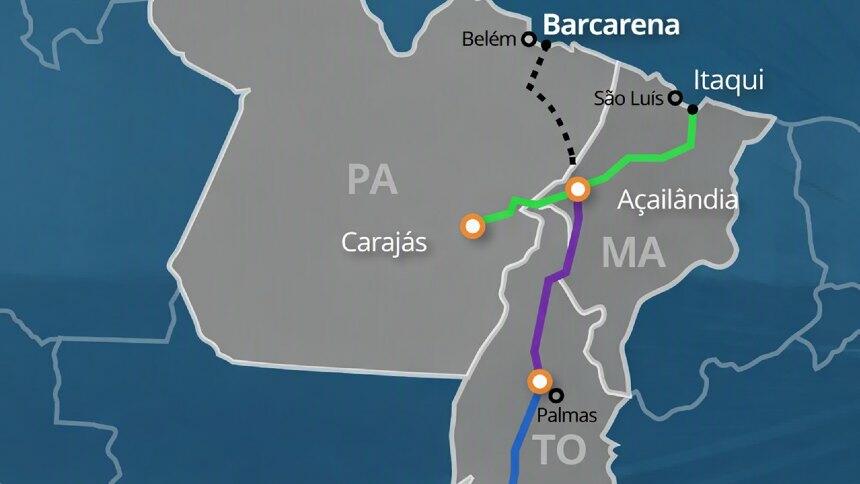
Another bottleneck is the Northern Arc. "The Port of Itaqui, in Maranhão, depends on the Carajás Railway, which may face a capacity conflict between grains and ore: the solution is to complete 380 km between the junction of the North-South Railway with the Carajás Railway, in Açailândia, to the Port of Barcarena (PA), diversifying rail access."
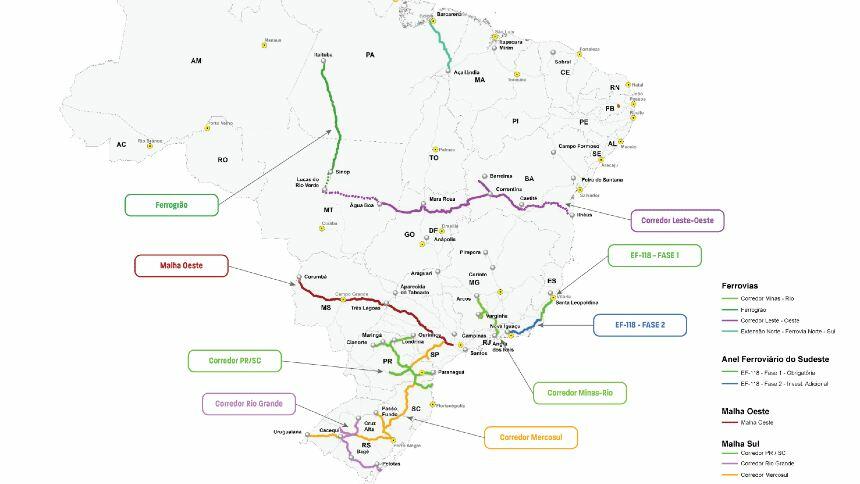
There is still doubt regarding the Ferrogrão railway. The legal issue at the Supreme Federal Court (STF) has been resolved, allowing the railway to proceed, the minister assures. The government has taken over the environmental licensing, which is being conducted by Infra S/A, and the project awaits analysis at the Federal Court of Accounts (TCU).
There is a discrepancy between the amount requested by the project's developer, R$ 180 million, and the amount accepted by the government, R$ 59 million. Without an agreement, the bidding process cannot proceed, as the project belongs to the developer. "The model indicates viability without public funding, but market appetite will depend on risk perception," he says.
Santoro admits that without public funding, a large portion of the projects never get off the ground. “Railways are different from highways – with highways, you just need to put in a toll and resources start flowing in,” he emphasizes. “Railways need government participation, whether through interest subsidies or investments to cover the viability gap, given that they require 5 to 7 years of investment without revenue.”
The Minister of Transport reveals the ministry's strategy since the beginning of the current administration. He explains that the government acted on two fronts: it restored investments via the public budget with DNIT – the agency responsible for the construction, maintenance, and safety of federal highways, railways, and waterways – tripling the average annual amount, from R$ 5 billion to R$ 15 billion, focusing on infrastructure without immediate economic viability to stimulate regional development.
Simultaneously, it launched an ambitious highway concession plan in 2023 with 35 projects and, subsequently, a plan for railways, aiming to reverse Brazil's historically low investment in infrastructure - just over 1% of GDP, compared to the 4% recommended by industry experts.
Santoro states that the administration focused on resolving problems with old concession contracts, which were stalled and economically unbalanced. An optimization project was created, with a model that modernizes the contract and guarantees investments with low impact on the tariff.
According to the minister, these actions have made Brazil the holder of "the largest portfolio of highway and railway concessions in the world," once again attracting the interest of foreign companies and funds.
On the road
Although the goal of 13 federal highway auctions for the year is unlikely to be met (it should be between 9 and 10), the minister considers the result a success, as holding three auctions already exceeds the historical average. "The volume of concessioned road network has increased from 13,000 km to more than 28,000 km, with expectations of reaching 32,000 km," he states.
The current government will leave a legacy of 57 structured projects for the next government, in addition to a consolidated public policy on concessions.
Santoro highlights the creation of modern regulations, with a well-defined risk matrix and new financial instruments, such as infrastructure debentures, which have reduced dependence on financing from BNDES, "which today accounts for 40% of financing, with market interest rates."
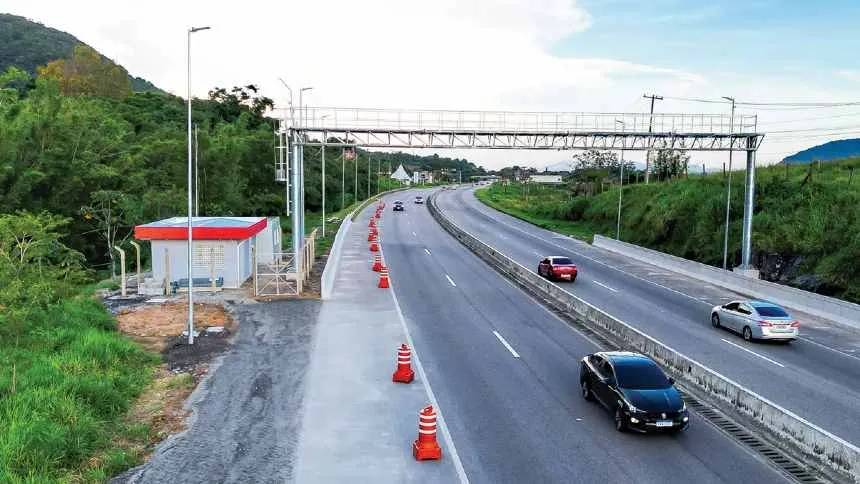
Santoro speaks of free flow , the electronic toll system that faced many implementation problems, as a personal victory in which he was directly involved. According to him, the initial resistance was overcome through new regulations.
“The free flow, provided for by law for more than eight years, had a problematic initial implementation,” he acknowledges. “The current administration promoted a broad debate with the market to create new regulations, defining technical standards for data transmission, signaling, and integration with Mercosur partners.”
According to the minister, the last barrier to electronic tolling is set to fall: starting August 7, 2026, all concessionaires will integrate their toll collection with the Digital Driver's License app, allowing for electronic notifications and verification of amounts. "I believe that all concessions will migrate to the Free Flow model within seven years, replacing the physical toll plazas."
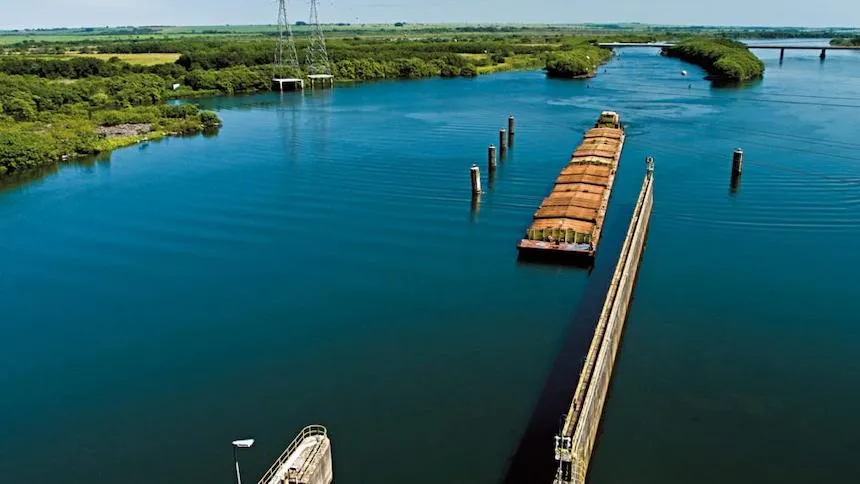
Finally, Santoro expressed optimism about an innovation created by the current administration: the concession of waterways. Although waterways such as the Tapajós and Madeira rivers are already in operation, a legal framework with contracts and obligations is lacking. Formal concessions would create mandatory investments in buoyage and dredging.
“The main obstacle is the need to advance environmental and social studies to provide legal certainty for investors,” says Santoro. “The new National Logistics Plan includes an analysis of socio-environmental risks, and we are confident that, with technical studies and social dialogue, the implementation will be structured.”