


The arrival of El Niño – a climatic phenomenon marked by the abnormal warming of the waters of the Equatorial Pacific – predicted for the second half of this year, should not surprise public managers or politicians. In recent years, Brazil has faced devastating floods in the South, cyclones in the Southeast, historic droughts in the Amazon, and wildfires in the Pantanal, resulting in losses and calls for prevention.
The expectation of a "Super El Niño" in September – at the height of a polarized election campaign – could generate two effects beyond above-average rainfall in the South and heat, drought, and the risk of wildfires in the Midwest, North, and Northeast. One is to force candidates seeking reelection to explain what they have done and what they intend to do in the face of climate change . The other effect is to directly expose the country's infrastructure bottlenecks.
Experts interviewed by NeoFeed state that, despite recent progress with private investments in sanitation, highways, and railways, supported by modern concessions and legal security, Brazil still lacks consistent long-term public policies to address extreme weather events.
A report released by the Brazilian Federal Audit Court (TCU) indicates a trend of the federal government adopting a reactive policy in the face of natural disasters and extreme events caused by climate change. The survey shows that, since 2012, the federal government has spent approximately three times more on response and recovery actions following floods and landslides than on measures to prevent them.
The various federal governments during that period spent R$ 21.5 billion on response – a category that includes aid to victims, restoration of services, and infrastructure reconstruction. Meanwhile, investment in prevention efforts, which encompass measures to avoid or reduce the impacts of disasters, totaled R$ 6.8 billion.
The history of stalled public works projects, another reflection of the chronic lack of planning by the public authorities, continues to rise. According to a survey by the TCU (Brazilian Federal Court of Accounts), the stock of interrupted projects linked to the New Growth Acceleration Program (PAC) of the current Workers' Party administration, for example, grew by 53.4% between 2023 and the end of 2025, totaling 4,234 paralyzed works, which drained R$ 13.5 billion already invested.
Economist Claudio Frischtak , from the consulting firm Inter.b and a specialist in infrastructure planning, states that there is consensus regarding the increasing frequency and intensity of extreme events.
"The 2024 flood in Rio Grande do Sul caught the attention not only of technicians and scientists, but also of politicians, showing how a reasonably developed state can be dramatically affected," says Frischtak.
The tragedy particularly affected sanitation and highways, sectors that the World Bank identifies as most vulnerable to climate change. "Highways in Rio Grande do Sul became impassable, isolating municipalities, and the impact on sanitation was equally drastic; the system stopped functioning due to the flooding, affecting the water supply, which is essential for life," he adds.
Infrastructure bottlenecks, in turn, have multiple causes: flawed planning, lack of program prioritization, political and partisan disputes, and a scarcity of resources for prevention. The biggest problem, however, is how resources are distributed amidst polarization and power struggles.
At the request of NeoFeed , the consulting firm Inter.b analyzed how the advance of climate change is putting pressure on concession contracts, which are currently central to the regulation of Brazilian infrastructure. The survey focused on the areas of highways and sanitation, identified by the World Bank as the most vulnerable to climate change.
The study shows that a large portion of concessions still operate with generic force majeure clauses, treating extreme events as inevitable and extraordinary, which pushes concessionaires towards a reactive stance with no incentive for prevention. This vulnerability is amplified by the low availability of climate insurance in the country, with limited and poorly standardized coverage.
The National Land Transport Agency (ANTT) has become an exception by modernizing its regulatory instruments in the face of increasing extreme weather events.
Aligned with the Ministry of Transport's Climate Resilience Program, the agency approved a new Standard Risk Matrix in 2024, which distinguishes between predictable climate events—fully assumed by the concessionaires—and extraordinary events, the cost of which can be shared with the public authorities, who can cover up to 80% of the losses in extreme cases. However, the concessionaire remains responsible for cleaning and clearing the roads.
The fifth phase of highway concessions incorporated specific clauses for geotechnical risks on slopes and embankments, encouraging continuous monitoring and preventive works. If the landslide occurs in a section already widened by the concessionaire, the cost is private; if it is extraordinary, cost sharing is permitted.
Contracts extending beyond 2024 also require concessionaires to act immediately in response to extreme events, with emergency maintenance and signage actions, without the right to economic-financial rebalancing.
The auctions planned for 2026, in the sixth phase of ANTT (National Agency for Land Transport), should inaugurate a model with more objective criteria for risk distribution and exchange rate protection mechanisms in the first years, increasing predictability for long-term projects.
The model also requires the purchase of four insurance policies — operational risks, general civil liability, engineering risks, and civil liability for works — to financially protect concessionaires against systemic interruptions caused by inclement weather.
In the sanitation sector, the National Water Agency (ANA) published Reference Standard No. 5 in 2024, which makes the inclusion of risk matrices mandatory in water and sewage contracts.
The standard consolidates scattered rules and identifies 31 types of risk, including environmental and climate risks. Public authorities are responsible for risks such as power outages and water scarcity; service providers are responsible for operating and maintenance costs, as well as insurable risks.
ANA also operates instruments such as hydrological monitoring, scarcity protocols, and the Water Security Index (ISH), created in 2019, which guides policies and investments in the face of extreme events.
The progress in infrastructure concession contracts, however, contrasts with the lack of concern from a large part of the political spectrum, which will face the test of the polls under the influence of Super El Niño.
“If the question is whether we are prepared for this, the answer is no, neither the federal government nor the state and municipal governments,” says Frischtak of Inter.b. The problem, he warns, is that a large part of the Union Budget is under the control of the National Congress, with parliamentary amendments and party funds.
Disarray
Venilton Tadini , CEO of the Brazilian Association of Infrastructure and Basic Industries (Abdib), notes that, in climate events, attention falls on municipalities, which are the first to feel the impacts.
“Brazil’s main shortcoming is the absence of a coordinated policy between federal, state, and municipal governments,” says Tadini, adding that polarization prevents the creation of a state policy, resulting in “patchwork solutions.”
Tadini points out that there are relevant studies, including those from COP 30 , on climate change, but implementation depends on political decisions.
That's where solutions end up getting stuck. About 90% of the Union Budget is committed to fixed expenses, with only the remaining 10% being discretionary, allocated to new investments.
The Executive branch's direct and indirect spending on climate change, spread across various ministries, accounts for one-third of the R$ 60 billion earmarked for parliamentary amendments in 2026—funds directed to municipalities without any connection to federal policies.
A survey conducted at the beginning of the year by the Institute for Socioeconomic Studies (Inesc), a non-governmental organization that monitors the public budget, showed that, among 284 actions foreseen in individual amendments presented last year, only 17 dealt with climate, totaling R$ 154 million – just 0.58% of the total.
“This shows the structural mismatch between the urgency of climate extremes and the way Parliament appropriates public resources,” says Alessandra Cardoso, a political analyst at Inesc. “The amendment model reinforces the inadequacy of climate finance.”
Marcio Astrini, executive secretary of the Climate Observatory - a network that brings together 172 entities and movements linked to the climate agenda - also highlights the alienation of a large part of deputies and senators in relation to the subject.
"The problem we have in the National Congress is that we are on the eve of a 'Super El Niño' and parliamentarians are more concerned with voting on increased deforestation, prohibiting Ibama from using satellites and machinery to combat wildfires," he says.
According to him, the climate change agenda has already moved from reports to reality. "The extremist is no longer the scientist, it's El Niño," warns Astrini. "Any politician who isn't panicking or worried about the situation is completely out of touch with reality."
The increasing number of extreme events linked to climate change has drawn the attention of the current government, which has been increasing programs and funding to address the issue. However, the distribution of actions and resources among different ministries reveals the absence of a centralized strategy.
The Ministry of Environment and Climate Change (MMA) even changed its name in 2023 to focus on the issue. The ministry coordinates the National Policy on Climate Change (PNMC), developing adaptation plans; coordinating with states and municipalities; and integrating with civil defense, agriculture, energy, and planning.
The Ministry of the Environment's direct budget for climate is small, although growing: it increased from R$ 300 million in 2023 to R$ 1.023 billion this year, including an extraordinary credit of R$ 337.5 million. The resources cover, among other measures, the hiring of firefighters, the acquisition of equipment, logistical support, monitoring, and training.
The Ministry of the Environment (MMA) created a Working Group responsible for coordinating, monitoring, and following up on actions related to the impacts associated with the El Niño phenomenon. The group is coordinated by the Ministry's Executive Secretariat and brings together representatives from different units to develop a work plan and monitor the planned actions.
The Ministry of Integration and Regional Development (MIDR), in turn, concentrates the main programs related to extreme events linked to climate change within the National Secretariat for Civil Protection and Defense (Sedec).
Of the R$1.8 billion budget allocated for this year, approximately R$1.2 billion was committed to Sedec. However, the department clarifies that this is not a budget exclusively for events related to climate change, but rather resources earmarked for responding to natural disasters.
According to MIDR, the National Civil Defense also structured a specific action plan for monitoring the El Niño phenomenon, focusing on the coordination and integration of federal agencies involved in risk and disaster management, including permanent monitoring of the phenomenon's evolution and real-time sharing of information among members of the Federal Civil Protection and Defense System.
Other sectoral ministries (Agriculture, Health, Cities, Mines and Energy) together allocate between R$ 10 and 15 billion annually to adaptation actions, such as rural insurance, combating arboviruses, strengthening reservoirs, electricity and sanitation networks, among others.
Adding up all the departments, the Executive branch spends around R$ 20 billion on actions related to climate change. However, a World Bank report released in February states that annual losses from natural disasters in Brazil alone total R$ 19.5 billion.
Tadini, from Abdib, acknowledges that the progress made in infrastructure in recent years is insufficient to address the challenge of climate change. According to him, private investment has been essential for advancements in sanitation, improvements to highways, ports and airports, and expansion of the electrical grid.
“We have seen fantastic progress in the quality of project structuring, with risk mitigation, more appropriate insurance structures, and in the overall planning of the concessions program,” he says. “But this progress does not cover the historical deficit nor is it adequately directed towards climate adaptation.”
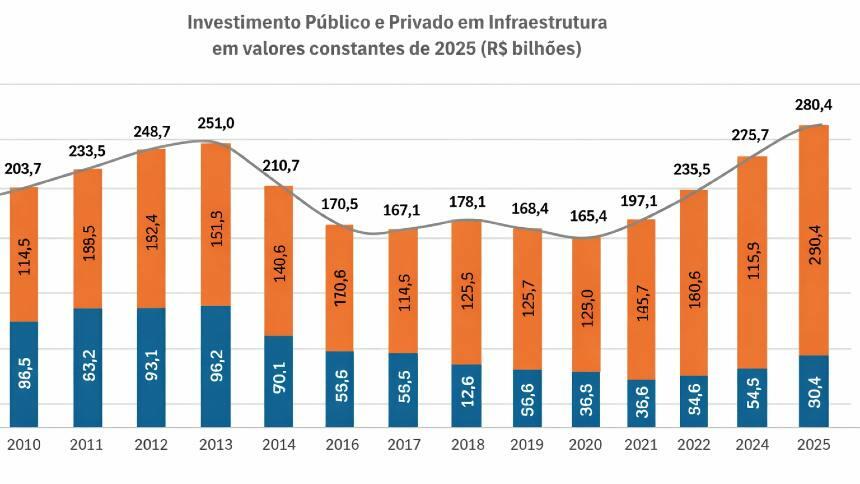
Data from Abdib shows that investment in the country's infrastructure has almost doubled in the last eight years, reaching R$ 280 billion in 2025, driven mainly by the private sector (R$ 220 billion). Public investments, however, fell from R$ 99 billion in 2014 – the highest value in the historical series that began in 2010 – to R$ 60 billion last year, reflecting the Executive branch's lack of funds.
“No country in the world builds infrastructure solely with private money; there are projects that inherently require public sector participation, such as the structural railways,” adds Tadini, noting that, excluding the Minha Casa, Minha Vida Program, the remaining PAC budget is smaller than that of parliamentary amendments.
(Contributed by Cristiano Zaia)