

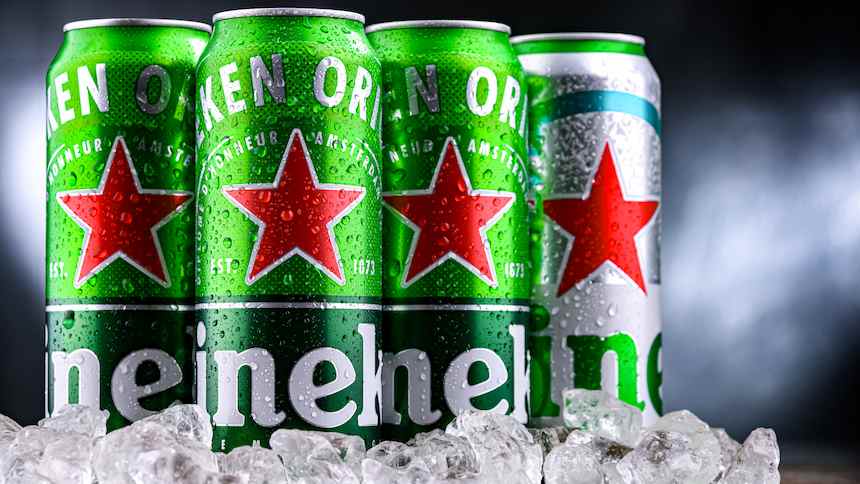

Throughout the 87 years that the Dutch brewery Heineken has been publicly traded, the position of global CEO has never been held by an executive from outside the company's operations, following a tradition of promoting and giving opportunities to the most senior and experienced employees within the company itself. But, in the view of Heineken's shareholders, this needs to change.
Two of the company's 15 largest shareholders explicitly told the Financial Times (FT) that they expect Heineken to abandon this practice and hire someone with greater market acumen to help reverse the brewery's situation, which lost its CEO, Dolf van den Brink, at the end of last month. He was expected to hold the position for another two or three years.
Julien Albertini, portfolio manager at New York-based First Eagle Investments, told the Financial Times that Van den Brink's departure, while regrettable, is an opportunity for the board to hire someone with a "fresh perspective." "My preference would perhaps be to bring in someone from outside," he said.
Daniel J. O'Keefe of Artisan Partners shares this view. However, he has a more pessimistic outlook on the type of candidate Heineken might attract, fearing it won't be anyone exceptional.
“They are a Dutch family business, so they will have to hire someone who is Dutch and… they won’t pay what would be necessary for a truly talented and exceptional executive,” O’Keefe told the FT . “We are destined to get someone relatively average, which has been the company’s history.”
This battle to change the company's tradition may not be simple. Currently, the eight-seat board has five members from the Carvalho-Heineken family, who founded the business and control it to this day.
Within the company, the two main candidates for the CEO position are Dutchman Jacco van der Linden, president of Heineken's Asia-Pacific operations, and Briton Glenn Caton, who joined the company two years ago and leads the brewery's European operations. These options are causing concern among some board members.
This uncertainty within the company is not positive for the stock. Since the beginning of the year, the company's shares have fallen by about 3.8% year-to-date. Last week, Deutsche Bank downgraded its recommendation for the shares from buy to neutral, citing the uncertainty in leadership as one of the reasons.
Earlier this year, Citi also assessed the company's situation as "delicate." In the bank's view, the industry is facing a period of weak volumes, which puts even more pressure on the business.
Furthermore, the bank states that there is a pricing issue to be addressed, since Heineken only began to normalize prices in July 2025, after freezing price adjustments from April 2024.
In terms of financial results, the signs point to stagnation. In the first quarter of 2026, the brewery recorded a drop in volume, between 1% and 3%, influenced precisely by the lower level of sales. At the same time, net revenue registered slight growth of 2.5%, reaching €6.7 billion.