


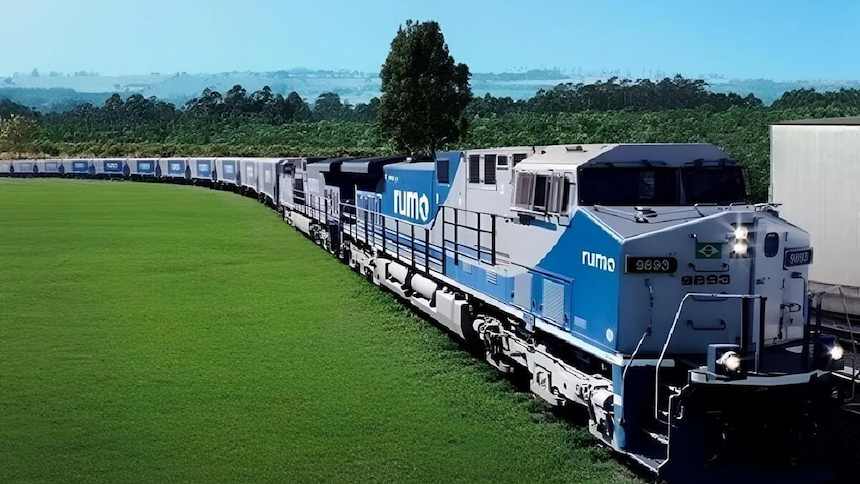
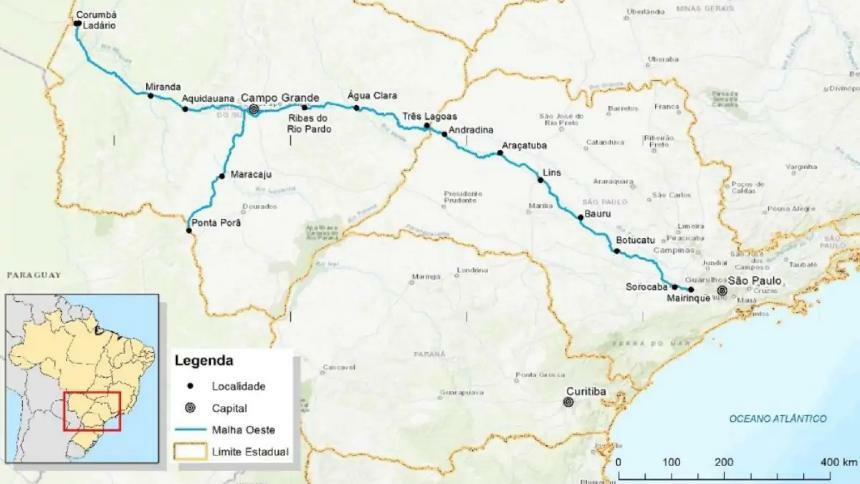
After three years of uncertainty, the fate of the Malha Oeste concession – a 1,900 km railway corridor between Corumbá (MS) and Mairinque (SP) operated by Rumo, whose contract ends in the middle of the year – began to be defined this week by the National Land Transport Agency (ANTT), but is still far from a conclusion.
The new concession model foresees investments of R$ 89.2 billion over the 57-year contract. Despite the amounts and timeframe involved, the Ministry of Transport has not yet decided whether to auction off the 1,900 km of railway – much of which is not currently in use – or to divide the Western Network into three concessions to seek better offers.
In this context, the concession project for the new Malha Oeste railway will still require the future operator to build the São Paulo Rail Ring. Even with uncertainty about the model, the department intends to auction off the Malha Oeste project later this year.
A number of factors are influencing the search for solutions for the concession. In 2023, the government decided to attempt a renegotiation of the contract with the current concessionaire, Rumo , within the scope of SecexConsenso (Secretariat for External Control of Consensual Solution and Conflict Prevention) of the Federal Court of Accounts (TCU).
The proposal envisioned extending the partnership ahead of schedule for another 30 years, with the return of approximately 1,600 kilometers and the upgrading of certain segments. The company wanted to retain only a stretch of approximately 300 km focused on cellulose, corresponding to the area between Três Lagoas and Corumbá. However, the request for renegotiation was denied by the TCU (Brazilian Federal Court of Accounts), with the justification that the plans would imply a "complete and radical remodeling" of the contract.
The R$89 billion value of the new concession was projected during the planning of the railway concession plan launched at the end of 2025. Approximately R$35.7 billion will be allocated to modernizing the entire railway infrastructure, which includes replacing tracks, acquiring new locomotives, and improving buildings.
It is estimated that R$ 53.5 billion will be invested over the nearly six decades of the contract to ensure continuous operation, track maintenance, and traffic system management.
The Ministry of Transport's intention to "break up" the concession stems from the fact that only two sections are heavily used. The larger section, from Corumbá to Bauru (SP), spanning 1,300 km, is used to transport iron ore via the Paraguay waterway. The smaller section, from Corumbá to Três Lagoas (MS), covering 300 km, serves the pulp and paper industry.
A large part of the stretch from Bauru to Mairinque is not attractive because both the ore and the cellulose cargo are transported via a connection with the Paulista Railway, also operated by Rumo, which goes down to the Port of Santos.
The government intends to test market interest in this model of multiple concessions. Among the options are the complete stretch (Corumbá-Mairinque), another equally extensive one (Corumbá-Bauru), and the shorter one, Corumbá-Três Lagoas.
The model approved by ANTT (National Agency for Land Transport) foresees an estimated federal investment of R$ 3.6 billion for the recovery and operational resumption of the railway network.
Federal funding will only be allocated to the concessionaire if the modernization and operation are carried out on the stretch from Corumbá to Mairinque or Bauru. If there is interest only in the Corumbá-Três Lagoas stretch, there will be no federal funding.
Ferroanel
The Minister of Transport, George Santoro , stated on Friday, May 22nd, that the concession project for the new Malha Oeste railway will require the future operator to build the São Paulo Rail Ring regardless of the length of the railway that is awarded in the auction. Its cost, estimated at R$ 6 billion, should be covered by a rebalancing of the contract.
“The only scenario in which the future operator of the Malha Oeste railway would be exempt from building the Ferroanel (rail ring) is if Malha Regional Sudeste assumes responsibility for the project, rebalancing its contract, which was renewed in 2022,” says Santoro, referring to the 1,821 km concession of MRS that runs through Minas Gerais, Rio de Janeiro, and São Paulo.
This is because, according to Santoro, since the renewal of the concession, MRS has assumed responsibility for the segregation works between the freight railway and the CPTM lines in the Metropolitan Region of São Paulo, an intervention currently estimated at around R$ 4 billion.
This high cost was one of the arguments used at the time for not implementing the Ferroanel (railway ring), which would have created an alternative route for cargo destined for the port of Santos without passing through the city of São Paulo.
With the new alternative under discussion, MRS could be partially relieved of the segregation works, freeing up resources for another priority project: the Barra do Piraí (RJ) bypass, a logistical bottleneck that hinders the flow of cargo between São Paulo and Rio de Janeiro.
According to Diego Fernandes , partner at the law firm Roenick Fernandes Advogados and specialist in infrastructure concessions, dividing the Malha Oeste concession into three scenarios within a single auction is viable, provided that the mining (Corumbá) and pulp (Três Lagoas) corridors remain sufficiently attractive to induce private investors to also take on the underutilized sections.
“The federal contribution of up to R$ 3.6 billion acts as an incentive mechanism: it is only released to those who take over the entire network, preventing the market from choosing only the most profitable segments,” he says. Even so, he warns, private interest in low-demand sections is not guaranteed, and the model attempts to “package” consolidated flows with branches that, in isolation, would not be sustainable in the short term.
For the strategy to truly lead to the full utilization of the rail network, Fernandes states that the contract will need to establish progressive and auditable targets for reactivating idle sections, as well as a clear risk matrix outlining who will bear the burden of any potential demand shortfall.
“Without these constraints, there is a risk of repeating history: the concessionaire concentrating investments only in competitive corridors, keeping part of the infrastructure formally granted, but in practice inactive,” he adds.
Regarding the government's haste to hold the auction in 2026, Fernandes observes that, although a longer period for structuring the bidding process would be technically desirable, the government is operating under strong institutional constraints: the current contract with Rumo is ending, and the TCU (Federal Court of Accounts) vetoed direct renegotiation, imposing a new bidding process.
According to him, the studies are not improvised — ANTT discussed the project in a public hearing in 2023 and approved the new design in 2024 — but the schedule is tight so that the TCU can carry out the prior control without pushing the auction to 2027.
"The government, therefore, chooses the 'least bad' option: accelerating the concession to avoid service disruption, while at the same time trying to deliver a tender detailed enough to convey speed without appearing improvised," concludes the expert.
When contacted, the Ministry of Transport stated, through a press release, that the Malha Oeste project is proceeding according to schedule, with the publication of the tender notice estimated to occur in the first half of the year and the auction taking place in the second half of this year.
"The studies are currently at the National Land Transport Agency (ANTT), in the consolidation phase, for subsequent submission to the Federal Court of Accounts (TCU), a necessary step for authorization to publish the tender notice," the statement says. "It is important to emphasize that the schedule may be adjusted, if necessary, to accommodate any demands or recommendations arising from the technical and institutional analyses."