

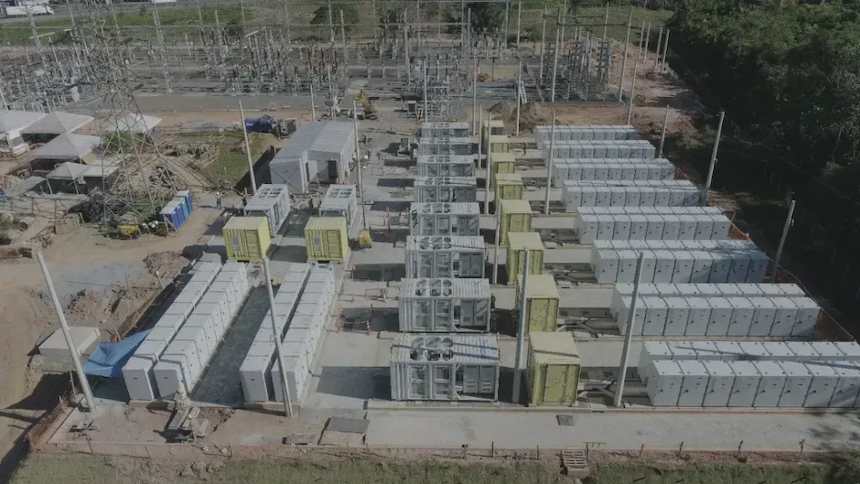
The Minister of Mines and Energy, Alexandre Silveira , announced that the decree for holding the energy reserve auction, using electric batteries, will be published within 15 days. There was an expectation that the auction would take place by the end of April, but the project lost momentum in Brasília, mainly due to the last mega-auction of energy from thermoelectric plants.
The announcement regarding the timeline was made during a panel at the Esfera Brasil Forum, held in Guarujá, on the coast of São Paulo, on Friday, May 22nd.
“It will happen. The auction will, in fact, take place later this year. We have already set aside the amount to hold this auction,” said Silveira, without revealing what the cost of the measure will be.
In this context, the giant electricity company Axia (formerly Eletrobrás) has signaled that it intends to allocate part of its planned investments until 2027, amounting to R$ 14 billion, to projects in this new segment.
CEO Ivan Monteiro, who was in the audience, listened attentively to Silveira's announcement. The executive participated in a panel immediately afterward, at the event promoted by Esfera Brasil, which dealt precisely with the future of the Brazilian energy matrix.
Asked by NeoFeed about the minister's revelation that the battery auction is finally starting to move forward, shortly after leaving the stage at the event in Guarujá, Monteiro refused to comment. But he was paying close attention.
The silence – at least momentarily – from the CEO of Axia makes sense. In his speech, the Minister of Mines and Energy stated that the current discussion revolves around establishing guarantees for greater participation of Brazilian companies in the bidding process. He explained that there is discussion about a percentage earmarked exclusively for local companies.
Although Axia, Engie , Isa Energia , and other important players have already shown interest in learning more details about the tender, which the minister has now revealed is about to become public, there is anticipation for a flood of participation from global battery giants such as Tesla, BYD , and Huawei. The Santa Catarina-based company Weg is also in the running.
“We are debating this issue. I have discussed this with the president and the Ministry of Economic Development regarding local content, which is fundamental. For us, it is essential to strengthen local industry,” the minister said. “We will see how much we can allocate to make the auction viable.”
Silveira also stated that another topic that came up during the discussion of the battery auction rules was whether or not financial transfers from the government were necessary to guarantee the projects that will be developed.
“In the world, this type of auction has only worked with government subsidies. And we don't have that subsidy in Brazil. A very thorough debate was needed so that the auction could be launched safely,” the minister explained.
Alexandre Silveira, Minister of Mines and Energy
Recently, the Swiss company ABB also told NeoFeed that it is closely monitoring the progress of the auction, as the company intends to act as a supplier to the energy companies that win the bid.
"Indirectly, ABB will participate by offering infrastructure to companies that may be involved in this process. It's a good way to take advantage of energy that is currently being wasted," said Luciano Nassif, CEO of ABB in Brazil, at the time.
According to the Minister of Mines and Energy, the Energy Research Company (EPE), linked to the Ministry, will now define the size of the volume offered, but the market foresees that the demand for projects could reach at least five gigawatts (GW).
The issue is that, according to the schedule established by Silveira, the bidding process itself, in an auction, should take place in the second half of the year, practically at the height of the presidential race, which will be in October. For Silveira, however, there is no risk of the energy plan being contaminated by the electoral contest.
"The elections cannot enter into this discussion. It is the opposition that politicizes technical issues. We need to deliver results," says the minister, with a politicized tone in his response.
In recent months, the productive sector has begun a cycle of criticism precisely because of the lack of information, until now, about the dispute in the electricity sector.
In March, during the inauguration of the Barro Alto solar park in Goiás, the CEO of Newave Energia – a joint venture between Gerdau and Newave Capital – Edgard Corrochano, complained about the slow pace of the project.
“There are several benefits to having a battery project within a solar park. We are studying it, with a very advanced project. Our idea is to generate around 200 MW of installed energy. And we will invest up to R$ 2 billion for this,” he told NeoFeed at the time.