

Since artificial intelligence (AI) became the biggest investment focus in the financial market, resources allocated to technological advancements have been steadily increasing. It is expected that most companies will invest over US$750 billion in this area this year alone.
This explains why the world's most valuable companies are in AI. Nvidia is currently valued at US$4.6 trillion, followed by Apple at US$4.5 trillion, and Alphabet at US$4.35 trillion. And there is enormous anticipation for the initial public offerings (IPOs) of giants like OpenAI , founded by Sam Altman, and Anthropic , which filed for registration in the United States in June.
But for the Brazilian company Positivo Tecnologia , this is not a problem. On the contrary. In the company's view, these giants will, over time, become their great allies.
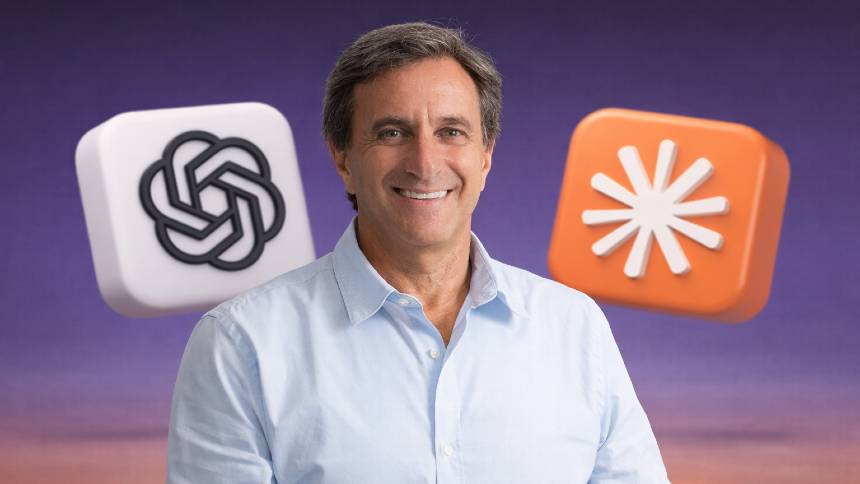
“The more artificial intelligence grows and the more computing power is needed, the more opportunities arise for us,” says Hélio Rotenberg , CEO and co-founder of the company, in an interview with NeoFeed .
In the businessman's view, one avenue lies in the concept called edge AI, a trend in which artificial intelligence is processed locally on devices, especially reducing dependence on cloud infrastructure.
According to Rotenberg, the key lies in the opportunities for regional infrastructure growth that will arise to absorb this global demand. "The big players will continue to grow, but there's room for local processing. And that's where we come in," he states.
The businessman's analogy lies in the electricity generation sector. The giant Itaipu hydroelectric plant, a binational project controlled by Brazil and Argentina, for example, cannot generate all the energy on its own. For that, there are small hydroelectric plants (PCHs).
“There are other forms of local energy generation. With that, this exchange of technologies arises. You have the centralized model, it starts to get expensive, so you decentralize. It starts to have problems of no longer being able to grow, and then you decentralize,” says Rotenberg.
Another reason to explain this argument lies in the cost of these operations. Running these AI operations in the cloud means, in practice, permanently paying for the use of this infrastructure.
According to the co-founder of Positivo, the high investment in the construction of large data centers worldwide has made centralized processing even more expensive. In this sense, the trend is for the construction of more sophisticated LLM (Laboratory Management System) parameters to be concentrated within the orbit of these giants.
“Processing with many parameters will remain centralized. Now, part of this construction can be done within the company itself,” he explains. “The cost of tokens is very high.”
Another point is the security of this information itself. “There is a data confidentiality issue. A bank won't want all its information to be open in the cloud. So, it will have its own servers to handle part of this processing,” explains Rotenberg.
In this sense, Positivo has already been capturing part of this trend, expanding its scope of operations in the local AI processing service.
In recent months, the company has delivered two mega AI servers to the University of São Paulo (USP) and the University of Campinas (Unicamp), two of the leading public higher education institutions.
In the case of Campinas, the supercomputer was installed in December. Called Abaporu, because it is a "data devourer," alluding to the work of Tarsila do Amaral, the model cost US$1 million and is installed at the Institute of Computing.
The one at USP is called Jairu, made in partnership with Nvidia and Scherm, and was delivered in January. The project cost R$ 40 million and uses 96 Nvidia Blackwell B200 processors.
Also recently, the company completed the delivery of an AI superserver for Petrobras, one of the largest in Latin America. The project is called HPC25 (High Performance Computing) and the tender was won by the French integrator Atos Bull, which purchased the model from the Brazilian company.
The plan is that projects of this type, following the opportunity generated by the strength of the tech giants, will help Positivo reach its projected revenue for this year, between R$ 4 and R$ 4.2 billion.
More than half of the revenue
This also explains the performance of Positivo's IT infrastructure division, which encompasses the businesses of corporate PCs, traditional and AI servers, and the services area, which already represents 52% of the company's revenue.
This means that this segment already has an annualized result exceeding R$ 2 billion. In the AI superserver division alone, Rotenberg states that Positivo has surpassed the R$ 500 million mark , as he revealed to NeoFeed last year. And the trend is for the segment to become even more significant.
“As other areas are growing, the expectation is that this percentage will rise, but in proportion to other markets. A good number would be to consolidate the infrastructure segment between 50% and 60%,” says the founder of Positivo.
In its innovation plans, the company also sees room for advancements in new technologies, with a palm reading model for payment terminals and solutions produced by Positivo. The launch took place last month.
The company is in the phase of presenting the technology to payment companies. Last year alone, the point-of-sale terminal segment accounted for 15% of Positivo's revenue.
“Today, we already have more than 1 million Positivo payment terminals. Now we are evolving. A person can register their credit card with one hand and their Pix payment with the other, for example. They don't even need a cell phone,” he explains.
“We are in discussions with several companies to begin operations, which are currently present in countries like China. We licensed the technology from there,” he added. The idea is that the system will already be embedded in the next payment terminals.
Some of these technologies are part of the approximately R$200 million that the company plans to allocate for investments in 2026.
In the first quarter of this year, Positivo achieved net revenue of R$ 741.4 million, a 3.6% increase over the same period last year. EBITDA grew by 31%. Today, the company sells 800,000 PCs per year.
In the accumulated total for 2026, POSI3 shares on the B3 stock exchange registered a drop of 3.16%. Positivo has a market value of R$ 564 million.