

The World Cup hit Lojas Renner hard in the second quarter of this year. And not in a positive way. The biggest sporting event weighed significantly on the retailer's sales during the period, to the point that the company was forced to revise its net revenue growth projection for 2026 downwards, even though it expects an acceleration in sales in the second half of the year.
Renner announced on Thursday, August 6th, that it now projects a 4% to 8% increase in net revenue in 2026, down from its previous estimate of 9% to 13%.
“We already expected that the lowest growth of the year would be in the second quarter, due to the comparison base of the previous year, when we grew 18%,” says Fabio Faccio , CEO of Renner, to NeoFeed .
"But we revised our projection for the year because the second quarter fell short of our expectations, due to the impact on foot traffic in physical stores," he added.
The effect was significant. At a time when high interest rates are harming the purchasing power of the population, net retail revenue totaled R$ 3.7 billion in the second quarter, a growth of 1.1% compared to the same period of the previous year, when it had registered an expansion of 18.5%. At that time, the colder autumn helped produce growth that was "outside the curve," according to Faccio.
In the concept of same-store sales (which considers the performance of units that have been operating for more than 12 months), the increase was only 0.5%.
The performance ended up hurting the main lines of the balance sheet. Total adjusted EBITDA amounted to R$ 844.6 million, a decrease of 5.3%. Net profit remained stable at R$ 404.6 million, partially benefiting from a lower effective income tax (IR) and social contribution (CS) rate.
Free cash flow fell 59.4% to R$135.1 million. Despite this, Renner closed the quarter with a cash position of R$1.9 billion and net cash of R$1.2 billion.
According to Faccio, the World Cup ended up overshadowing Mother's Day, which had record sales during that period. With the end of the event, operations returned to normal, but the effects on the results had already been felt.
"So far we've had a cumulative growth of 2.5%, and we anticipate an acceleration in the second half of the year to reach the level we expect for this year," says the CEO.
“We had already anticipated that 2026 would be closer to 9%, in the lower end of the projected range. With the first half of the year's performance falling short of expectations, we've already begun to project that reaching the top of the original range would be unlikely,” he adds.
Faccio emphasizes that this revision is specific to a particular period. For the years 2027 to 2030, Renner maintained its projection of net revenue growth between 9% and 13%, as well as other metrics, including Return on Invested Capital (ROIC), which should reach approximately 20% by 2030.
Although the second quarter was negative in terms of sales, the period was also marked by new margin gains, a result of operational adjustments made in recent years.
Renner closed another quarter with record gross margins in retail and apparel, at 57.5% and 58.7%, respectively, resulting in a 1.8% growth in gross profit.
Renner's CFO, Daniel Santos, also pointed out that operating expenses grew by only 1.5%, to R$ 1.3 billion, even with inflationary pressure and higher investments related to store openings during the period.
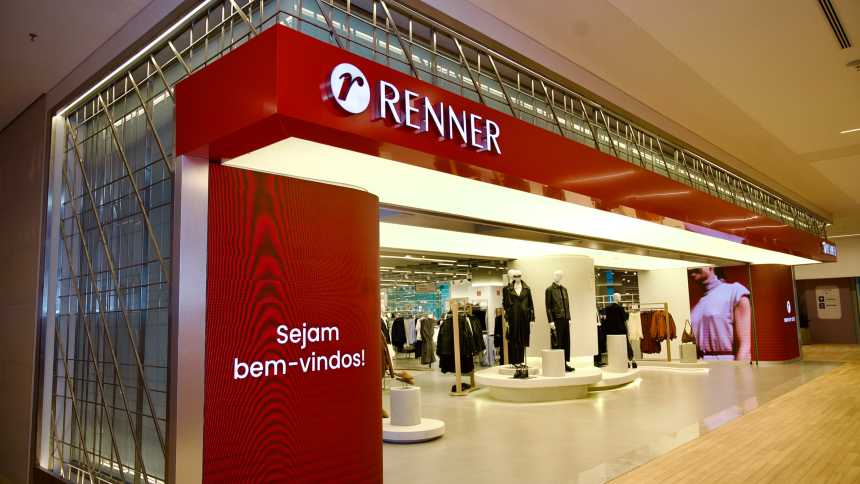
Despite the drop in sales, nothing changes in Renner's plans, including investments to expand its store base . Regarding this plan, which foresees the opening of 140 to 170 Renner stores by 2030, raising the network to between 570 and 600 stores, he said that the stores opened in 2024 have margins slightly above the company average.
“The expansion we are undertaking is efficient in terms of capital allocation,” he said. “All the strategic factors, all the strategic levers, remain.”
Regarding Realize , Renner's financial arm, the guidance is to maintain a more restrictive stance on origination, without using its full potential to boost retail sales until the macroeconomic scenario improves.
In the second quarter, Realize's total portfolio decreased by 1% year-on-year, to R$ 6.4 billion. The share of proprietary cards in sales was 28%, a drop of 0.6 percentage points.
Renner's shares closed the trading session down 1.39%, at R$ 13.48. Year-to-date, the shares have risen 0.75%, bringing the market value to R$ 13.6 billion.