

Over the past 12 months, the health insurance company Hapvida has registered a loss of 114,000 health plan beneficiaries. In the last quarter alone, the decrease was 44,000 lives. The company currently has 8.68 million users, compared to a base of 8.79 million in the first quarter of 2025. Another 7.2 million are enrolled in dental plans.
But the recovery plan for the health insurance company Hapvida, which faced harsh criticism four months ago from the asset manager Squadra regarding its financial and management direction, is expected to be slow and without a quick fix.
The person who sees that there is still a long way to go is precisely the new CEO, Luccas Adib, who was the company's CFO. He took over operations in April, replacing businessman Jorge Pinheiro, from the founding family, who moved to the position of chairman of the board of directors.
“The issues being questioned by the market won’t be addressed in one, two, or three quarters. What we’re doing is a company improvement program, which should start to show results in a few quarters,” Adib stated in an interview with NeoFeed .
In practice, what the market expects is a concrete response to the public letter released by Pinheiro before leaving his position as CEO: “I acknowledge that the recent financial results fell short of what we are capable of delivering. We could have done more and better. This awareness drives us.”
In this sense, Adib acknowledges that there are still many tasks to be accomplished. "There won't be an immediate answer, there won't be a short-term promise. We are very much focused on a vision of delivery."
The CEO's statement comes after shares fell 5.69% on Wednesday, August 5th, amid a combination of factors that reinforced the perception of risk among investors.
The move was primarily driven by Fitch's downgrade of the company's national rating , which highlighted the "persistent pressure on operating margins," a sensitive issue for the healthcare sector and one already observed in previous quarters.
The agency also drew attention to projections of "negative free cash flow through the end of 2026," which adds concern about the company's ability to finance its expansion and reduce leverage without resorting to new fundraising.
This tighter financial scenario occurs during a time of management transition. The change, while seen as part of an internal reorganization process, increases the feeling of instability in the short term.
The "return" of Notre Dame
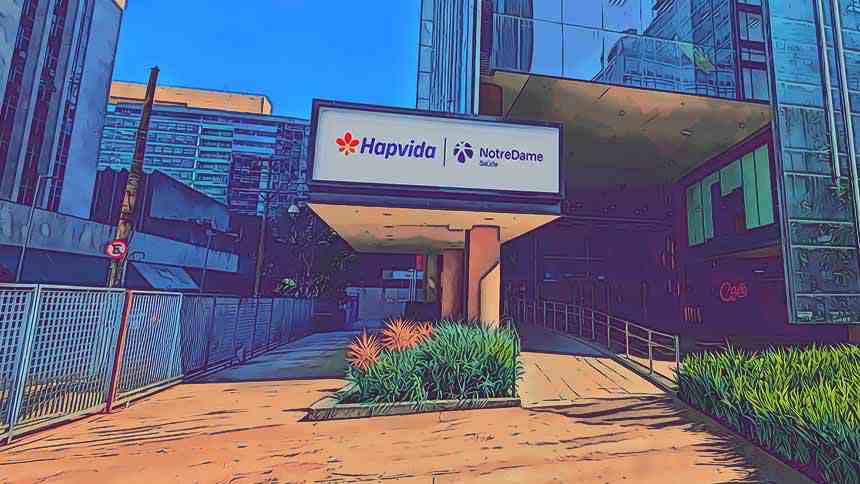
The CEO's first initiative to restore Hapvida's financial health has already been taken. Earlier this month, the company announced the launch of the NotreDame Saúde brand, with a product aimed at the premium market.
The proposal benefits clients who are already at the top of the company's service hierarchy, with a more exclusive service structure, concierge service, app, and unique brand identities.
Although the company currently has 84 hospitals in its own network in Brazil, the focus of this new plan will be on affiliated hospitals such as Sírio-Libanês, Albert Einstein, HCor, Nove de Julho, Mater Dei, among others. The coverage also includes the Fleury and Dasa laboratory networks.
The new plan reverts to the name of the NotreDame Intermédica group, with whom Hapvida merged in January 2021, making it the largest health operator in Brazil.
With the deal, the company began offering both PPO plans (more premium), with a wide network of accredited providers and reimbursement, and HMO plans (more basic), focused on its own network of care.
“With the acquisition from the Pinheiro family, we came across the PPO portfolio, which today has 320,000 lives, exposed to a third-party network, and that wasn't really Hapvida's DNA,” says the CEO.
Four years after this integration, the company then decided to separate the pipelines from the plans. According to the CEO, the company's consolidated structure remains unchanged.
“But the back office changes. There’s a package of initiatives that aren’t visible, but that make the experience different,” he says. “The idea, in the end, is to improve the company’s profitability, since this health plan model has a higher average ticket price. And also to help curb the negative net balance of beneficiaries, in general.”
In September 2025, Jorge Pinheiro revealed to NeoFeed his intention to improve the premium plan , but at that time, without associating it with a rebranding. The idea was to change the perception of a company that had grown by serving the lower-income population.
Changes in the structure
Following the relaunch of the NotreDame brand, Adib also says that the new strategic action will involve implementing a more comprehensive review of the company's organizational structure, with the decentralization of decision-making in some regions.
“There is no single decision here that works for everything and is good for our entire organization. We need to look at each location individually to extract the maximum benefit from each one. This is so that our managers can make decisions with more autonomy,” he says.
Hapvida has been making changes to the company's governance structure. One of the positions created was that of vice president of clients, precisely to understand, from the user's point of view, what the needs for change are.

Adib says the plan now is to focus on improving operations, so that it will then be reflected in the company's financial results. "We're going to talk about numbers, not narratives. We're going to do our homework."
Deleveraging
In addition to operational changes, there is the need for deleveraging itself, which Pinheiro has already prioritized.
In the first quarter of this year, Hapvida achieved a net debt to EBITDA ratio of 1.38 times. In the same period of 2025, it was 0.98 times. According to Adib, the company is facing the deleveraging process "head-on".
Therefore, the market perceives that the company plans to sell its assets in the Southern Region. The package would include a group of eight hospitals and 21 clinics, serving a base of approximately 500,000 beneficiaries.
According to NeoFeed , the goal is to secure at least R$1.5 billion in capital from the sale of assets. The CEO did not respond regarding this potential plan.
New council
With the actions underway and the strategic plan in execution, the CEO affirms that there is no longer any disagreement among the company's main shareholders. At the board meeting held in April, Squadra managed to approve the entry of three representatives.
“The relationship is very good. It’s a privilege to have the Pinheiro family and colleagues from Squadra on the board. Everyone came to contribute and is on the same side. There was some tension, but everyone wants what’s best for the company. We are working together in a very positive way,” says Adib.
Squadra, which currently holds a 5.2% stake (excluding treasury shares, it totals 5.5%), had previously published a harsh letter to Hapvida before securing seats on the board of directors, criticizing strategic and governance decisions since the IPO.
According to Guilherme Aché's asset management firm, the company's decisions led to one of the biggest value destructions in the history of the stock market, with an 85% drop in shares, the loss of 238,000 beneficiaries, increased leverage, and compensation considered excessive for executives.
At the time, he argued that the company should evaluate the sale of assets in the Southeast and South to reduce debt, rebalance its capital, and focus on more profitable operations.
In the first quarter, Hapvida reported net revenue of R$ 7.9 billion, a 5.2% increase over the same period of the previous year. Claims ratio, at R$ 5.7 million, grew by 0.4 percentage points.
During the period, the company recorded a net accounting loss of R$ 154.3 million, compared to a net profit of R$ 54.3 million on the same basis in 2025.
Adjusted EBITDA of R$803 million was 20% higher than reported in the first quarter of 2025, and 12.5% higher than recorded in the fourth quarter. The financial results for the second quarter of 2026 will be released on August 12th.
The analysts' view.
Citi analysts stated in a report released in July that a difficult scenario remains in sight for the next quarter, with "anemic" revenue growth and continued difficulty in acquiring new net beneficiaries. However, according to the bank, more information is still lacking.
"While we continue to see merit in the recent management/governance overhaul and a more pragmatic approach to asset/structure rationalization, the lack of concrete quantitative details and recent execution setbacks understandably leave investors reluctant to grant the benefit of the doubt," the report says.
Over the past 12 months, the company's shares on the B3 stock exchange have depreciated by 68.7%. The projected drop for 2026 is smaller, at 23.7%. However, in the last month, the trend has been upward, with a 7% increase.
Hapvida, which was once worth close to R$ 100 billion in 2021, shortly after the merger with NotreDame Intermédica, now has a market value of R$ 5.6 billion.