

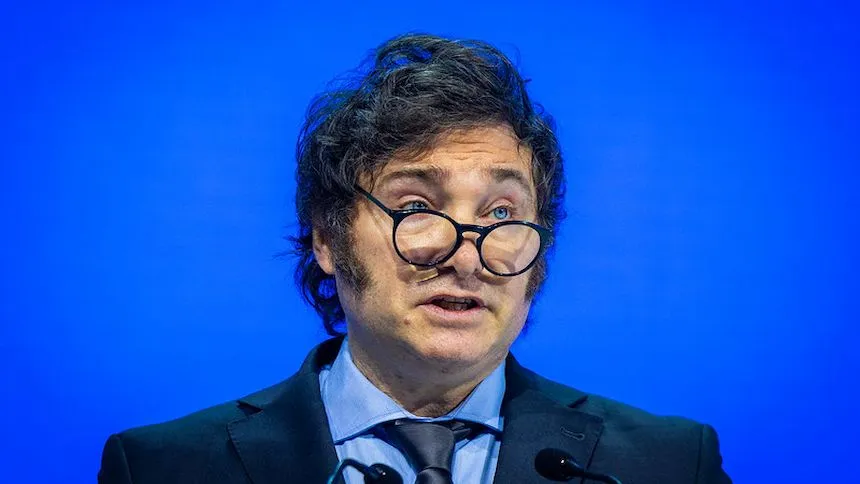
Argentine PresidentJavier Mili is experiencing the worst moment of his presidency since taking office in December 2023.
Despite the extremely tough economic reform program, which even generated an unprecedented fiscal surplus and some notable macroeconomic advances, inflation is still high – 32.6% per year in April –, unemployment remains high (7.5%), and industrial activity and commerce continue to decline.
On another front of bad news, a corruption scandal involving his chief of staff has undermined the popularity of the Argentine president, which has reached its lowest level since his inauguration, with 63% of the population disapproving of his government.
To complete the picture, Milei witnessed this week more than 1 million students occupying the streets of Buenos Aires because of the 45.6% cut in the education budget, in the fourth protest against the current government. Behind the demonstrations lies the drama of teachers' salaries and the public sector in general, which have fallen by about 30% in real terms in the last three years.
Strictly speaking, Milei's administration can be divided into two phases. The first began after his inauguration, as Argentine president facing the challenge of escaping the populist trap in a country mired in a paralyzed economy, with measures to normalize public spending to levels compatible with fiscal balance, open the economy to international trade, and avoid being influenced by political fluctuations during the process.
The positive results obtained were reflected in the midterm legislative elections last October, with a significant and unexpected victory for the government. This support for his radical agenda of cost-cutting and liberalization allowed him to pass a series of reforms in Congress.
Starting this year, a new government framework began, with the Argentine president experiencing more setbacks than successes. Although the economy is growing, the normalization of regulated prices and the opening to international competition have impacted the private sector.
New sectors are expanding, such as energy, mining, and agriculture, while others that traditionally benefited from a closed and inflationary economy, such as import substitution industries and, especially, the textile sector, are contracting.
Some criticisms of Milei's economic policy focus on his prioritization of reducing inflation at the expense of promoting growth.
Until last year, this strategy yielded results – inflation fell from 25% per month at the time of inauguration, in December 2023, to 1.5% in May 2025. Since then, it has begun to recede, rising for ten consecutive months. However, April's inflation was 2.8%, a slowdown compared to the 3.7% recorded in March.
Several government measures contributed to this escalation, such as cuts in energy subsidies. The oil shock in March impacted the price of beef, which skyrocketed amid the global crisis.
Tripod and scandals
The inflation-interest-exchange rate triad is one of the government's major challenges. Milei's strategy included advocating for a strong peso as a tool in the fight against inflation.
Today, the currency is trading within wide ranges and has shown appreciation for much of the year. This movement is driven, in part, by high interest rates, which attract capital to the country.
Increased oil production and rapid export growth also contributed to strengthening the peso, especially in a context of rising prices caused by the conflict in Iran.
Despite this, the strong currency has had negative effects on industry, as it makes imported products more competitive. The labor-intensive construction sector is also suffering, remaining in deep recession. Surveys show that low wages and unemployment are now the biggest concerns for Argentinians.
In April, the IMF revised its GDP growth projection to 3.5% in 2026, after a growth of 4.4% in 2025. Great hopes rest on the expansion of oil extraction and international investment in gas and mining.
"Looking to the future, part of the transition must include an acceleration of the infrastructure program, largely implemented by the private sector; there has been no investment in roads in the last three years," wrote Nicolás Dujovne, Minister of Economy during Mauricio Macri's government, in an article in the newspaper La Nacion .
"A clearer and more robust monetary policy will help to partially reduce the discrepancy we observe between macroeconomic indicators and microeconomic difficulties," Dujovne added.
But the good news for Milei was compromised by a type of problem uncommon in his government: corruption allegations. For now, there are two, but enough to bring down the popularity of the Argentine president, who has always pointed the finger at scandals involving Peronism.
The most explosive case involves the Chief of Staff of the Presidency, Manuel Adorni , who is the target of a federal investigation on suspicion of illicit enrichment. Prosecutors are analyzing reports of luxury trips, including a stay in Aruba paid for in cash, inconsistent with his official salary.
They are also investigating the use of a private jet for a family trip to Uruguay and the purchase of an apartment for an unusually low price, made possible by an interest-free loan.
Adorni denies any wrongdoing, while Milei came to his defense, intensifying attacks on the press – a maneuver clearly aimed at diverting attention from the case.
The Argentine president went so far as to call the Argentine press "filthy scum," releasing an AI-generated image depicting a reporter in a prison uniform. The tension culminated in a temporary ban on media professionals entering the Casa Rosada, which was only reversed in May under stricter accreditation rules.
This week it came to light that the lawyer in charge of defending Adorni is the same one involved in a murky case concerning the launch of the cryptocurrency LIBRA , promoted by Milei on social media in February of last year.
Following public endorsement from the president, the asset soared and then plummeted, generating estimated losses of US$250 million for small investors, while large holders sold at the peak.
Milei denied any connection to the project, but phone records obtained by investigators indicate seven calls, on the same night of the publication, between the president and a businessman linked to cryptocurrency, now defended by the same lawyer as Adorni.
Although there is no evidence of payments or that Milei received any benefits, prosecutors have classified him as a person of interest in the case. All those involved deny accusations of wrongdoing, but the episode reinforces the pressure on a government already marked by clashes with the press and suspicions of private favoritism.