

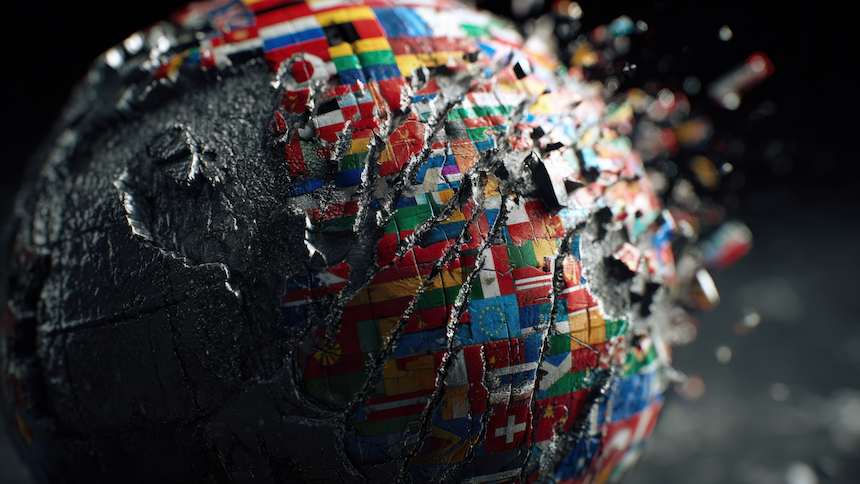
New York – The world that companies learned to navigate no longer exists. For decades, the so-called "Davos Consensus" defined the rules of the game. Free trade was a competitive advantage, American alliances were reliable, and globalization brought nations closer together.
Today, that consensus is dead, according to Mark Leonard, director and co-founder of the European Council on Foreign Relations, the first pan-European think tank , and one of the leading geopolitical analysts of our time.
In recent years, the author of "The Age of Unpeace: How Connectivity Causes Conflict" and "Surviving Chaos: Geopolitics when the rules fail" has interviewed presidents, generals, diplomats, and ministers on four continents.
According to him, we are not living in an era of "disorder," which would imply that rules still exist but are simply being violated. We are living in an era of unorder , that is, a moment in which norms have become irrelevant, replaced by bottomless uncertainty.
"Brazil is in an extraordinarily strong position to benefit from the new fears that dominate this world of disorder ," he said at the event hosted by Citi on Tuesday afternoon, May 12, during Brazil Week.
In this new world, Leonard identifies seven major domains of globalization, which have become the main geopolitical battlegrounds.
Next, follow the "battlefields":
1. Economy: Economic warfare arrived before military warfare. American tariffs, Chinese export controls, European sanctions, and Russian energy cuts show that the state has once again become the main player in global competition. Power is concentrated: 90% of international payments still pass through the dollar – which makes secondary US sanctions an unparalleled weapon.
2. Technology: the hottest battleground in the US-China dispute. Ninety percent of the world's most advanced semiconductors are produced in Taiwan – right at the epicenter of geopolitical tension. And Nvidia, an American company, controls 85% of the global market for artificial intelligence chips. The race for technological dominance is fragmenting the flow of ideas, patents, operating systems, and hardware into incompatible blocks.

3. Energy and climate: the transition away from fossil fuels is redistributing power. China refines 90% of the world's rare earths – minerals essential for batteries, turbines and electronics. Whoever controls the inputs of clean energy controls the next chapter of the global economy.
4. Migration: the movement of people has become an instrument of political pressure. Leaders such as Vladimir Putin (Russia), Aleksandr Lukashenko (Belarus), and Recep Erdogan (Turkey) have used the threat of forced migration to bend the will of other countries – a tactic that has occurred 76 times in recent decades and has proven more effective than sanctions or military force in many cases.
5. Health: The pandemic exposed the fragility of health systems as a geopolitical field. Ninety-seven countries imposed restrictions on the export of medical products during Covid-19. And the fact that most worries analysts: more than 90% of the active compounds for essential medicines, such as antibiotics, are produced exclusively in China.
6. Politics: Interference in democratic processes has become routine. In the last decade, foreign powers have attempted to influence more than 30 elections, affecting over 2 billion voters. A country's domestic politics is increasingly becoming a theater of global dispute.
7. Militarism: ever-present, but now deeply integrated with the other six domains. New technologies and shifting alliances are changing how wars are fought and the balance of power between nations.
Although they may seem distant, Leonard does not exclude Brazil from these events. For him, "China Shock 2.0," a process by which China is replacing industrial players in several countries with increasingly aggressive margins, is already deindustrializing parts of Europe, with Germany as the first and most dramatic example.
The expert points out that the next area of focus for economies like Brazil's is food.
"People are very focused on the productivity gains of AI, but much less on the geopolitical loops it will generate — and these loops can be extremely disruptive," the expert stated.
Leonard sees several areas where Brazil's infrastructure has an advantage: critical minerals and mining, with the caveat that the challenge is to move up the value chain; food security and agribusiness, where Brazil is well-positioned to meet growing global demand; the energy transition, an area in which the country has significant natural assets; and fintechs and digital payment infrastructure: with the increasing weaponization of the global financial system, countries are seeking sovereignty alternatives in payments, and Brazil is in a unique global position.