


Softbank 's Vision Fund posted annual gains of $46 billion, almost entirely driven by the owner of ChatGPT. Now, the market is questioning the size of the investment, which could exceed $60 billion and has already led S&P to revise the group's credit outlook to negative.
OpenAI has put Softbank back at the center of the global technology race. After years in which the Vision Fund was associated with billion-dollar losses and unsuccessful bets, the group ended the fiscal year with a record net profit of ¥5 trillion ($31.7 billion), well above the ¥1.15 trillion ($7.29 billion) of the previous year, driven mainly by the valuation of the owner of ChatGPT.
The Japanese group's investment arm recorded annual profits of US$46 billion, almost entirely attributed to OpenAI. Its stake in the company alone generated profits of US$45 billion in the year ending in March.
In the fourth fiscal quarter, the concentration became even more evident. The Vision Fund gained approximately US$20 billion in the three months to March, almost all of it coming from OpenAI. This gain offset losses in other portfolio companies, such as Coupang, DiDi Global, and Klarna.
The turnaround is symbolic for Softbank. Created to be one of the world's largest technology investment platforms, the Vision Fund has spent the last few years pressured by falling valuations , rising interest rates, and bets that have become emblematic of the excesses of the previous cycle, such asWeWork .
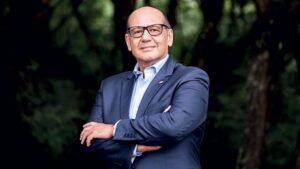
Now, OpenAI puts Masayoshi Son, the company's CEO, back in the position he always sought to occupy: that of an investor willing to write huge checks for a thesis he believes can redefine the global economy.
The size of the bet is a concern.
Softbank has already invested over US$30 billion in OpenAI and has committed to investing over US$60 billion in the company, which would give it approximately a 13% stake. The funding round, closed in March and co-led by the Japanese group, valued the company at hundreds of billions of dollars, even amidst growing competition from rivals such as Google, Anthropic, and other developers of large language models.
And this creates a certain unease. On the one hand, OpenAI transformed Softbank's balance sheet and gave new life to Son's narrative. On the other hand, a good part of this gain is still accounting-based, derived from the fair value valuation of a private company without immediate liquidity.
The concern has already reached the rating agencies. In March, S&P Global Ratings revised Softbank's credit outlook from "stable" to "negative." According to CNBC , the agency stated that the liquidity of assets, portfolio quality, and the group's financial capacity could deteriorate because of the new multi-billion dollar investment in OpenAI.
To finance the venture, Softbank has been selling stakes in companies like T-Mobile and Nvidia, as well as resorting to debt and loans. In the fiscal year, the group recorded gains of ¥218.1 billion (US$1.38 billion) from these sales and other investments. However, excluding the Vision Fund, the investment result was negative by ¥472.1 billion (US$2.99 billion), after effects such as exchange rates and expenses.
In the earnings conference call, CFO Yoshimitsu Goto attempted to reinforce the message of financial discipline. He highlighted that Softbank had a cash position of ¥3.5 trillion ($22.2 billion), sufficient to cover more than two years of bond maturities.
In March, the group secured a $40 billion bridge loan. By April, $20 billion had been drawn down, primarily to fund investment in OpenAI, and $2.5 billion had already been repaid.
Goto also said that Softbank could use its stake in Arm — one of the jewels of its portfolio — to raise funds via margin loan . He even raised the possibility of using the assets linked to OpenAI itself as collateral for financing.
Softbank's argument is that competition in artificial intelligence expands the market. When questioned about rivals like Google 's Gemini and Anthropic's Claude, Goto said it's positive for the industry to see competitors refining business models and offering new services to new users.
OpenAI, however, is only the most visible piece of a broader strategy. Softbank is trying to position itself at the center of the artificial intelligence boom with investments in AI, chip, and robotics companies.
In addition to its stake in OpenAI, the group holds Arm as a strategic asset, recorded a gain of ¥278.6 billion (US$1.77 billion) from Intel, and completed the purchase of the robotics unit of the Swiss company ABB for US$5.4 billion.
The move shows that Son wants to build a platform that goes beyond generative models, connecting AI, semiconductors, infrastructure, and robotics. But, in the short term, OpenAI is the focus of most of the narrative, and the risk.
Therefore, for the CEO of Softbank, OpenAI is the validation of a new era. But for the market, it remains to be seen how much of this billion-dollar gain will translate into cash and how much depends on the next round of the global race for artificial intelligence.