

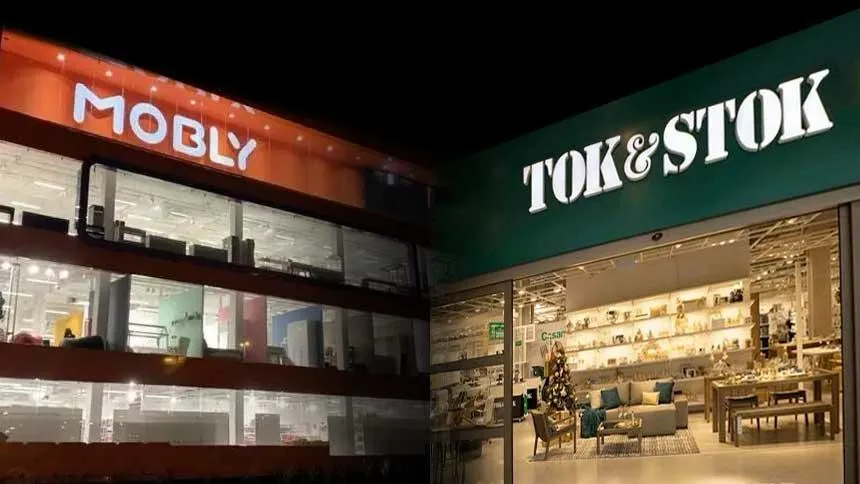
As a result of the turbulent merger between furniture and home decor retailers Tok&Stok and Mobly , the Toky Group announced that it filed for judicial reorganization in the Bankruptcy and Judicial Reorganization Court of São Paulo this Tuesday, May 12, with debts of R$ 1.11 billion.
In a statement, the company cited the challenging macroeconomic environment, characterized by still high interest rates, high household debt, and more restrictive credit conditions that affect consumers' wallets and, consequently, its sales and operations.
The group further emphasized that temporary restrictions on inventory levels are impacting its short-term liquidity, requiring the urgent adoption of measures to preserve its operations and allow for the orderly restructuring of its debt and capital structure.
Shares of Grupo Toky were down 41.3% around 4:15 PM on the B3 stock exchange, trading at R$ 0.17. Year-to-date, the shares are down 79%. The company is valued at R$ 36.8 million.
In its bankruptcy filing, the company highlights that, prior to the merger, the results of both companies were already being significantly impacted, largely due to the restrictions imposed by the pandemic, especially on retailers who relied heavily on physical stores.
In this context, in 2023, Tok&Stok negotiated agreements to restructure its bank debts, which at the time amounted to approximately R$ 339 million. However, these measures proved insufficient, and a year later, the company approved an out-of-court restructuring plan.
The merger with Mobly took place amidst this scenario, in August 2024. And the fact is that, aside from the external factors highlighted by the group, the turbulent process that gave rise to the group and various movements that followed the announcement of the operation only further heated this cauldron.
From the outset, the expectation was that the agreement would put an end to a corporate dispute that had been dragging on for years and involved, on one side, the Dubrule family, founders of Tok&Stok, and on the other, SPX Capital, which, since 2021, when it took over the operation of the Carlyle fund in Brazil, held 60% of the operation.
These expectations did not materialize, as the clan strongly opposed the merger and initiated a dispute for control of the group, which, among other developments, resulted in a public takeover bid by the clan in early 2025, which was rejected by the company's board.
In parallel to these and other complications, the expected synergies between the operations of Tok&Stok and Mobly were unable to write a roadmap for the recovery of the Toky Group's indicators, which, since then, have been struggling to show what they were capable of.
In this scenario, the group notes that it continued to adopt measures to restructure its liabilities. However, it pointed out that its situation worsened even further with the blocking of R$ 77 million in credit card receivables by SRM Bank, a payment institution.
In the petition, the company emphasizes that the amount in question is "extremely higher than the overdue debts," which are approximately R$ 1.3 million. It also states that it has contested the amount with SRM on numerous occasions and through various channels, but that these measures have been ineffective so far.
According to the group, the risks in this scenario are "absolutely evident," since the blocking of receivables – the main source of working capital for its operations – directly compromises the cash flow necessary to meet basic obligations.
These obligations would involve suppliers, partners, and workers, whose salary payments were scheduled for next Friday, May 15th. This also applies to logistics operations, physical stores, distribution centers, and digital channels.
“The extremely serious damage is aggravated by the ongoing nature of the measure, since, each day, the financial and operational impacts of the blockages increase, substantially raising the risk of collapse of cash flow and paralysis of the Applicants' business activities,” the company writes.
The group also emphasizes that several contracts signed by the company contain insolvency clauses, which allowed creditors to trigger the early maturity of these agreements, resulting in the immediate enforceability of all its liabilities and, in practice, making its recovery unfeasible.
In this regard, among other points, the company urgently requests the Court to suspend these insolvency clauses and immediately release the receivables blocked by SRM Bank, under penalty of completely jeopardizing the alternatives that the judicial reorganization seeks to preserve.