

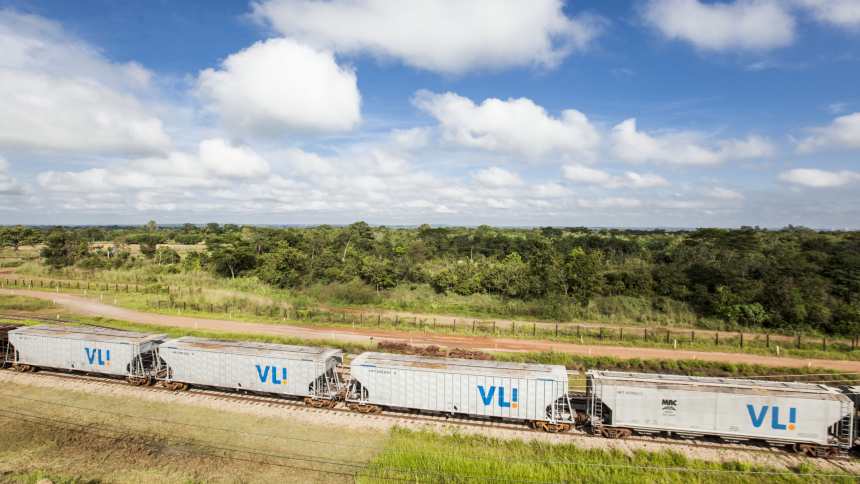
VLI operates as one of the leading integrated logistics operators in Brazil, connecting railways, intermodal terminals, and ports (in Santos, São Luís, and Vitória) to serve sectors such as agribusiness, mining, steelmaking, and fuels, with concessions for the Ferrovia Centro-Atlântica (FCA) and sections of the Ferrovia Norte-Sul .
The company is experiencing a moment of anticipation, with the possibility of renewing the concession for FCA, the largest railway in the country, with 7,856 km of track. According to the renewal proposal agreed upon with the government and awaiting approval from the Federal Court of Accounts (TCU), 5,725 km of the FCA would be maintained and modernized by VLI, while between 2,132 km and 3,082 km would be returned to the federal government, depending on different stages of the process. The company proposes to pay R$ 30 billion for the concession for the next 30 years.
For Fabio Marchiori, CEO of VLI, the renewal of the concession is important, but the company continues to invest in other areas. "In the last two years alone, VLI has invested approximately R$ 7 billion in its own assets," he says in this interview with NeoFeed . "If the renewal of the FCA concession is approved by the TCU (Brazilian Federal Court of Accounts), we will double the investments from 2014 to the present, which also totaled R$ 30 billion."
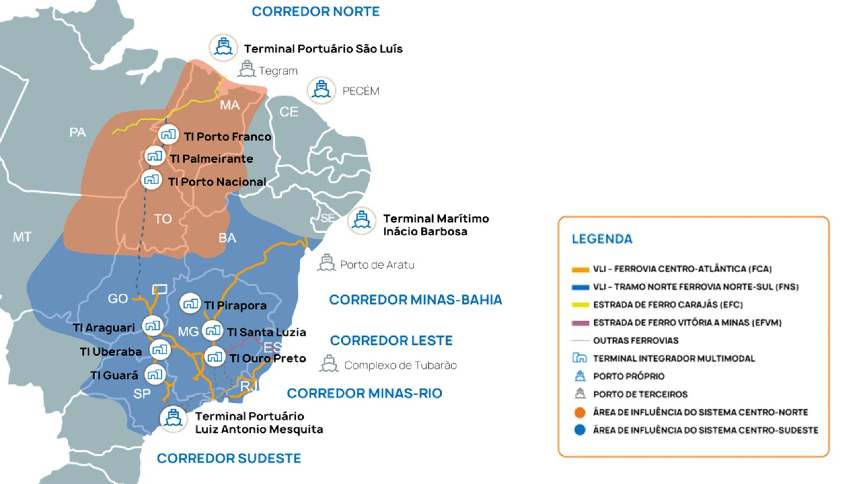
A giant in the sector, VLI is mainly composed of five shareholders: Brookfield (36.5%), Vale (29.6%), FI FGTS (15.9%), Mitsui (10%) and BNDESPar (8%). The three logistics corridors, which connect the railways to intermodal terminals and ports, form the heart of VLI's operation - whose acronym appropriately stands for Value of Integrated Logistics.
And Marchiori highlights where VLI is placing its bets. “We believe that the next logistical opportunity lies in the Northern Corridor, due to the influence of the Matopiba region,” he says, referring to the new agribusiness frontier. “This corridor includes the North-South Railway and ends at our TPSL port terminal in São Luís (MA), which is expected to grow significantly,” he adds.
Behind the approximately 15 billion ton-kilometers (TKU) transported in 2025 by the Northern Corridor — a 4.1% increase over the previous year — lies a strategy built over more than a decade, based on logistical integration, demand anticipation, and geographic positioning. VLI invested R$ 80 million in modernizing the São Luís terminal.
In recent years alone, the Northern Corridor has received R$ 1 billion in investments, half of which came from two companies (Mosaic and Ultracargo) that established themselves near the Palmeirante Terminal (TIPA), focused on grains and fuel, on the edge of the North-South Railway in Tocantins - the terminal, incidentally, received R$ 400 million in investments from VLI.
The company's CEO believes that the inauguration of the Central-West Integration Railway (FICO) should increase the flow of cargo through the Northern Corridor. He also reveals which railway networks should receive greater government attention to connect the country.
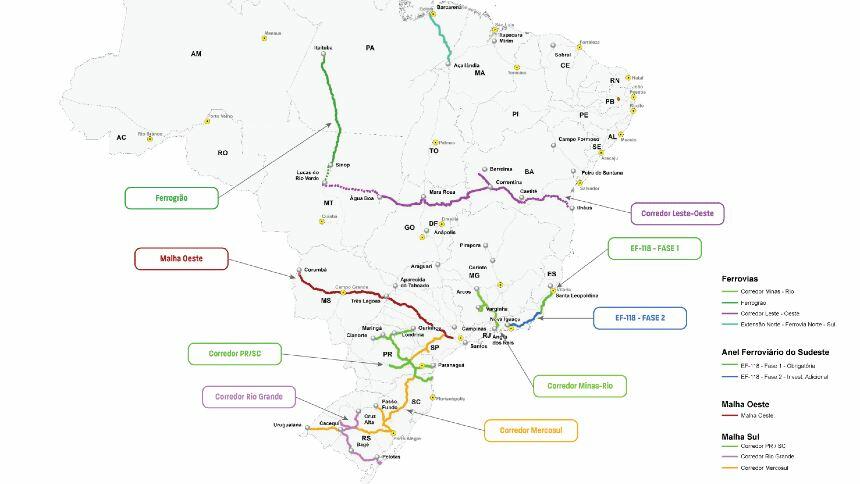
“I would say Ferrogrão; FCA well implemented, plugged in with railway authorizations; and Fico connecting with the north,” he says. “It is also necessary to resolve, even based on our experience of renewing FCA, the concessions related to the Western Network and the Southern Network, all of which are part of a backbone that runs through Brazil from north to south.”
Read below the main excerpts from the interview:
VLI has just finalized an agreement with the government to renew the concession for the Ferrovia Centro-Atlântico railway, the largest in the country, which is currently under review by the TCU (Federal Court of Accounts), and is investing heavily in logistics corridors. What are the company's medium-term plans?
In the last two years alone, VLI has invested approximately R$ 7 billion in its own assets and in the concessions under its management, including more than R$ 600 million in the acquisition of 27 locomotives to increase freight transport capacity. Going further back, from 2014 to the present, investments have already reached almost R$ 30 billion. If the renewal of the FCA concession is approved by the TCU (Federal Court of Accounts), we will double the investments from 2014 to the present – an additional R$ 30 billion over 30 years to increase FCA's capacity.
What are the strategies to increase the efficiency of logistics corridors, the company's main area of operation?
VLI has been organized around the integration of rail and port since the company's creation in 2011, a spin-off from Vale, which created this methodology for the outflow of iron ore. In our case, where we work with different products, we replicate this model by receiving cargo from clients at our integrated terminals for grains, sugar, and steel products. We then transport this cargo by rail to a port exit, where it is exported. The reverse flow, for imports, works the same way. Internal flows, which are not geared towards export or import, are organized into logistics corridors.
" VLI has been organized around the integration between rail and port since the company's creation in 2011."
How many logistics corridors does VLI manage?
We have three corridors – the North Corridor, the Southeast Corridor, and the East Corridor – all of great importance, in addition to smaller corridors, under discussion, operated by FCA. We organize the corridors according to customer needs, which includes the creation of terminals for cargo outflow.
Which of the corridors has the greatest potential for expansion?
We believe that the next logistical opportunity lies in the Northern Corridor, due to the significant influence of the Matopiba region on agribusiness, including Mato Grosso and Tocantins. This corridor, which ends at the ports of Maranhão, is expected to continue growing considerably.
Why?
Because it is through this corridor at the port exit that we unload grains, fuels, fertilizers, and even pig iron. We invested R$ 80 million in the refurbishment of our terminal in São Luís, the TPSL. The goal is to increase the terminal's operational efficiency, with significant gains in the internal grain handling capacity to serve clients in the Matopiba region.
What is the advantage of the Northern Corridor compared to the others?
We are prioritizing the ports of Maranhão precisely because of the capacity that the North-South Railway brings us, especially for transporting cargo from our two integrating terminals of the Northern Corridor, located in Tocantins - the Porto Nacional Terminal (TIPN) and the Palmeirante Terminal (TIPA), focused on grains and fuel. We have guaranteed right of way on the Carajás Railway, on the northern section of the North-South Railway, and with this we reach the Itaqui Port complex in São Luís.
Does the North-South Railway have the potential to increase the volume of cargo transported?
Yes, but it will depend on the port's capacity. With these two integrated terminals in Tocantins, located next to the North-South Railway, the volume of cargo that VLI handles has quadrupled in ten years to 8 million tons – and we can increase the capacity of these two terminals by another 50%. A great example is TIPA, where we invested around R$ 400 million to create a fertilizer flow from the Itaqui port complex in São Luís to the terminal in Tocantins.
Last year, two large companies established themselves in areas adjacent to TIPA as a result: Mosaic, with investments of R$ 400 million, and Ultracargo, with an investment of R$ 140 million. In other words, the Northern Corridor has already attracted more than R$ 1 billion in investments. And the North-South railway can transport more; we have the capacity to carry more cargo by rail, but we lose efficiency at the port. That's why we are investing in our port terminal.
The Ministry of Transport plans to expand the North-South Railway's connections with other railways, including the West-East Integration Railway (FIOL) and the Central-West Integration Railway (FICO). Does this reinforce the potential of the Northern Corridor?
The Fico railway is a reality: it's under construction and the government is drafting the bidding documents for the auction. But it should be operational well before the Fiol corridor is viable – in fact, it's stalled. As a logistics corridor, it obviously interests us, especially because the exit of cargo from Fico before the completion of the Fiol corridor – which should take at least another ten years – will be more viable via the Northern Corridor, passing through the Central Rail Network, the North-South Railway, the Carajás Railway and reaching the port of Maranhão.
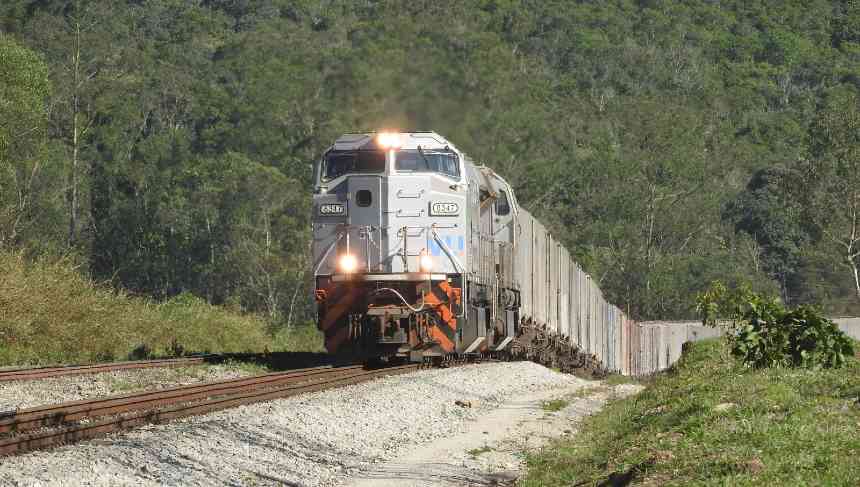
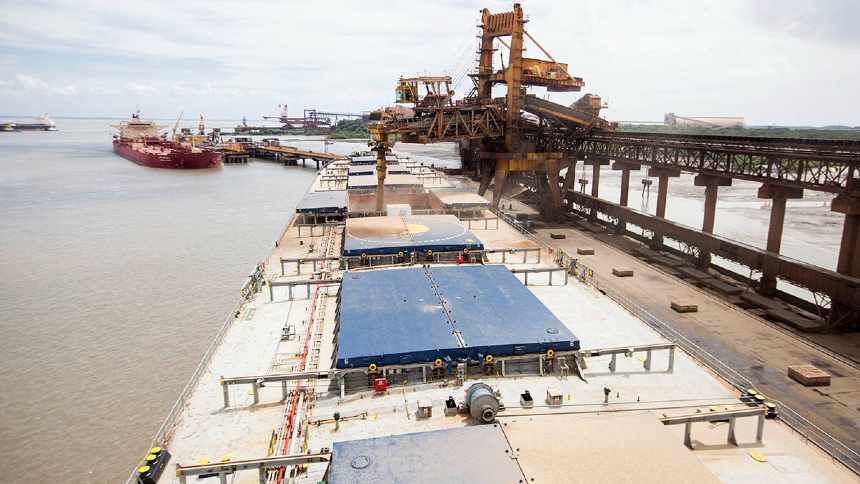
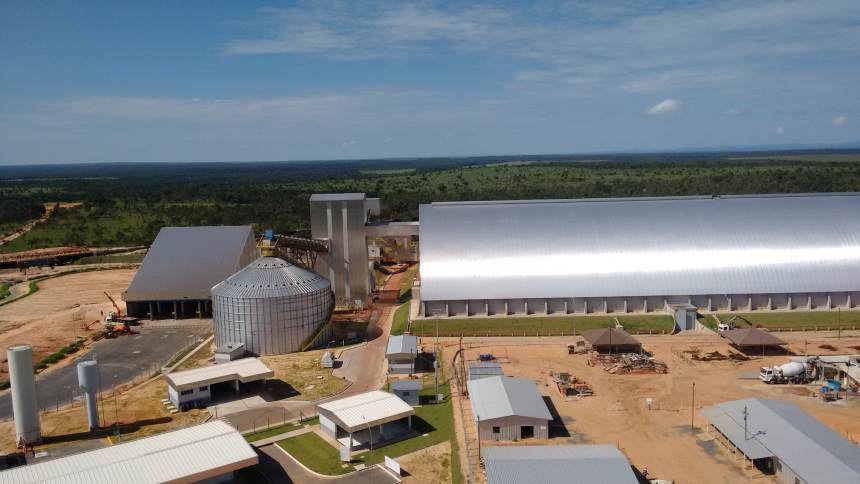
Are the other two logistics corridors, besides the Northern Corridor, also receiving investments?
Yes. The Eastern Corridor, for example, is the largest of all and the most important for the company in terms of volume moved. It connects the Triângulo Mineiro region to the port system of Espírito Santo. We transport grains, fertilizers, steel products, and mainly cellulose through the corridor. So, it's a very versatile corridor. We partnered with Vports and Multilift to install a new railway hopper at the port of Vitória, in Espírito Santo, with an investment of R$ 16 million. The hopper is a structure used for receiving and unloading products transported by train.
Did the Southeast Corridor also receive investments?
In this corridor, which connects the Midwest to the Port of Santos, VLI completed in March the second phase of a project to generate greater efficiency in the flow of fertilizers at our terminal, Tiplam. We invested R$ 38 million to expand a 5th railway line within the terminal, which was adapted into a pear shape, exclusively for loading fertilizers. This improvement will reduce bottlenecks, decrease waiting times, and increase the volume shipped. We use FCA as the backbone to transport cargo from the Southeast Corridor, connecting producing regions of Minas Gerais, Goiás, the Federal District, and São Paulo to Tiplam in Santos.
What are the expectations regarding the renewal of FCA's concession?
FCA is an asset in which VLI invests perpetually. In the last four years, we have invested almost R$ 5 billion in the concession. We've gone through four governments, and the discussion surrounding the concession has always progressed. The 1996 project, during privatization, was very important for the country, but it didn't bring balance to the concession. We paid more than R$ 20 billion in grants, which is money that didn't stay in the railway; it ended up being allocated to other things. Many sections of it remained unused because there was no cargo to be transported.
What changed in this final negotiation?
This time, in this negotiation for the next 30 years with Minister Renan Filho, we concluded that it wasn't a case of simply granting a concession, because FCA isn't a ready-made railway, in the style of "pay the concession fee and use it." In fact, it needs modernization. Therefore, a very sophisticated technical refinement was undertaken, involving studies of signaling technology and track standards, locomotives, wagons, and fleet age. And also the return of 2,500 km of track sections. Railways only make sense when there is cargo to transport, which is not the case in these sections to be returned; there are very interesting public uses that states and municipalities have already been requesting for these sections. So we consider this R$ 30 billion renewal proposal, agreed upon with the government and now being sent to the TCU for approval, a second great opportunity for FCA.
"FCA needs to be modernized; we consider this R$ 30 billion renewal proposal as a second great opportunity for the railway."
For the first time, there is an expectation of an expansion of the country's rail network, with authorizations allowing the construction of small sections and legal security for private investments. Will the rail sector be able to close the gap with road transport in the medium term?
Infrastructure is not a government policy, it's a state policy. And, in fact, there is continuity in the planning of this area, initiated in the previous government, maintained in this one, and which should continue from 2027 onwards. We need to increase the rail network, which today is probably below 20%, to something close to 30% in the medium term. Trucks are important, but only for short distances.
Which railway projects should be prioritized by the government?
There are interesting investment possibilities, despite all the questions that need to be asked to make them viable. One of them is Ferrogrão, which I consider a smart investment in an area that is already being explored. There is already a highway passing through there ( BR-163, which runs parallel to the railway line ). A train there with 160 or 240 wagons carries much more cargo than trucks on BR-163, with better environmental results.
But several experts claim that the Ferrogrão railway is unaffordable; the cost to build it is too high...
After the pandemic, the cost of civil construction and rolling stock has indeed increased significantly. Whether or not the Ferrogrão project pays off is a matter of strategic direction. We changed that by altering the perception of risk regarding the safety of what is important in the construction of, for example, a railway. I'm talking about environmental licensing and long-term financing lines that don't compromise the companies' balance sheets. This can be done through project finance , where there is security for the financier that the investment will be repaid. So, for that, we have to find a way for the public and private sectors to manage risk.
What other rail networks would be relevant?
Another possibility I see is FICO connecting to the north of the country. We also need to give a well-defined purpose to FCA, with well-implemented investment, because FCA functions as a backbone, where other railway authorizations can connect to take advantage of potential new cargo. There are iron ore complexes to be explored in Minas Gerais and Bahia. Arauco, for example, recently announced that it will build a branch line to connect its pulp production in Inocência (MS) and bring it to Santos. There are several options, but we need to define some priorities in the short term.
What would they be, in your opinion?
The other rail networks not directly influenced by VLI are part of a backbone that runs through Brazil from north to south. The Western Network is an example; currently it's not carrying cargo, but it needs to find a use for it – the network exists and can be utilized depending on the cargo that arises. The Southern Network is also under discussion. In short: Ferrogrão, a well-implemented FCA line connected with railway authorizations, the Fico line connecting to the north, and resolving, based on our experience with concession renewals, the issues related to the Western and Southern Networks.