

Driven by growth in revenue from its apparel segment, fashion retailer Riachuelo returned to profitability in its first quarter. After six years of losses in the first three months of the year, the company generated R$ 5 million in profit in 2026.
Net revenue recorded between January and March was R$ 2.3 billion, a 6.7% increase over the same period of the previous year. Consolidated EBITDA for the period was R$ 268 million, a 14.1% increase compared to the same period in 2025. The margin was 11.5%.
The basis for this result lies precisely in the evolution of the performance directly linked to the company's core business . Same-store apparel sales (SSS) grew 10.1% in the first three months of the year, marking the 11th consecutive quarter of growth in this division.
The segment's gross margin reached 54.9%, an increase of 1.2 percentage points compared to the same quarter of 2025. This growth has occurred for the 10th consecutive quarter, directly associated with efficiency gains and improved profitability.
“We have adopted a lot of management and improvement in the apparel supply chain. Over a three-year period, we have grown our gross margin for apparel by 5.2%. Revenue and margin growth are what have catapulted the company's results,” says André Farber , CEO of Riachuelo, in an interview with NeoFeed .
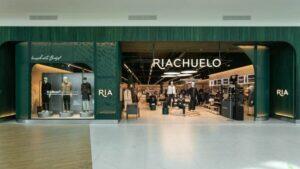
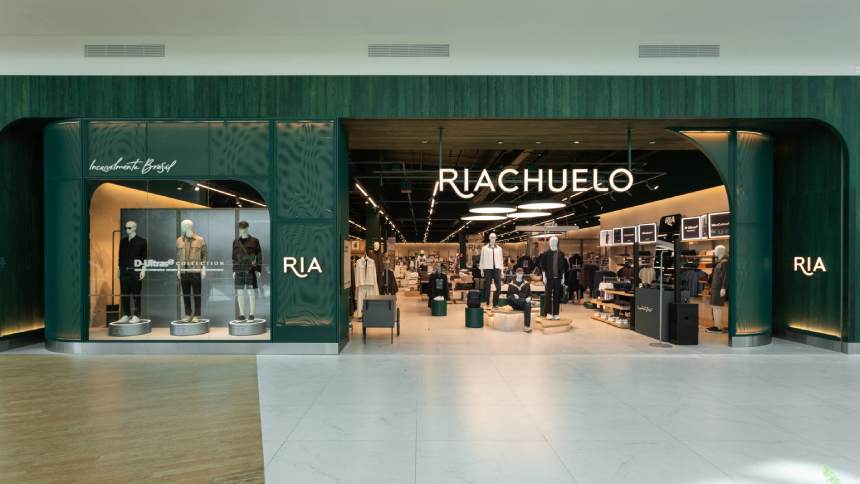
According to the executive, the improvement in results is also related to the advancement in the model and format of Riachuelo's physical stores. Recently, the company inaugurated a new experience concept at its store in Park Shopping Barigui, in Curitiba.
The store, which spans over two thousand square meters (m²), has gained a new floor dedicated to men's and children's fashion, and a new, slightly more immersive aesthetic for customers. The idea is that, still this year, the company will adopt this strategy in four to five stores with this new format.
“We just delivered this model in Curitiba. Along with that, our team has been doing a good job managing the factory and improving our pricing. We had only made a profit in the first quarter before the pandemic. And now we've changed that,” says Farber.
A smaller-scale pilot format, in a store of approximately 200 m², was tested last year in the Pinheiros neighborhood of São Paulo. According to the CEO, the result was extremely positive and motivated the company to proceed with the proposal for the store in the capital of Paraná.
"The company has been moving forward with the belief that what makes the difference in our business is increasingly improving the customer experience. And this involves a range of elements, including stores and products," says the CEO.
According to the executive, the company has also invested in teams, to have more senior professionals involved in collection development. "We've been seeking more designers to bring more innovation, fresh perspectives, and innovation to Riachuelo."
Thus, Riachuelo's merchandise operation maintained its growth trajectory, with EBITDA of R$ 135 million, a growth of 23.7% compared to the first three months of 2025.
The unit's margin was 8.1%, an increase of 1.1 percentage points, the best growth in the segment in a first quarter in nine years for the retailer.
Another highlight for the Riachuelo group was in the financial segment, with Midway. This vertical recorded EBITDA of R$ 133 million, an increase of 5.8% compared to the first quarter of last year.
“Riachuelo has a very strong combination of a powerful fashion business with a financial services business. It's practically fifty-fifty now, unlike other quarters where fashion takes precedence,” says Farber.
In this unit, part of the explanation for this growth lies in service innovation and the opportunity to develop new consumer products. At the end of last year, for example, Riachuelo launched payroll-deducted loans, in addition to improving the availability of resources.
“We have been improving the way we grant credit, with new management models and the use of more data. Our goal is to offer these resources in a more conservative way, but allowing the consumer to have access,” he explains.
Blouse tax
Even with the improvement in financial results in the first quarter and the return to profit for the period, Farber points to concerns about discussions surrounding the end of the so-called " blouse tax ," instituted by the federal government in 2024, which ensures a 20% import tax on platforms, mainly from Asia, for purchases up to US$50.
Recently, more than 50 entities from various retail segments released a manifesto addressing the risks of ending this tax, which could negatively impact the national industry.
The document released by the associations also states that the potential revocation, discussed in the Presidential Palace, puts at risk an investment volume of approximately R$ 100 billion in Brazil.
According to the company's CEO, this is a "bizarre conversation." He believes it's unreasonable that Brazilian companies shouldn't have the same conditions as Chinese companies that sell to Brazilian consumers.
“Today, a shirt from Riachuelo, which we bring from Asia, has a 90% tax. Today, cross-border commerce pays 45%, because it doesn't pay PIS/COFINS and the import tax is 20%. Brazil is experiencing a reversal of values. This isn't a tax on blouses. It's Chinese incentives,” he states.
“This asymmetry needs to be corrected. Either by removing taxes or increasing them for everyone. But we were already growing before the tax on blouses. And even if there is this situation of reverse dumping, we are prepared to continue with our growth cycle,” Farber concludes.
In the first 2026, RIAA3 shares on the B3 stock exchange have appreciated by 16.4%. The company has a market capitalization of R$ 5 billion.