

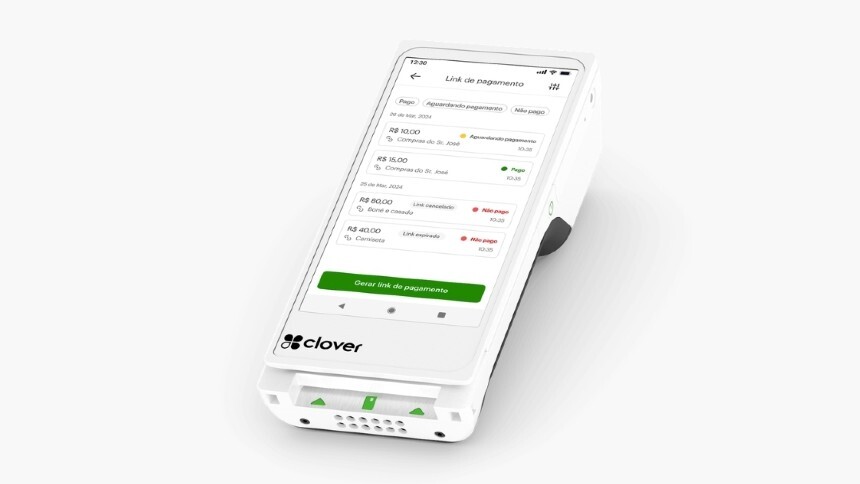
The world's largest payment processor, the American company Fiserv, is opening its first factory outside of Asia in Brazil this Wednesday, May 6th. Located in Betim, Minas Gerais, the unit will have the annual capacity to produce 100,000 Clover platform payment terminals.
The equipment will be destined for the domestic market, primarily to serve small and medium-sized retail businesses. Currently, the company supplies the payment device, which is manufactured in China.
The imported models of the card payment terminals have been in Brazil since December 2024, and today the company already has 100,000 devices in operation, which have already carried out 50 million transactions. In practice, the company wants to move beyond simply providing software and also produce hardware.
The model that will be produced in the country will be the Clover Flex, which also offers business management features on the device. Including the other payment device models, the company currently operates in approximately 500,000 commercial establishments in the country.
The investment for the construction of the production and manufacturing unit for payment equipment is part of a US$100 million investment package by Fiserv in Brazil, which also includes actions in technology development, until the end of 2027.
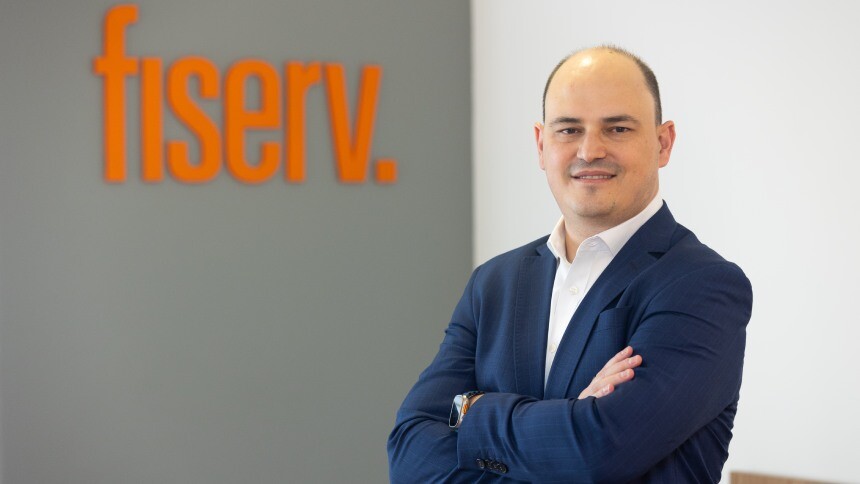
“The factory arrives at a time when the product is already mature in Brazil and has reached a certain scale. It starts to make sense to make a larger investment to produce locally and expand service in the country,” says Ricardo Daguani, CEO of Fiserv in Brazil, in an interview with NeoFeed .
With this, Fiserv seeks to gain ground in a rapidly expanding area in the country. Data from the Brazilian Association of Credit Card and Service Companies (Abecs) shows that card transactions totaled R$ 4.5 trillion in 2025, a 5.4% increase over 2024.
Market estimates suggest there are at least 23 million payment terminals in operation in Brazil, placing the country among the largest in terms of transaction volume, behind only the United States and China.
According to the executive, local production allows the company to reduce logistics costs, delivery time, and increases the availability of equipment in the country.
In Brazil, more than half of Fiserv's revenue comes from the merchant acquiring market. And in this segment, the company also directly offers equipment and enables partners to operate using the company's technology.
One example of this model is with Caixa, which sells its acquiring services to retail companies using the Clover payment terminal. "Our growth comes precisely from these two fronts." In addition to the state-owned bank, the company also has a similar partnership with Sicredi.
As part of its national retail expansion plan, Fiserv decided to implement physical stores, which will serve as a kind of "showroom" for all Clover card machine models offered by the company, and not just the one that will be produced in Minas Gerais.
The first unit was opened last year in Guarapari, in Espírito Santo. The plan is to expand to regions with a higher concentration of businesses, such as São Paulo.
Fiserv's other revenue stream comes from invoicing, which in this case serves financial institutions such as traditional banks and fintechs.
The CEO of Fiserv sees that, in the case of point-of-sale terminals, there is still an avenue to be explored in the increase of payments via Pix, using QR codes. According to him, a significant portion of payments are made directly between banking apps, which makes the transaction slower.
“We have the technology to capture this transaction. There are still many transfers in Brazil using the Pix key directly through the cell phone, instead of using the card machine technology, which is very secure. And, for the establishment, it is much better to be on the device, to facilitate its financial control,” says the executive.
According to the Central Bank, in March there were 7.4 billion transactions via Pix, totaling R$ 3.5 billion. Of this total, only 8% were made with a static QR code and 11% involved manually entering the key.
For Daguani, the point of attention regarding the company's growth prospects in Brazil lies in the path that the Monetary Policy Committee (Copom) will adopt in relation to the interest rate, currently at 14.75% per year.
“High interest rates don't help growth because they reduce credit. But there's the explanation of controlling inflation. If the economy grows more, it's good for everyone, both the institution and the consumer. We expect interest rates to fall, but we have to adapt to the scenario,” assesses the CEO.
In 2025, Fiserv achieved revenue of US$21.2 billion, a 3.6% increase over the previous year (US$20.5 billion). Net profit was R$3.5 billion, 11% higher than the 2024 result of US$3.1 billion. In the global market, Brazil is in the top 10. The company does not disclose revenue by country.
As of 2026, Fiserv's shares on Nasdaq have depreciated by 14.7%. The company has a market capitalization of US$30.5 billion.