

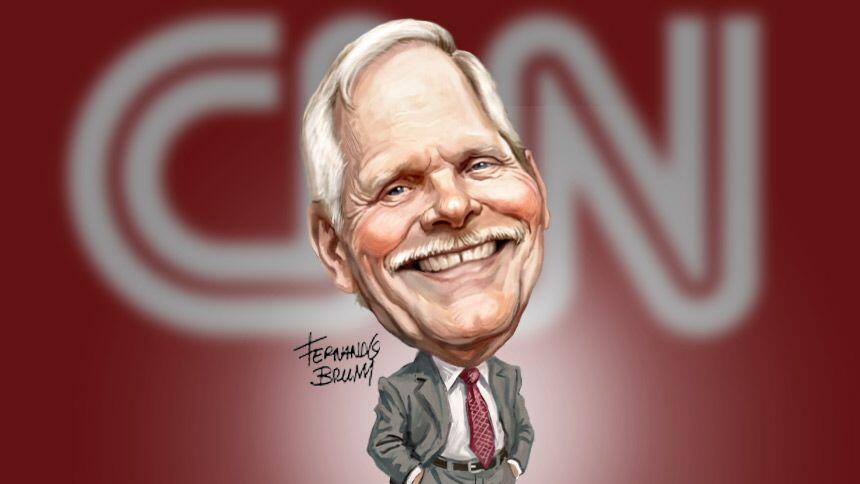
In a 1998 Reader's Digest article, American businessman Ted Turner declared, without modesty, to journalist and writer Dale Van Atta: “I am trying to set the absolute record for accomplishments by a person in a single lifetime. And that puts me in quite illustrious company: Alexander the Great; Napoleon; Gandhi; Christ; Muhammad; Buddha; Washington; Roosevelt; Churchill.”
The self-praise, of course, contained a huge dose of exaggeration, but it's impossible to deny Turner's influence. In 1980, by founding CNN, the world's first 24-hour news channel, he helped redefine not only television, but the way the world consumes information.
Upon his death on Wednesday, May 6, at the age of 87, Turner leaves behind a legacy that extends far beyond his media empire—just as he intended. His mark is also felt in sports, philanthropy, and American society at the end of the 20th century.
“I’ve always been more of an adventurer than a businessman,” he once told The New York Times , summarizing a career often marked by improbable bets, financial crises, and spectacular turnarounds.
When CNN was launched, the idea seemed absurd to much of the industry. The major networks, such as ABC, CBS, and NBC, dominated prime time, and the notion that audiences would follow continuous news was seen as unfeasible—especially with a relatively low budget.
In its first two years, the network lost up to $2 million a month, according to the New York Times .
Competitors mocked the project, calling the network the " Chicken Noodle Network ".
The comparison to chicken soup, a typical dish from Atlanta, was a way of mocking a dish considered homemade and low-budget.
But the businessman persisted. “Turner wouldn’t listen,” wrote British journalist Malcolm Gladwell in The New Yorker magazine in 2010. This stubbornness ended up redefining television journalism.
During the liberation of American hostages in Iran in 1981, CNN was there. During the Challenger space shuttle accident five years later, it was also there. During the Gulf War in 1991, the same. It was there, shaping the global experience of following history live and in real time. And so, chicken soup remained confined to Atlanta menus.
Until CNN began broadcasting, governments had to wait for intelligence reports from the battlefields to get information—a complicated and time-consuming process. "I learn more from CNN than from the CIA," President George H.W. Bush reportedly said, according to the New York Times .
Turner's empire began to be built in 1963, with the death of his father. That year, Robert Edward Turner Jr. committed suicide after incurring heavy debts to expand the billboard company and battling alcohol and drug addiction.
The experience would deeply affect his son, who was 24 years old at the time. As he would tell Time magazine years later, he felt profoundly alone: "I relied on him to judge whether or not I was a success."
Rough sea
Against all advice, Turner refused to sell the family business. Instead, he transformed the business and set out to expand.
He bought a failing station in Atlanta in 1970 and named it WTCG — initials for Turner Communication Group, but which he used to say stood for Watch This Channel Grow. At a time when few believed in the new communication satellites, Turner invested in the technology and transformed the network's small market into a system that would cover the entire country.
To fill the gaps in WTCG's programming, he acquired the Atlanta Braves baseball team and the Atlanta Hawks basketball team. It was much cheaper to broadcast the games than to buy or produce other attractions. In the end, the acquisition of the baseball team proved to be a great deal. In 1976, he paid $500,000 in cash and $8 million at 6% annual interest for ten years. Forty years later, the Atlanta Braves were worth almost $1.2 billion.
Meanwhile, the businessman was sailing. A passion he acquired in childhood at the Savannah Yacht Club in his hometown. Twice, in 1970 and 1973, he was elected yachtsman of the year by the United States Sailing Association. In 1977, he won the America's Cup—an ambition from his youth. Two years later, he would participate in the Fastnet Race, organized by the Royal Ocean Racing Club, in the Irish Sea.
Due to strong winds, many boats sank and 15 athletes died. Of the approximately 300 registered, only 85 finished the regatta. Turner came in first place. “Like any experience, whenever you overcome it, you feel better,” he said at the time. “We’re not talking about the other people who died, but being able to face all that and come out victorious is thrilling. Sailing in rough seas is the essence of the sport.”
The tycoon also enjoyed excitement on dry land. Direct and often explosive, he was nicknamed "Southern Mouth" because of his self-praise, frankness, and controversial statements. He had three marriages. The last one, to actress and activist Jane Fonda, lasted from 1991 to 2001 and ended because of his infidelity.
Turner was also an activist. He was involved in campaigns to end nuclear weapons and landmines. One of the largest landowners in the United States, he created nature reserves on part of his 2 million acres. In 1997, he donated US$1 billion to the UN, distributed over a decade to help refugees and children and combat some of the world's most prevalent diseases.
In 2018, he was diagnosed with Lewy body dementia, a progressive neurodegenerative disorder. The businessman leaves behind five children, 14 grandchildren, and two great-grandchildren.
Few descriptions of Turner's personality are as accurate as Malcolm Gladwell's in The New Yorker : “He was 'Captain Courageous,' the man of nerves who won the America's Cup, defied the major networks, married a movie star, and became a billionaire (...) He gave the impression of signing contracts without even looking at them. He was a heavy drinker, a loudmouth, a man of uncontrollable impulses and desires, the personification of the risk-taking entrepreneur.”