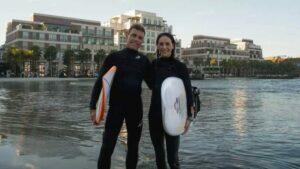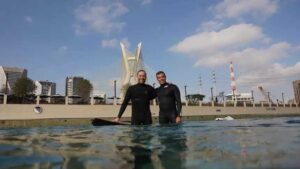


Bruno Garfinkel rejects the classic label of heir. Son of Jayme Garfinkel, founder of Porto, he grew up within one of the largest groups in the sector, but says he transformed that starting point into fuel to pursue something of his own.
Today, as chairman of the board of Porto, he divides his time between strategic decisions for a company with tens of thousands of employees and a routine that includes racetracks and waves around the world. A Porsche Cup driver and surfer since adolescence, he uses the sport as a laboratory for testing, error, and evolution.
It was in this context that he welcomed surfer Carlos Burle for an experience outside the sea. In an interview with Bravamente, a program in partnership with NeoFeed , Garfinkel took Burle to the track in a Porsche Cup event, reversing roles and showing how the world of speed also demands risk assessment, emotional control, and decision-making under pressure.
This logic of challenge runs through his career. In motorsports, he speaks of "accelerating and braking" as a direct metaphor for management: knowing when to move forward and, especially, when to hold back.
In surfing, you find an even more unpredictable environment — where there is no control, only adaptation. "It's in this type of scenario, where you don't control everything, that true evolution happens," says Garfinkel.
The same mindset appears in corporate decisions. Garfinkel avoids shortcuts that could compromise the company's culture, even when they involve significant financial opportunities. In a recent episode, he chose not to move forward with an investment market project after realizing that the strategy involved unfounded promises, a path that, for him, does not align with the relationship of trust built by Porto.
More than just numbers, the entrepreneur has focused his attention on behavior and culture. He argues that companies are, above all, platforms for value at scale. In Porto's case, this means impacting not only employees, but a network that includes brokers, service providers, and millions of clients.
But it's outside the office that he identifies his biggest challenge. A father of two teenagers, Garfinkel admits that fatherhood exposes vulnerabilities that don't appear in the corporate world. After years of adopting a more rigid stance, he now tries to recalibrate his role, with less pressure and more presence.
At the heart of it all is an unease that has nothing to do with performance or legacy: the fear of not deserving it. Garfinkel reiterates that he doesn't want to be seen as someone who got there without effort. He wants to feel that each achievement carries intention, work, and consistency.