


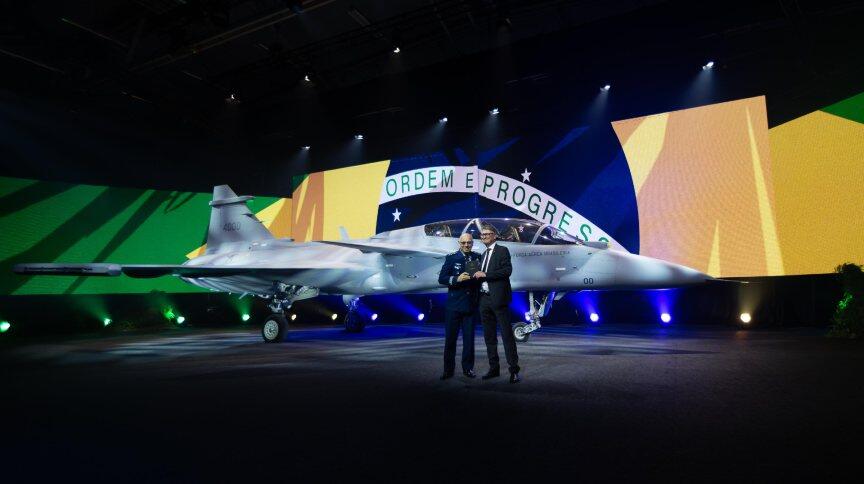

Linköping - The partnership between the Brazilian Air Force (FAB) and Saab, the Swedish defense industry, should go beyond the joint development of the Gripen fighter jets.
Following the launch ceremony of the two-seater Gripen F-39F on June 2nd, at an event in the Swedish city of Linköping, Saab CEO Micael Johansson admitted to discussing with Defense Minister José Mucio the signing of a memorandum of understanding aimed at creating an innovation and research center in São José dos Campos (SP).
"The Saab-Brazil partnership provides a rare end-to-end technology transfer, enabling sovereign capabilities for design, development, production, maintenance and flight testing in Brazil," said Johansson, in a press conference after the presentation ceremony of the two-seat Gripen F model - the first two-pilot aircraft developed through the partnership between Saab and Embraer.
"A two-pole production model is being implemented, with capacity expansion in both Linköping and Brazil to meet growing global demand driven by geopolitical tensions," said the CEO of Saab, responding to a question from a Colombian journalist – the neighboring country has ordered 15 Gripen E fighter jets.
The possibility of Saab and the Brazilian Air Force expanding their partnership was already known, but the expectation was for increased production at the Embraer factory in Gavião Peixoto (SP), in the Araraquara region, where the Gripen E model is produced. When questioned by a journalist who had spoken with Mucio about plans to create a research center in São José dos Campos, Johansson confirmed.
NeoFeed has learned, however, that the plans have not yet been discussed in depth. At the press conference, Johansson also did not confirm whether, with the closing of the contract for the sale of 20 Gripen E/F aircraft to Ukraine, announced last week, Saab will expand its factory in Gavião Peixoto.
After the article was published, Saab released a statement confirming that the Swedish company and the Brazilian Air Force (FAB) signed a Memorandum of Understanding (MoU) to conduct joint studies and analyses on the possible establishment of an Innovation and Research Center in Brazil, focusing on improving the operational and technological capabilities of the Gripen fighter jet, as well as strengthening the ability to maintain and operate the aircraft over time.
"The negotiations between Saab and the Brazilian Air Force will be conducted within the scope of the DCTA (Department of Science and Technology of the Air Force), a Sectoral Management body of the Air Force Command whose purpose is to conduct Science, Technology and Innovation Actions," says the statement from the Swedish company. "The next steps involve carrying out the agreed studies and analyses, followed by an evaluation of the results, with the aim of defining how to move forward to a formal agreement."
Developed by Saab in partnership with Embraer , the new two-seater model was produced in Linköping and does not offer significant technological advancements compared to the Gripen E, the first unit of which manufactured in Brazil was delivered in March in Gavião Peixoto – a result of the FAB's contract with Saab, which provides for 36 aircraft (28 E and 8 F), with production shared between Sweden and Brazil. So far, 11 fighters have been delivered. The original value was approximately R$ 13 billion, subject to contractual adjustments.
The Gripen F rollout was led by Johansson, in an event attended by Minister José Mucio and the Air Force Commander, Brigadier Marcelo Damasceno. The Gripen that performed an aerial demonstration for guests and authorities at the Saab hangar at the local airport, however, was a D model, also a two-seater – the F version still needs to undergo testing before delivery. Afterwards, the new model was formally presented in a light show.
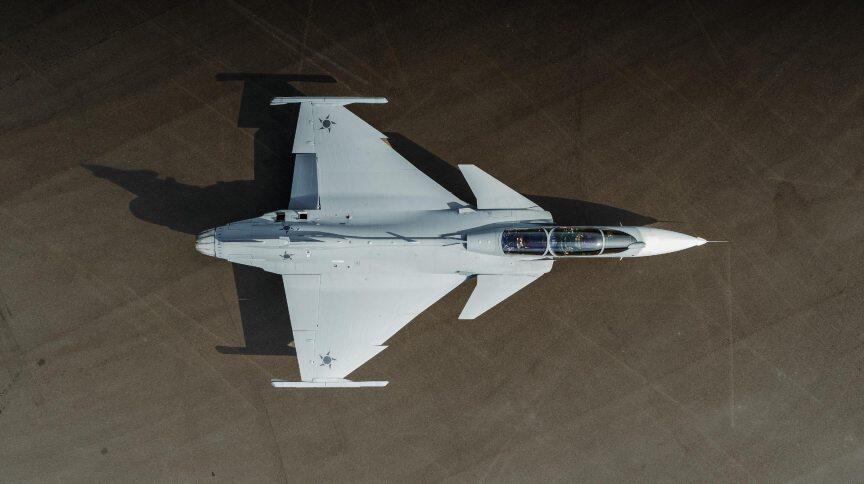
The Gripen F has a range of up to 4,000 km with refueling, can carry up to 7 tons of weaponry, and is considered one of the most modern fighter jets currently available. The major change to the Gripen F was the adaptation to a two-seat model, which expands the range of missions possible without altering the technological base of the single-seat model.
In addition to the second cockpit, which allows for operational missions and pilot training, the Gripen F is approximately 70 centimeters longer than the Gripen E. The extended fuselage accommodates the new cockpit, while the width remains the same, 8.6 meters, since the wings have not changed.
Although they share AESA radar, F414 engine and the same sensor architecture, the two versions differ in their mode of operation: the Gripen E was designed for a single pilot, while the F distributes tasks in more complex scenarios.
The second crew member doesn't turn the F into a simple training aircraft. It allows for the division of functions such as sensor management, mission coordination, and unmanned aircraft control, increasing efficiency in long-distance operations or those with a high volume of information.
The use of AI in the Gripen F acts as a digital co-pilot, reducing the workload of the two crew members and increasing efficiency in complex missions. It analyzes sensors, radar, and communications in real time, prioritizing threats and suggesting actions to the pilot and the weapons system operator. The model also facilitates the adaptation of new pilots and the experimentation of operational methods involving collaboration between manned aircraft and drones.
The two-seat version retains ten external hardpoints for weapons and the same payload capacity as the Gripen E. Its architecture facilitates the integration of different weapons already used by other air forces and allows for rapid updates of software, algorithms, and hardware.
The Gripen F still retains the ability to operate on short runways, perform attack, reconnaissance and defense missions in a single sortie, and reach speeds of up to 2,400 km/h, with a range of about two and a half hours.
More important than the launch itself is the confirmation of the progress made possible by the contract signed in 2013 between the Brazilian government and Saab, which includes technology transfer, training for 350 engineers, and the participation of approximately 60 Brazilian companies.
The country is a co-producer of the Gripen E/F and is home to Saab's only final assembly line outside of Sweden. Embraer actively participated in the development of the Gripen F, including the extended fuselage, systems redistribution, dual cockpit, certification and testing, as well as final assembly in Gavião Peixoto.
AEL Sistemas supplies the Wide Area Display (WAD). Present in both models, it forms one of the central technologies of the cockpit - a 19-inch high-resolution panoramic touchscreen that replaces traditional panels and concentrates virtually all mission information on a single display.
Akaer worked in structural engineering and became a global supplier to Saab. Atech developed mission planning systems, while companies like WEG and Eleb produce electrical and hydraulic components.
The Gripen program has faced delays. The original contract stipulated the delivery of 36 Gripen E/F fighter jets – 28 Gripen E (single-seat) and 8 Gripen F (two-seat). Deliveries were scheduled to begin in 2019 and end in 2025. However, over the years, the Brazilian government has not guaranteed stable and continuous payments.
As a result, the contract has already had 12 addendums, the cost has increased by 13% - enough to acquire six extra fighter jets, considering the original value of the contract signed in 2013 - and the schedule has been pushed back to 2032. Behind the delay in funding is the tight budget of the Ministry of Defense.
Of the total R$142.5 billion approved for the ministry in 2026, approximately 85% of the total amount is allocated to the payment of active personnel, retirees, and pensioners. The remaining R$15 billion is for troop maintenance, operations, and equipment modernization.
In January, military commanders submitted long-term planning proposals to the federal government—ranging from R$450 billion to R$800 billion—that projected layered defense needs (including cyber, space, and anti-aircraft defense) for the coming decades.
The R$800 billion investment over 15 years aims to bring Brazilian defense investment in line with international standards, increasing it from the current level of 1.1% to approximately 2% of GDP. The crisis in Venezuela and military actions involving neighboring countries were mentioned as factors reinforcing the need for greater preparedness and response capacity.
Brazil is projected to increase its military spending by 13% in 2025 compared to the previous year, reaching US$23.9 billion (R$119.6 billion), according to a report by the Stockholm International Peace Research Institute.
Ecosystem
According to Vinicius de Carvalho, from the Department of War Studies at King's College London and a specialist in the areas of defense and security, to sustain growth, the defense industry needs to overcome its dependence on sporadic contracts and invest in an ecosystem of innovation, science, and technology, following the model of the Technological Institute of Aeronautics (ITA).
"The first step in a defense policy is to realistically define the country's potential threats and vulnerabilities, avoiding speculation; without this clarity, it is impossible to plan adequately," he states.
According to him, there is a chronic misalignment between the ambitious plans of the Armed Forces and the budgetary reality, which leads to scope cuts and compromises the effectiveness of investments.
Carvalho warns that Brazil confuses the concepts of defense – which refers to threats to sovereignty – and security, which refers to crime. "Because of this, the Armed Forces are frequently called upon for security tasks, which is a mistake that compromises both areas, leads to the misuse of resources, and results in inadequate troop training."
Despite this planning flaw, the expert states that the Gripen program filled a critical gap in the country's air defense, which had an obsolete fighter jet fleet. However, he considers the partnership between the Brazilian Air Force (FAB) and Saab as part of an ongoing maturation process and not the sole catalyst for the national defense industry.
He cites other strategic contracts, such as the submarine contract with Naval Group and the frigate contract with the German company Rheinmetall, which were also fundamental in modernizing technology transfer legislation and integrating Brazil into global supply chains.
According to Carvalho, the true strategic value of the agreement lies in the embedded systems (software, command and control), and not just in large platforms such as aircraft carriers.
“These contracts allow Brazil to evolve from a supplier of materials to a systems developer, a significant qualitative leap,” he says, citing the successful example of this model with the Super Tucano (A-29/EMB 314) – a turboprop light attack and advanced training aircraft, developed in Brazil by Embraer and considered one of the greatest successes of Brazilian military aviation, used by both the FAB and more than 15 other countries.
"The Super Tucano is an efficient, relatively inexpensive, and technologically suitable product for its missions, and has been a global sales success," praises Carvalho.
Another product cited by experts is the KC-390 Millennium, a multi-mission military cargo plane also produced by Embraer, which gained prominence for its ability to refuel the Gripen E/F in flight. The unit price is not fixed, fluctuating between US$85 million and US$160 million. This value depends on the quantity ordered and the support, training, and spare parts package.
The Brazilian Air Force (FAB) has delivered 8 units out of a total contract for 19 aircraft. The Portuguese Air Force (FAP) has received 4 units out of an order for 6. Deliveries are underway to Hungary and the Czech Republic. Countries such as the Netherlands, Austria, South Korea, and Sweden have also ordered the model.
Military expert Joakim Paasikivi, a consultant to the Swedish Armed Forces, sees the possibility of the KC-390 gaining even more market share among NATO countries.
“The Millennium is quite well suited to European conditions and distances, and I believe there is a good chance of new orders on the continent,” he says, noting that Sweden decided to acquire the KC-390 Millennium to replace its aging C-130 Hercules, thus joining several other nations in the military alliance that use it as their main aircraft for tactical transport and aerial refueling.
Paasikivi, however, is more pessimistic about the role of the A-29 Super Tucano. "Europe is rearming itself in the face of Russia as the main threat, and the focus is on both drones and high-tech systems, which makes an aircraft specialized in counterinsurgency inadequate," he points out.
The journalist traveled at the invitation of Saab.