


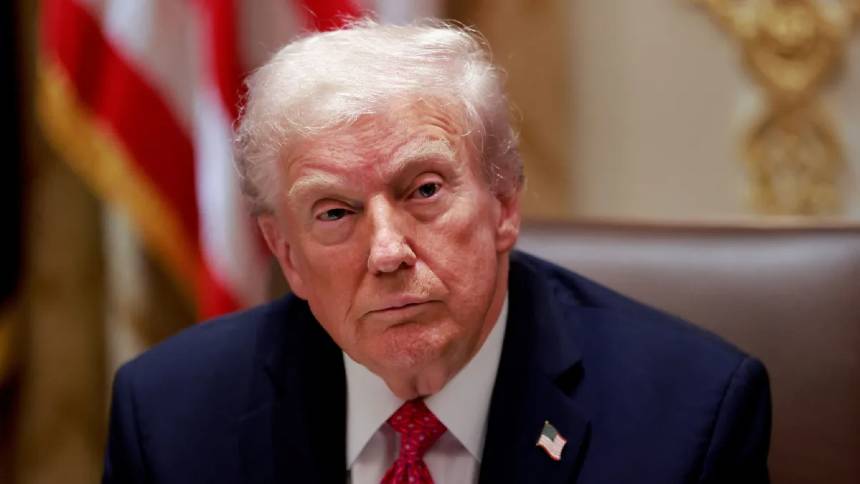

President Donald Trump 's threat to impose a 20% toll on all cargo transported through the Strait of Hormuz may have exacted a higher price than the American government anticipated. Following the announcement made on Monday, July 13th, major New York stock indices closed the day in the red, while oil prices surged more than 10%, renewing inflationary fears and leading the market to price in higher interest rates in the United States.
According to the FedWatch tool from CME Group, which monitors bets in the US interest rate futures market, the probability of the Federal Reserve (Fed) raising interest rates by at least 50 basis points — two increases of 25 basis points each — by the end of 2026 exceeded 57.5% on Monday. Earlier in the day, the market was pricing in 47.6% for two increases, and a week ago, 33.9%.
On Monday, fears about the effects of the geopolitical escalation in the Persian Gulf were amplified by a speech from Fed director and FOMC voting member Christopher Waller at the New York Association for Business Economics in New York.
In a speech that goes against President Donald Trump's wishes for interest rate cuts, Waller warned that if core inflation this week comes in higher than expected again, "the FOMC will need to consider tightening monetary policy in the near term."
The U.S. Consumer Price Index (CPI) for June will be released this Tuesday, July 14th.
Waller was explicit in drawing a parallel with the 2021 mistake, when the Fed was slow to react to inflation. "I am determined to avoid repeating the same mistake," the director said.
The consensus is for a slowdown in headline inflation over 12 months, from 4.2% in May to 3.8%, with the monthly CPI falling 0.1%. Meanwhile, the core annual CPI, which excludes energy and food and is the indicator Waller said he is monitoring most closely, is expected to remain stable at 2.9%, according to market projections, and at 0.2% compared to the previous month.
With the core oil price persistently running above the 2% target and the surge in Hormuz threatening to reverse the recent oil price decline, any upward surprise tomorrow could be the missing trigger for the start of a new tightening cycle.
In the next FOMC decision, scheduled for July 28 and 29, the probability of a 25 basis point increase reached 43.3% this Monday — compared to 34.2% a day ago and only 8.3% a month ago. In September, the market is pricing in a 76% chance of at least one cumulative increase from the current level.
“Waller’s remarks today and the latest FOMC minutes from last week show that the FOMC has become increasingly open to the possibility of interest rate hikes to combat inflation,” Goldman Sachs wrote in a report.
Although economists at the bank expect a more favorable dynamic for the overall CPI in the coming months, they anticipate a more challenging outlook for core inflation.
"Core PCE inflation is expected to remain slightly more persistent, averaging 0.23% over the next three months, partly due to continued pressure on imputed prices of financial services from rising stock markets and price increases in software and accessories, whose weight in core PCE is 30 times greater than in core CPI," it states.
Bank of America also expects more persistent core inflation. According to the bank's economists, the full CPI for June should have fallen 0.09% compared to May, with the drop in gasoline prices. For the core PCE, BofA projects a 0.29% increase for the month, which would bring the annual rate to 3.4%. "This should strengthen the argument for interest rate hikes in the short term," the bank stated.