


The board of directors of ANP (National Agency of Petroleum, Natural Gas and Biofuels) made two decisions on Friday, July 10, that are expected to intensify the dispute between sectors of the industry, with the support of the Ministry of Mines and Energy (MME), against Petrobras , which is fighting to maintain its primacy in the commercialization of natural gas .
At the meeting, the ANP approved the opening of a public consultation and hearing on the draft resolution that regulates non-discriminatory access by third parties to natural gas transportation and processing infrastructure, involving submarine pipelines and Natural Gas Processing Units (UPGNs).
Another decision was to open an investigation into possible evidence of anti-competitive conduct by Petrobras regarding PPSA's (Pré-Sal Petróleo SA) access to gas pipelines for the commercialization of natural gas. PPSA – a public company controlled by the federal government and linked to the Ministry of Mines and Energy – is the state-owned company that represents the Union in production sharing contracts in the pre-salt layer.
The day before, the Gas Forum – a coalition of business associations representing energy-intensive industrial sectors that depend directly on competitive natural gas – with the support of 12 entities, including associations from the chemical industry (Abiquim), glass (Abividro), aluminum (ABAL) and ceramics (Anfacer), among other sectors, had launched a manifesto asking the ANP to adopt the two measures approved at the collegiate meeting.
The Gas Law, approved by Congress in 2021, mandated that the ANP (National Agency of Petroleum, Natural Gas and Biofuels) define the rules for authorizing private agents to access the gas pipelines that make up the product processing and distribution systems.
Currently, 80% of this infrastructure belongs to Petrobras, which has an interest in maintaining control over the product, delaying as much as possible the creation of specific regulations that, in practice, would ensure an effective opening of the market in Brazil. The Ministry of Mines and Energy (MME), however, advocates opening the market to auctions through PPSA so that any company can buy natural gas.
Lucien Belmonte , spokesperson for the Gas Forum, compares the absolute control that Petrobras exerts over essential gas infrastructure to that which the Iranian government exerts in the Strait of Hormuz, controlling the oil tankers that can pass through the route for transporting oil produced in the Persian Gulf.
"This monopoly acts as an insurmountable 'toll,' creating a barrier that prevents other producers from accessing the market," Belmonte tells NeoFeed .
The infrastructure consists of integrated gas flow systems (SIE) — pipelines that carry gas from offshore fields to the coast — and processing systems (SIP), units that treat the raw gas to make it marketable. The integrated system includes Routes 1, 2 and 3 of the pre-salt layer and UPGNs (Natural Gas Processing Units).
Besides Petrobras, there are minority owners, usually consortia formed by oil companies that operate specific fields and have built sections of pipelines or associated units.
PPSA's formal request for access to the infrastructure in the Santos Basin was initially filed more than four years ago, in May 2022. According to the ANP (National Agency of Petroleum, Natural Gas and Biofuels), negotiations have already exceeded the 180-day deadline stipulated by a resolution of the National Council for Energy Policy (CNPE) for the conclusion of agreements between operators of essential infrastructure and interested third parties.
The regulatory agency forecasts growth in natural gas production in the coming years, which increases the relevance of the topic for national energy policy and for the monetization of federal resources.
The spokesperson for the Gas Forum states that the opening of the gas market, although foreseen in the Constitution, has never actually materialized, occurring only selectively by Petrobras. Belmonte says that this abuse of power extends beyond gas, increasing the price of products such as aviation kerosene and asphalt pitch, whose price has risen far above inflation in the last 20 years.
"The company operates in a 'grey area,' acting as a market entity or arm of the state as it sees fit, undermining free competition and severely harming, in the case of natural gas, the competitiveness of key industrial sectors such as chemicals, ceramics, and glass," he laments.
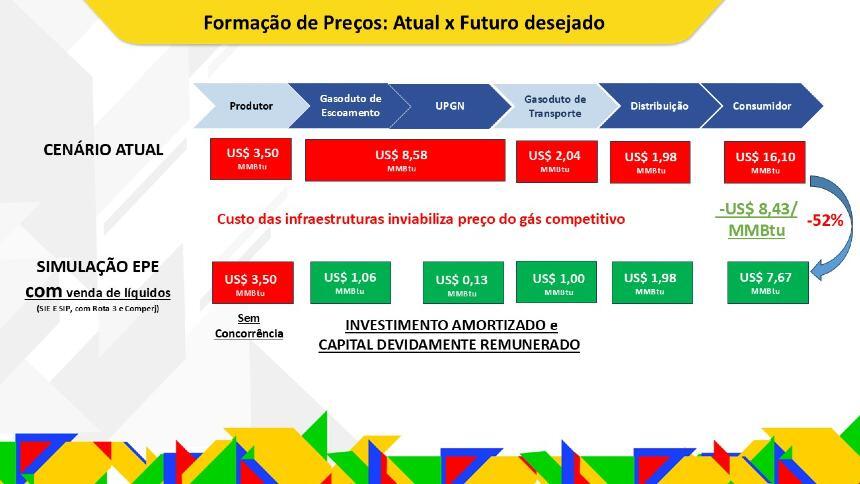
Belmonte cites a 2025 study by the Energy Research Company (EPE) which shows that the cost of natural gas in Brazil should be much lower. While the price at the wellhead is estimated at around US$3.5 per million BTU, the cost charged by Petrobras for transportation and processing, calculated via netback, reaches US$8.5.
According to the spokesperson for the Gas Forum, a new investment in this same infrastructure, depreciated over 20 years, would cost only between US$1.18 and US$1.20. This difference of approximately US$7.38 per million BTU generates an extra profit for Petrobras of around R$11 billion per year, without any additional effort.
To unlock the market, he cites proposals from the productive sector that depends on natural gas. The main one is the effective regulation of access to and cost of transportation and processing infrastructure, guaranteeing fair tariffs. Furthermore, he states, it is crucial to conclude the tariff review of transportation pipelines so that Petrobras is not the sole controller of capacity.
“Another essential measure is the implementation of gas release, a mechanism that would oblige Petrobras to release into the market the volumes of gas it holds through contracts, allowing for fairer and more competitive pricing,” Belmonte adds. “Despite the expectation of strong resistance from Petrobras, the productive sector is determined not to remain silent and to fight for its competitiveness.”
Competitiveness
Marcos Lopomo, economic and regulatory director of Abegás – an entity that represents natural gas and piped biomethane distribution companies – sees the ANP's decisions as a necessary step aimed at non-discriminatory and negotiated access to essential infrastructure.
"The goal is to ensure that PPSA, as the Union's representative, can market the gas that belongs to the State and bring transparency and clarity to the issue in order to increase competitiveness and the supply of gas in the market, based on previous studies by EPE, which already indicated price disparities," he states.
Lopomo acknowledges that Petrobras is still a dominant player with significant market power. But he emphasizes that the crucial point is to increase the availability of gas.
“Currently, a significant amount of extracted gas is reinjected to optimize oil production, instead of being offered to the market,” he states. “The suggestion is that Petrobras rethink this practice and make more gas available to the domestic market, which today suffers from prices tied to the international market.”
Contacted for comment, Petrobras did not respond to a request for a statement regarding the decisions of the ANP's board of directors.