


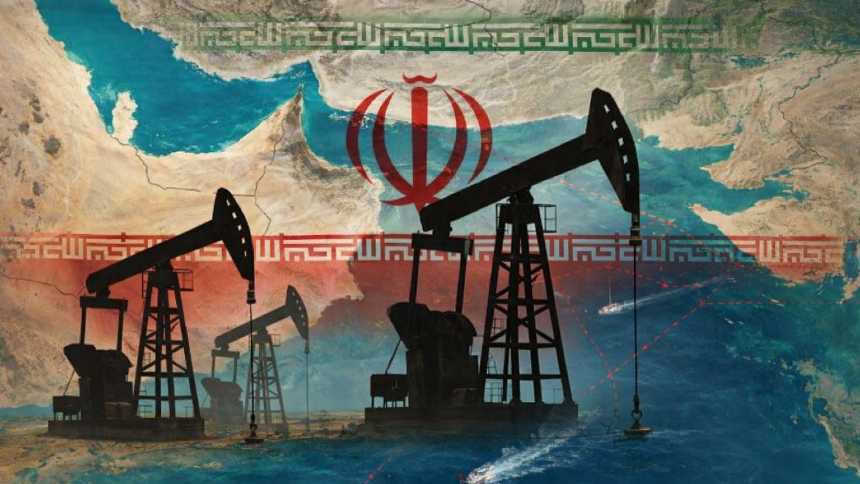
The hope for a return to normalcy in global oil prices lasted three weeks after the reopening of the Strait of Hormuz , a result of the provisional ceasefire signed last month between the United States and Iran.
Wall Street's main indexes fell on Wednesday, July 8, after an irate Donald Trump declared, at the opening of the NATO meeting in Ankara, Turkey, that an interim agreement to end the war with Iran was "over."
Behind the latest twist in the provisional ceasefire between the United States and Iran lies the uncertainty surrounding the full opening of the Strait of Hormuz, which is hindering progress on other aspects of a potential peace agreement between the two countries.
The virulence of the American president in referring to Iranian leaders, calling them "scum" and "sick people" and promising a series of attacks on Iran, surprised European leaders who were following his speech.
Later, in a conversation with journalists, Trump reiterated his withdrawal from the interim agreement: "As far as I'm concerned, it's over."
The threat of further military action emerged after renewed mutual attacks on Tuesday, January 7th. The US Central Command stated it had struck more than 80 targets in Iran and taken measures to block the country's legal oil sales in response to Iranian attacks on ships near the Strait of Hormuz.
Iran's Islamic Revolutionary Guard Corps said its forces responded with missile and drone strikes in the early hours of Wednesday, targeting 85 US military installations in the Middle East.
With the conflict resuming at full speed, Brent crude oil futures surged well above pre-war levels, reaching $80 a barrel after an 8% increase mid-session, interrupting a consistent decline in the price of a barrel over the past two weeks, which had hovered around $60. At the close, Brent crude was up 5.20%, quoted at $78.02 a barrel.
US stocks were down on Wednesday, with the Dow Jones index falling about 700 points, or 1.4%. The Nasdaq and S&P 500 indices declined by about 0.7%. At the close, the Dow Jones was down 1.09%, the S&P 500 fell 0.28%, and the Nasdaq rose 0.20%. In Brazil, after fluctuating between 169,972 and 172,018 points, the Ibovespa closed down 0.79%, at 170,653 points.
The new escalation of tension in the Middle East comes at a time when investors are already showing uncertainty about the sustainability of the US stock market rally. Technology stocks had already fallen on Tuesday, dragged down by a sell-off in technology and semiconductor stocks, while investors continue to assess whether the artificial intelligence boom has gone too far.
Nine of the 11 sectors in the benchmark S&P 500 index traded lower on Wednesday, with the exception of the energy and information technology indices.
The impact of renewed hostilities in the Middle East on technology stocks was only mitigated by Apple's announcement that it plans to spend more than $30 billion as part of a chip supply agreement signed earlier this week with manufacturer Broadcom, which saw its shares rise by 3%.
End of the honeymoon
The renewed tension in the Middle East, with Trump's threats of new bombings against Iran, has left investors worried.
“The honeymoon phase is over,” Dan Pickering, chief investment officer at Pickering Energy Partners, a Houston-based financial services firm, told The New York Times . “We are being reminded that this is still an ongoing conflict.”
Approximately 570 vessels have crossed the Strait of Hormuz since the memorandum of understanding was signed in June, of which almost three-quarters were departing from the Persian Gulf, according to Lloyd's List Intelligence. More than 150 of these crossings were by oil tankers, raising expectations of a return to normalcy.
Under the terms of the memorandum of understanding signed last month, Iran agreed to allow ships to pass through the strait free of charge during a 60-day extension of the April 8 ceasefire. In exchange, the U.S. would lift the naval blockade of Iranian ports.
Iran also promised to remove mines from the strait within 30 days, and traffic should gradually return to pre-war levels. As a financial incentive, the US granted the Iranian regime an exemption to sell its crude oil and refined products in dollars.
However, Iran later stated that it would impose "service fees" in the future. In other words, the provisional ceasefire was born threatened at its most sensitive point – the status of the Strait of Hormuz.
This became clear with Iran's insistence that ships use a route through the strait close to its coast, in order to monitor traffic on the waterway – through which about a fifth of the world's oil and liquefied natural gas passed before the war.
The US, however, encouraged the ships to transit close to the coast of Oman, whose territorial waters cross the canal. This allowed American warplanes to provide air cover to the ships from the end of May.
The emergence of the alternative route frustrated the Iranian government – and this impasse, now resumed, explains the new tension.
“Iran does not want to relinquish its influence over the strait — its weapon of mass disruption — before a broader agreement is reached on US economic aid,” said Ellie Geranmayeh of the European Council on Foreign Relations.
“For Trump, the reopening of the strait is the central point of the memorandum of understanding — and without it, he will be under immense pressure from Republican hawks to resume the war with Iran,” she added, pointing out the obvious: the two sides should have reached a mutually acceptable protocol for the strait before signing the memorandum of understanding.
The standoff in the Strait of Hormuz was not the only reason to expose the American president's irritation at the NATO meeting. During the morning, Trump renewed his attacks on the alliance's European allies for refusing to support him in his attempt to take control of Greenland and for not providing military support to the US during the operation against Iran.
In the afternoon, after being informed of the negative reaction from the stock markets, Trump changed his tone. He stated that the NATO summit was "very successful" and that there was "a lot of unity" among those present.
After a meeting with Ukrainian President Volodymyr Zelensky, Trump surprised reporters by stating that he supported Ukraine's attacks on targets in Russian territory, describing them as an escalation that could help end the war.
Trump praised Ukraine's bravery, signaled he would consider granting Zelensky a license to produce U.S. Patriot missile interceptors, and said he would consider traveling to Kyiv at the appropriate time for peace negotiations. The comments represent his strongest praise yet for Ukraine's military strategy.
But for US investors, a definitive resolution to the conflict with Iran is a higher priority than Trump's appeasement of Zelensky.
“The million-dollar question is whether Trump’s new threats to Iran mark a complete collapse in negotiations and a return to hostilities, or just a temporary setback,” said Matthew Ryan, head of market strategy at Ebury, a global fintech company specializing in international payments and foreign exchange, controlled by the Santander group.