

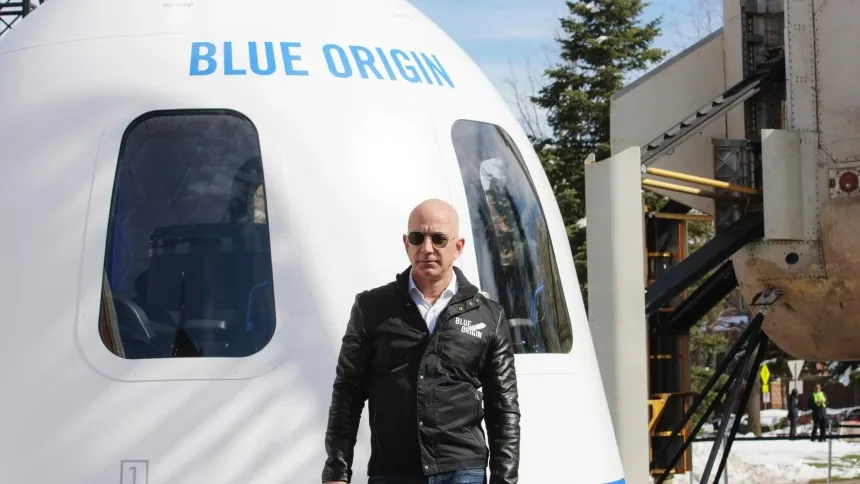
Blue Origin , the spaceflight company founded by Jeff Bezos , is close to completing its first external funding round in its 25-year history. The investment round aims to raise US$10 billion, with a pre-money valuation estimated at around US$130 billion, according to information from the New York Times ' DealBook newsletter.
Until now, the company had been financed exclusively by Bezos himself, who now plans to invest US$2 billion in the operation. The Coatue Management fund is expected to lead the round with a commitment of US$4 billion, while another US$4 billion should come from large institutional investors.
The funding round comes amid an increasingly fierce space race , driven, in the company's case, by demand for projects such as the TeraWave satellite communications network, launched in January and designed to connect up to 100,000 priority customers, such as data centers.
Blue Origin's initiative competes directly with Starlink , from SpaceX , Elon Musk 's company, which recently conducted an initial public offering on Nasdaq, registering the largest IPO in history and attracting even more investor attention to this market.
After the initial euphoria, when shares rose nearly 50% in the first few days, prices returned to near IPO levels, with the company valued at around US$2 trillion – 15 times more than the valuation sought by Blue Origin. Since 2023, SpaceX has been valued at over US$150 billion .
However, the rivalry between Bezos and Musk goes beyond satellite internet. In 2021, NASA chose SpaceX to develop the first crewed landing module for the Artemis program, in a contract worth US$2.9 billion. Blue Origin challenged the decision in administrative bodies and in the American courts, but failed to overturn it.
Two years later, Bezos' company won a $3.4 billion contract to act as a second supplier of lunar modules to the American space agency. Since then, the two companies have also been competing in orbital launches, missions to the Moon, and contracts with the American government.
The numbers still show some advantage for Musk's company, however. In 2025, SpaceX will have completed 165 orbital launches—most of them with the Falcon 9—while Blue Origin has only carried out two New Glenn flights .
The disparity between the companies widened even further in May of this year, when the New Glenn rocket exploded during a static launch test at Launch Complex 36 in Cape Canaveral, Blue Origin's only operational launch site. According to industry sources cited by Ars Technica, reconstruction could take more than a year.
Despite the incident, investor interest remains focused on the company's long-term prospects. Bezos stated in an interview with CNBC that Blue Origin finally has "enough visibility into its future and financial success" to attract outside investors.
Analysts estimate that Blue Origin could spend nearly $5 billion this year alone, bringing its total investment since its founding to approximately $28 billion.
The influx of external capital could alleviate Bezos' need to finance the company by selling his shares in Amazon, the company he founded.
With this funding round, Blue Origin establishes a valuation that can serve as a basis for future negotiations and expands the financing possibilities for its ambitious projects.
The new funding round will give Blue Origin more resources to resume New Glenn flights, advance development of the Blue Moon lunar module, and expand TeraWave — three projects considered essential to closing the gap with SpaceX.