

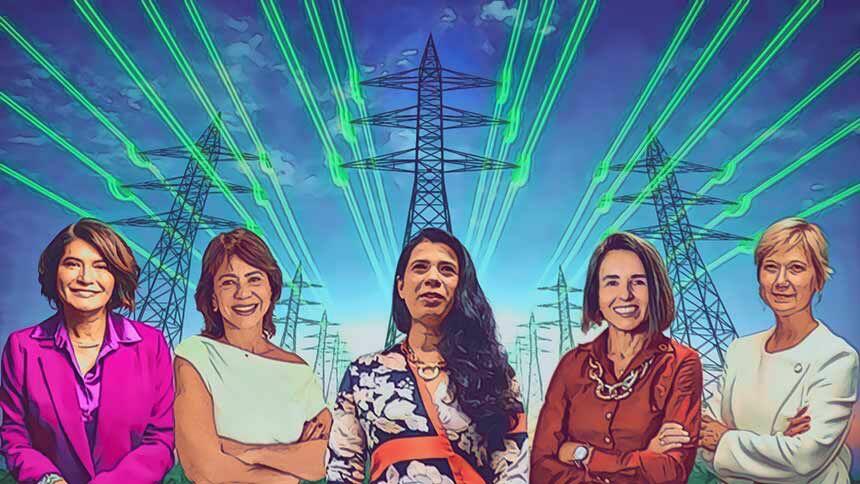
Brasilia — A movement of female executives in top leadership positions has been drawing attention in the electricity sector : through various groups (WhatsApp or meetings) and coordinated and organized action, they already preside over eight of the largest entities in the segment in Brazil — occupying a total of 12 leadership positions, including director and vice-president.
From the perspective of the energy sector, women are now finding a favorable environment for executive positions in the sector, historically dominated by men, especially engineers. And they are increasingly demanding more space, both in the private and public sectors.
Currently, the following entities are led by women: Abeeólica (wind energy), Abrage (hydroelectric generation), Abradee (distributors), Abrate (transmission), Abragel (generation), Abiogás (biogas and biomethane), ABIHV (green hydrogen), and Adelat (energy distribution in Latin America). And this year alone, three new presidents have assumed this highest position.
They have been building a presence on the board of directors or executive presidency of the main associations in the energy sector. They also participate in the nomination of candidates for positions in public bodies such as Aneel ( Brazilian Electricity Regulatory Agency), the Ministry of Mines and Energy, technical advisory roles in the National Congress, etc.
In 2018, a movement called "Yes, They Exist" was created, which organizes lists with the names of women in the sector who are qualified to hold public office. This year, the group will deliver its third list to presidential candidates.
According to Agnes Costa, director of Aneel and one of the initiators of the project, there have always been women in the energy sector with the competence to hold leadership positions, but previously there was a certain fear among them to get involved in the cause.
“The sector itself now recognizes that women possess these skills, because before, nobody saw or talked about it,” Costa told NeoFeed . “Our greatest contribution was to bring this up for public discussion without people being afraid to address the issue,” she added, a career public manager who served as an economic advisor to ministries and energy agencies for 18 years.
According to Costa, the movement that gave rise to the lists also stemmed from a concern: a minister in the government of former President Michel Temer declared that there were no women in the ministry at the time due to a lack of competent personnel. This was further fueled after a course at Harvard on female leadership. But she cautions: “Not everything is rosy. In 30 years at Aneel, I am only the third woman on the board and, currently, the only one.”
In the private sector, one of the pioneers was Elbia Gannoum, CEO of Abeeólica for 15 years. Before that, she worked with former President Dilma Rousseff when the latter was Minister of Mines and Energy, and even led the Chamber of Electric Energy Commercialization (CCE).
She mentions that there is a WhatsApp group called "Women in Energy" that brings together more than 100 women from the electricity sector and promotes interaction and encourages female participation in private sector positions.
“It’s a support movement, a club. If we go to an event and there are only men, we criticize, we pressure them to include more women and, of course, because of their competence, not just because they are women,” Gannoum points out.
"We always discussed the lack of women in associations, and we felt the need to bring them into the presidency of these organizations. Today, these organizations have started to want women."
In 2026 alone, three new female executives assumed the presidency of three entities in the sector. With 30 years of experience in the energy field, being one of the founders of the Energy Research Company (EPE) and director of CCE and Abesolar, Talita Porto, executive president of Abrate, understands that this scenario of several female executives in the presidency of entities reflects a maturation of the sector.
“But these women had also held positions for many years and accumulated experience in the regulatory field that qualified them for these roles,” says Porto, who has been leading the association since February.
The executive is a clear example of the challenges that these new leaders in the sector are facing: after a period of investments of around R$ 90 billion made since 2023 through auctions, the transmission line segment will require another R$ 148 billion in the next decade.
Patrícia Audi, who chairs Abradee (electricity distributors), does not come from the electricity sector, but has extensive leadership experience in the financial sector (Santander) and also the public sector (INSS, CGU), in addition to the international area (ILO).
She believes that today the energy sector demands more of this executive profile, with connections in the National Congress, public authorities, and a focus on innovation and modernization of the sector, in addition to institutional relationships.
"A more executive and less technical profile. And all these women who have been occupying leadership positions in the [energy] sector have this profile," says Audi, who has been in the position for three months.
Women's groups in the energy sector have been advancing so much that there are now initiatives that encourage training, mentoring for leaders, and even advisory boards. This is the case with "Women in Biogas," a messaging group that brings together more than 300 professionals in this sector.
“Today we already have some movements to further promote the presence of women in the electricity sector. The market changes themselves, the energy transition, have ended up opening opportunities for multidisciplinary positions and these leadership roles,” analyzes Josiane Napolitano, executive president of Abiogás, a recently established entity in the sector.
“My role is to strengthen my sector so that it can scale up and grow,” she adds, noting that she has never experienced gender discrimination in the workplace, but acknowledges that she was once the only woman at the beginning of her career.