

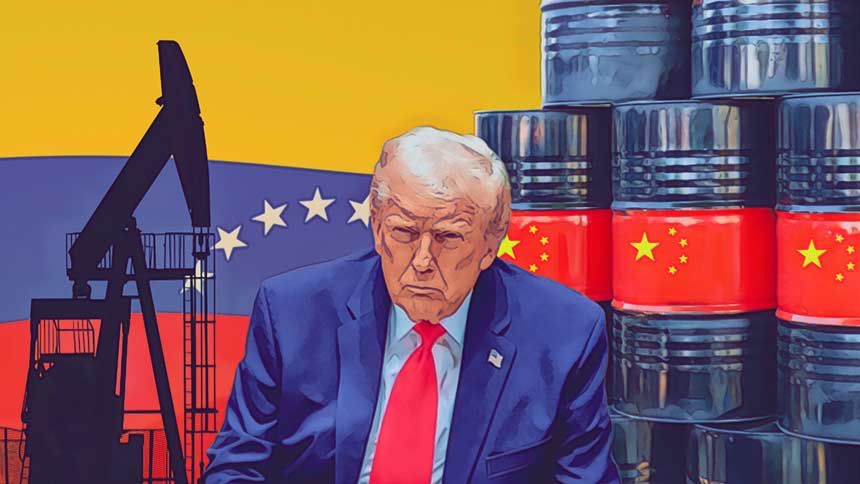
The cinematic US military operation in Venezuela in the early hours of Saturday, January 3rd, which ended with the capture of Venezuelan President Nicolás Maduro and his wife, Cilia Flores – removed from a military bunker where they were hiding and taken to the US – has already had at least two effects on global geopolitics.
One of them was to confirm the end of the world order that had been in place since the end of the Second World War, which established as central principles respect for the sovereignty of states and the peaceful resolution of conflicts.
Since taking office in April, President Donald Trump had been signaling his intention to dismantle this order. The imposition of protectionist import tariffs against several countries was his first act in this direction, a move that disrupted global trade, definitively relegating the World Trade Organization (WTO), one of the symbols of respect for rules among nations, to oblivion.
On another front, Trump threatened to annex Canada as the 51st American state, retake control of the Panama Canal, and invade Greenland to exploit its critical minerals, among other bravado, in clear disregard for the autonomy of nations guaranteed after the creation of the UN in 1948.
The second effect of the military offensive in Venezuela was that Trump officially inaugurated a new era, which began to emerge last month with the announcement of the new US national security strategy by the American president.
Among other topics, the document reinforces US hegemony in the Western Hemisphere. In practice, the new strategy revives elements of the Monroe Doctrine – drafted in 1823 by then-President James Monroe, according to which the Western Hemisphere is the US sphere of influence – by advocating American primacy in the region and containing the influence of external powers, especially China and Russia.
In explaining the US action against Maduro during a press conference on Saturday, May 3rd, Trump provided more details about this new era. At no point did he promise to restore democracy in Venezuela, saying that the US would "manage" the country until a supposed transition – but he ruled out handing power to the opposition political group, led by María Corina Machado.
But he repeatedly cited Venezuela's past expropriation of American oil assets and his plans to recover them: "We have tremendous energy in that country," he said. "We need it for ourselves."
The American president also described what he called the "Trump corollary to the Monroe Doctrine," which immediately became known as the "Donroe Doctrine." "The United States will never allow foreign powers to steal our people or drive us out of our own hemisphere," Trump said. "The future will be determined by the ability to protect the trade, territory, and resources that are essential to national security."
Mercantilist view
Judging by his actions since taking office, Trump's "Donroe Doctrine" does not fit into any known geopolitical, economic, or security strategy in modern US history.
The imposition of tariffs, for example, exposed Trump's mercantilist vision. His trade negotiations aim to extract maximum tariff revenue and investment commitments, with threats of extortionate tariffs in case of refusal, even from allied countries.
Trump also resorted to unorthodox strategies to interfere in the US private sector. Acting as a kind of CEO of the White House, he ordered the US government to acquire 10% of Intel 's shares, for which it paid US$8.9 billion, under the justification of "strengthening US leadership in semiconductors."
It also announced that the U.S. government would become the largest shareholder in MP Materials , the only rare earth mining company operating in the country, to ensure strategic control over essential minerals used in technology, chips, and defense.
Even bolder was his move to block Nippon Steel's purchase of US Steel. Trump only authorized the merger after imposing "national security conditions," including additional billions of dollars in investments by Nippon Steel in the US; maintaining jobs and operations for at least 10 years; and requiring the US to hold a golden share in the resulting company.
In his actions in Venezuela, Trump made clear his CEO-like governing style, outlining plans for American oil giants to control the country's oil infrastructure, which holds the world's largest reserves.
Victoria Murillo, director of the Institute for Latin American Studies at Columbia University, argues that Trump's actions in Venezuela only make sense if understood as an opportunity for American companies to gain access to Venezuelan oil. "There is no other justification for this intervention; it's old-fashioned imperialism in the economic sense," she says.
The suspicion sounds strange given the US oil reserves – which a few years ago made it the world's largest producer, with 14 million barrels per day, while Venezuela, at its peak, produced no more than 3 million barrels per day.
The fracking boom – the US shale oil industry that has changed the global oil market – has made supply more sensitive to prices. Producers can increase or decrease production much more quickly than during previous crises or recessions, which explains the low impact of American intervention in the oil market.
The Orinoco Belt, rich in heavy and viscous oil, for example, will require billions of dollars of American investment. Its only virtue, from the US perspective, is that the Gulf Coast refinery complex, built when the US was still a net importer of oil, is geared towards crude oil, not the light and sweet variety that gushes from the Texas shale oil wells.
“If US oil production in the Permian Basin stabilizes and demand for oil increases, there will be few places capable of supplying those barrels,” says Francisco Monaldi, a specialist in the Venezuelan oil industry at Rice University, referring to the southwestern region of the US, the country's most productive oil-producing region.
The target is China.
The threats made by the American president against Colombia, Greenland, and Iran – where the local government faces opposition protests – have suggested a supposed appetite on the part of the US president to revive the imperialist character of the "Monroe Doctrine," which gained traction during the administrations of Presidents William McKinley and Theodore Roosevelt, around the 1900s.
Inspired by other empires whose colonies provided raw materials, markets, and naval bases, they annexed Hawaii and seized Puerto Rico, the Philippines, and Guam from Spain; in addition to fomenting the secession of Panama from Colombia to allow the construction of the Panama Canal. John Coatsworth, a historian at Columbia University, counted at least 41 successful US interventions to change governments in Latin America between 1898 and 1994.
Trump knows that not even his ultraconservative base supports US military adventures abroad. In fact, unparalleled American military might would be a kind of silver bullet for the US to contain its biggest adversary at the moment: China.
The irony is that, for the first time since 1978, when China opened its economy, the Chinese strategy of conquering markets worldwide is at risk because of the "Donroe Doctrine".
This strategy was described in the last decade by the Indian thinker Parag Khanna as "functional," where the relationship between nations was no longer mediated by supranational entities, such as the UN, but rather through supply chains and infrastructure that connect countries.
“In approaching other countries, China is not seeking to impose political control, but rather to expand infrastructure to increase the trade on which it depends, whether to import raw materials or to export products,” Khanna wrote.
The Indian thinker draws a parallel between present-day China and 17th-century Holland, which adopted a strategy of commercial dominance through the East India Company, in contrast to the conquest of territories used by colonial powers of the time, such as Portugal and Spain.
The prime example of this commercial dominance is the Belt and Road Initiative , a global megaproject of infrastructure and economic integration launched by China in 2013, with the goal of connecting Asia, Europe, Africa, and parts of Latin America through land corridors and sea routes. Of the 143 countries participating in the program, 22 are from Latin America.
For the White House, the "Donroe Doctrine" is incompatible with Chinese economic power in the region – the Asian country being the largest trading partner of Brazil, Chile, Venezuela, and Peru. In this sense, the American military action that deposed Maduro was a severe blow to Xi Jinping's government.
Since 2007, China has invested approximately US$67 billion in Venezuela, primarily in the energy sector, with about 90% of Venezuelan oil exports destined for China by the end of 2025. In August 2025, a few months before the US attack, a Chinese company signed a US$1 billion, 20-year agreement to develop Venezuelan oil fields.
As China launches its 15th Five-Year Plan (2026-2030), this vulnerability becomes strategically consequential. Latin America occupies a prominent place on the Chinese agenda, with its December 2025 Policy Paper explicitly designating the region as central to the expansion of the Belt and Road Initiative and the Global Development Initiative.
Since the US withdrawal from Afghanistan, the Chinese government had operated on the premise that regime change was no longer part of American strategy. The US attack on Venezuela shattered this assumption and will force the Asian country to reformulate its strategy for Latin America, possibly prioritizing industrial hubs in Brazil and Chile.