



President Luiz Inácio Lula da Silva's recent decision to revoke a decree that included three waterways in the Amazon in the National Privatization Program (PND) has prevented – at least for now – the integration of the last major transportation mode in the infrastructure sector into the current government's concessions policy.
The announcement, following pressure from indigenous leaders and the invasion of an area linked to the Cargill terminal in Santarém (PA), halted the progress of concessions for the Madeira, Tapajós, and Tocantins waterways. The haphazard way in which the episode was handled by the government did more than just jeopardize the General Plan for Waterway Concessions.
Prepared by the Ministry of Ports and Airports and the National Agency for Waterway Transportation (Antaq), the sector's regulatory agency, the plan foresees the concession of a total of six waterways, which should generate R$ 4 billion in direct investments. Four of these waterways are in the Amazon, and three, whose processes were progressing, ended up being suspended.
With this decision, the government ended up contradicting one of its priorities: to carry out the largest number of infrastructure concessions in a single administration in the country's history. In fact, there were 50 auctions between 2023 and 2025, representing 31% of all concessions made to the private sector in the last 30 years in the country.
“There was a strategic error by the government in issuing the decree including waterways in the privatization plan, which is different from the concession of waterway services, the model foreseen by the granting plan,” says Edeon Vaz , executive director of the Agency for Sustainable Development of Waterways and Export Corridors (Adecon), an entity that relies on waterways to transport agricultural production through the ports of the Northern Arc.
According to him, the decision ended up helping the discourse of NGOs and indigenous communities that the government was "privatizing" the Amazon rivers. "The government should continue conducting feasibility studies, prepare the concession tender, and, on the eve of the auction, issue the decree including the waterways in the National Privatization Program (PND), a formal measure."
Vaz sees a cascading political effect that tends to hinder the concessions of waterways in the Amazon. "With this, the government has opened a floodgate for indigenous entities and NGOs that are against infrastructure projects in the Amazon, threatening the progress of the Ferrogrão construction process – which depends on a decision from the Supreme Federal Court – and the works to remove the Pedral de São Lourenço rock formation on the Tapajós River," he warns.
The Pedral do Lourenço is a rocky stretch of the Tocantins River, located between the municipalities of Marabá and Itupiranga, in southeastern Pará. Construction work is underway following a court decision in Pará, but faces protests from riverside communities and challenges from the Federal Public Prosecutor's Office.
The director of Adecon says that the lack of awareness among the population of the Northern Region about the benefits of waterways also contributed to the paralysis of the concessions: "There was a lack of communication from the government to highlight the importance of waterways, especially in the Amazon, as it is the most ecological and economically efficient mode of transport."
Vaz reveals that the organization held an event in Porto Velho last year and says he was surprised by the lack of knowledge among local leaders about the Madeira Waterway concession. "They believed the tolls would be R$36, when the real value was R$0.86 per ton, and they didn't know that small users, such as riverside communities and passenger transport, would be exempt," he reveals.
Potential of waterways
Brazil has 42,000 kilometers of navigable waterways, of which approximately 19,000 kilometers are economically viable – meaning that ships and barges transport grains, liquid bulk and fuels; vehicles; fertilizers; containers and general cargo. The goal of the waterway concessions is to triple the capacity of economically viable rivers.
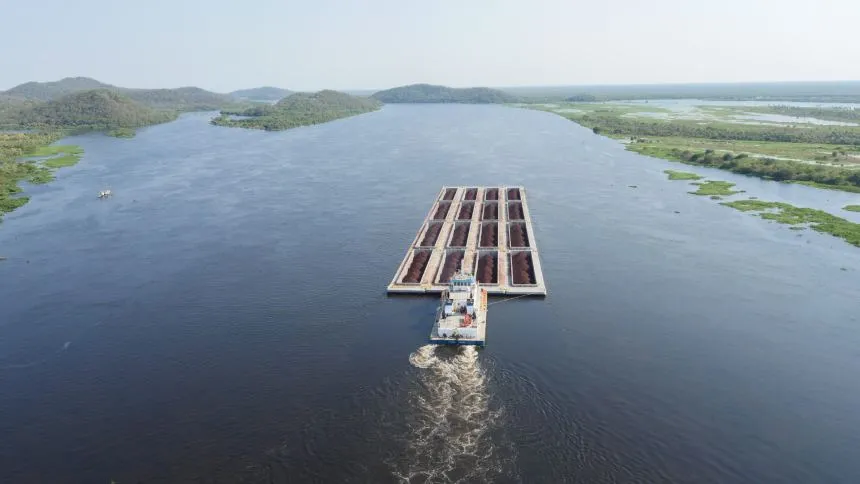
The potential represented by waterways is undeniable. Besides being a less polluting mode of transport than road and rail, it offers a significant advantage in terms of freight cost per ton transported. A barge carrying 1,500 tons of cargo, for example, transports the equivalent of 15 train wagons or takes 58 truck trailers, each weighing 26 tons, off the road.
The three waterways with suspended concessions are very long. The Madeira Waterway concession, from Porto Velho (RO) to its confluence with the Amazon River in Itacoatiara (AM), will cover a stretch of approximately 1,075 km. The Tocantins Waterway, from Belém (PA) to Peixe (TO), extends for 1,735 km. The Tapajós Waterway – from Itaituba (PA) to its confluence with the Amazon River in Santarém (PA) – is shorter, at 250 km. Concessions are also planned for the Barra Norte Waterway (Amazon River), the Paraguay River, and Lagoa Mirim.
A study by the National Agency for Waterway Transportation (Antaq), released in 2023, projected that the Tapajós Waterway alone could move 66.5 million tons by 2035, with the feasibility of improvements through the concession. In 2022, the volume transported was 11.9 million tons.
Vaz defends the concession model due to the operational limitations of DNIT, the agency within the Ministry of Transport responsible for maintaining and overseeing transport infrastructure. "The inability to guarantee continuous maintenance of waterways, such as dredging, creates instability and scares away investors," he warns.
According to him, the severe Amazonian summers lower the level of rivers, such as the Tapajós, even paralyzing navigation. With the river low, barges carry less, increasing freight costs. "This volatility harms the entire productive sector, which depends on the waterway to transport harvests."
Indigenous people from about 14 different ethnic groups occupied the facilities of the Cargill company in Santarém, in western Pará, for 36 days, in protest against a dredging tender.
“That was another mistake by the government,” says Vaz. “A specific tender for dredging, although well-intentioned, had a negative side effect: it was perceived as part of the concession, fueling the narrative of a lack of consultation and intensifying the conflict.”