

Greater diversification of investments outside the United States has set the tone in global markets, with currencies appreciating against the dollar and stock exchanges worldwide benefiting from the inflow of foreign capital. The continuation of this trend throughout the year is a bet for many investors, given the level of uncertainty surrounding the current administration of Donald Trump.
But with midterm elections scheduled for November 3, some of the country's top managers are monitoring how a potential change of power in the United States' legislative houses could alter the dynamics of global flows.
Luis Stuhlberger , manager and founding partner of Verde Asset , stated during his participation in the CEO Conference, an annual event of BTG Pactual , that the issue is something that concerns him. Although he admits he doesn't know for sure the consequences of a possible Democratic victory in the House and Senate, the trend is for the movement to lose intensity, without a major reversal of flows.
“It’s still worth maintaining a diversified portfolio. You can have currency, you can have stocks, you can have gold , emerging market stocks, Asian stocks. I think it’s still a positive thing and that this movement is far from over,” said Stuhlberger. “Once the toothpaste is out of the tube, it doesn’t go back in.”
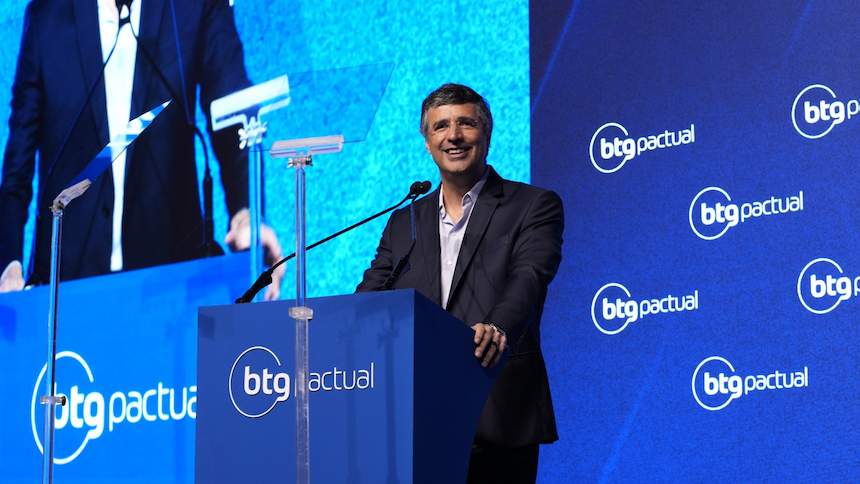
As usual, Stuhlberger shared the table with Rogério Xavier , manager and founding partner of SPX Capital , André Jakurski , manager and founding partner of JGP Capital, and André Esteves , chairman of BTG Pactual, who moderated the conversation.
Despite market bets pricing in a 38% chance of Trump's party losing the Senate, Esteves pointed out that "it's very difficult" for that to happen. However, should it occur, he predicts far more drastic consequences.
“I think it’s very easy for Trump to lose the House, but very difficult for him to lose the Senate. If he loses, then the scenario is completely different in the United States, because I think there will be an impeachment – and this time, with the capacity to execute it,” said Esteves. “Then it could turn into a mess of a different nature.”
According to Esteves, the greater diversification outside the United States had less to do with the fundamentals of the American economy than with geopolitical strategies.
“The Greenland story had a huge impact in Europe. If you are a Norwegian, Dutch or Danish pension fund, you are reducing your investment in the United States. It has nothing to do with the status of the American economy, it has to do with a certain geopolitical insecurity about who your allies are and who are not.”
With the local stock market booming since last year and uncertainty looming, Jakurski, the most experienced panelist, reiterated what he calls "rule number one." "The truth is this: in Brazil, rule number one is to ask yourself what foreigners are doing. Is the money coming in or going out? If the money is coming in, my friend, buy. That's the basic rule."
The thesis has been proven by the numbers. Without going too far back, in just the first few weeks of the year, the Ibovespa rose 15.46%, with foreign investors putting R$ 29.456 billion into the B3. This inflow already exceeds by 9.6% the total net foreign capital recorded in 2025, when the stock market rose 33.95%. Since last year, the accumulated increase is 54.7%.
“So, that’s what’s happening. And the truth is that financial markets don’t think about multiple variables at the same time. It’s one variable at a time,” said Jakurski. “Later, when we get closer to the election [in Brazil], then the market will worry about that. For now, it’s not even thinking about it.”
Elections in Brazil
Regarding the Brazilian elections, managers are less optimistic than before about a possible change of power. The consensus is still that the election will be divided, but that a re-election of a Workers' Party candidate would not cause an immediate downturn in the markets.
"Given that the scenario is 50-50, I don't think people will withdraw from the markets before knowing the election results," said Rogério Xavier.
"If we have this perception that there won't be a rupture on election day, that it will be a slow and safer death, we'll be able to see if, at the beginning of Lula's government, there will be any fiscal adjustment, something that will give some credibility boost to the new term."
For Xavier, fiscal adjustment would be the "normal" thing to do at the beginning of a government, given the current debt trajectory – although the story has been different in his current term.