


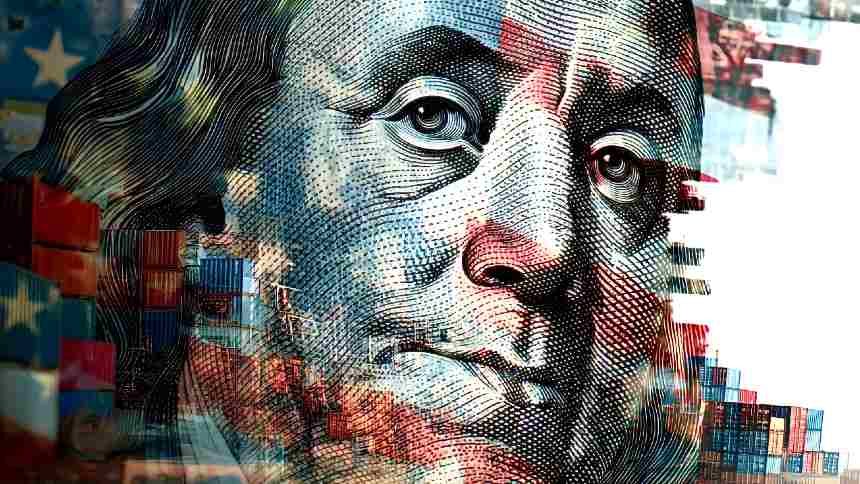
A series of surveys conducted by the US financial sector in recent days has confirmed a trend that had already been detected in the first months after the imposition of the import tariffs in April by President Donald Trump : most of the cost of the tariffs levied last year fell on American companies and consumers, and not on foreign exporters, as the White House had hoped.
A new report from the JP Morgan Chase Institute released this Thursday, February 19th, showed that tariff payments by mid-sized American companies tripled in the last year. A study released last week by the Federal Reserve Bank of New York had already reached a similar conclusion, finding that 90% of the cost of tariffs in 2025 fell on American businesses and consumers.
Other surveys, conducted in the beginning of the second half of 2025, concluded that American importers were bearing the brunt of the tariff increases, but the expectation at the time was that, as new orders were placed, foreign exporters would begin to share the cost.
The JP Morgan study was released on the same day that the Commerce Department announced that imports to the U.S. will hit a record high in 2025, leaving the trade deficit virtually unchanged, despite the high tariffs imposed by the Trump administration aimed at reducing trade disparities.
Overall, last year, tariffs did little to deter Americans from importing—goods and services purchased from abroad remained virtually unchanged from levels seen during the Biden administration.
The release of figures on the tariff bill and the Commerce Department's balance sheet comes on the eve of the Supreme Court's official ruling on the legality of Trump's tariff hike, which could generate negative political repercussions for the administration at a time when the White House is entering an election campaign, aiming for this year's midterm elections.
The JP Morgan study showed that mid-sized companies — which do not have the same power of influence as large companies to dictate the rules and alter supply chains — continued buying foreign products in 2025, even with tariff payments increasing to as high as 316% of pre-election levels.
“This is a major shift in the cost of doing business internationally,” said Chi Mac, executive director of the JP Morgan Chase Institute and one of the report's authors.
The White House has consistently insisted that foreign companies will "absorb" the cost of the tariffs. And it has pointed to recent macroeconomic data showing that, despite the tariffs, inflation has not risen in recent months and US growth has accelerated as proof that concerns about domestic repercussions are exaggerated.
But a growing body of evidence — including studies from the Kiel Institute in Germany and the National Office for Economic Research (NBER) — suggests that they are having a significant impact on Americans, affecting businesses of all sizes.
Research from the National Small Business Association (NSBA) suggests that even small businesses, which are not as directly exposed to imports, are feeling the impact of tariffs. “There’s a lack of stability, no predictability, when it comes to economic policy,” said Molly Brogan, vice president of public affairs at the NSBA. “These ups and downs, these fluctuations, are common.”
More taxes, fewer votes.
When announcing the tariff increase last year, Trump said the goal was to force the repatriation of industrial production and rebalance a trade deficit that he considers unfair to the US.
In practice, the measures have boosted the federal government's coffers, raising $30 billion in January and $124 billion in the fiscal year to date — more than 300% more than in the same period of 2025.
For the Trump administration, the fact that the U.S. imported a record amount of goods in 2025 proves that tariffs did not impact the domestic market as much as reports suggest.
According to the Department of Commerce, the country's trade deficit — the difference between imports and exports of goods and services — was $901.5 billion last year, slightly lower than the $903.5 billion deficit recorded in 2024.
Overall, imports last year totaled $4.334 trillion, an increase of about 5% compared to the previous record of $4.136 trillion in 2024. Exports totaled $3.432 trillion, an increase of about 6% compared to the previous year.
A separate survey, published this week by the Council on Foreign Relations and Morning Consult, however, found that about two-thirds of respondents believe the tariffs have made everyday items less affordable, exacerbating the cost-of-living crisis that has become the president's biggest election problem.
Democrats have sought to exploit the fallout from the tariffs and capitalize on discontent among Republican lawmakers. Last week, the House of Representatives voted to repeal the tariffs imposed by Trump on Canada and rejected a motion that would have blocked similar measures in the future, with several Republicans breaking with party discipline.
The fear of a negative impact should the Supreme Court declare the tariffs illegal has led government officials to criticize recent surveys on the impact of the tariff hike on the domestic economy.
Kevin Hassett , Trump's economic advisor, called the study by researchers at the New York Fed – which found that American consumers and businesses bore about 90% of the cost of tariffs last year – "a disgrace" and said its authors should be "disciplined."
Analysts consider Hassett's attack on the New York Fed report a way to divert attention from what matters. "I think the study's conclusions are consistent with what standard economic analysis suggests," said Michael Strain, an economist at the conservative American Enterprise Institute. "I trust the Fed's research; in fact, I arrived at the same result."
In fact, alarm bells have been ringing in the White House. According to an average of polls by Real Clear Politics, Trump's overall approval rating has fallen from 50.5% when he took office to a low of 42.1% this week.