


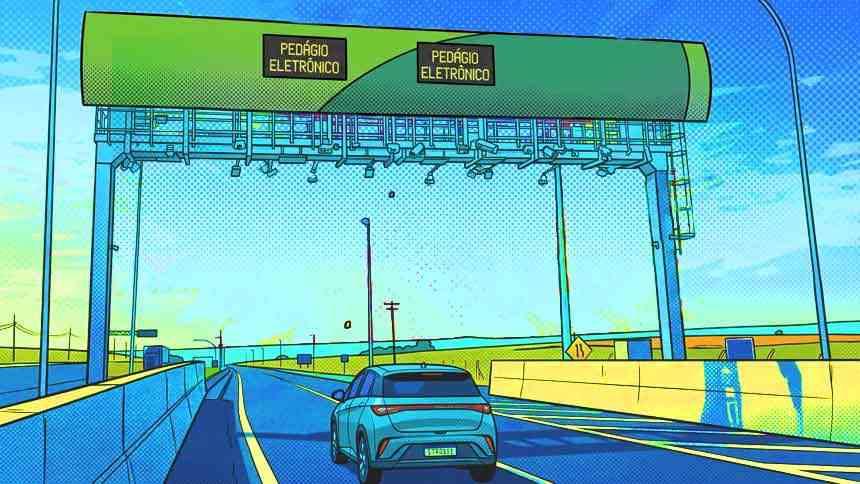
A technical failure at the National Traffic Secretariat (Senatran), an agency of the Ministry of Transport, helped to trigger a new crisis surrounding free flow – the electronic toll system without booths or barriers, which emerged in 2023, in which the driver passes through a gantry installed on the highway without needing to reduce speed, automatically registering the toll amount.
The delay by Senatran in complying with Contran Resolution No. 1,013/2024, published on June 12, 2025 - which mandates the homologation and unification of toll collection systems by concessionaires within 180 days before the start of gantry operation on a free-flow highway - ended up generating a 93% default rate on fines collected for non-payment of tolls via app.
Between 2023 and the beginning of 2026, more than 3.1 million fines were issued for late payment of free flow fees, of which only 210,000 were paid (7%). The remaining 93% generated R$ 563 million in fines for toll evasion.
The losses from not collecting fines until December will fall on ANTT, the agency within the Ministry of Transport responsible for issuing the fines. The concessionaires also lose out, as they only receive the unpaid toll.
The problem generated a ripple effect, as many drivers were not notified of the toll evasion fine. Therefore, the government is considering suspending the collection of fines (and the loss of five points on the National Driver's License, CNH) until December 30th of this year.
However, the user will need to settle any outstanding toll payments – those who pay the amount by the end of this year, regardless of when they were fined, should be exempt from the R$ 195.23 fine and the loss of points on their driver's license.
Although many drivers use tags like Sem Parar and ConectCar, valid for regular and free-flow tolls, the lack of a unified system that reports all due tolls—a responsibility that should be fulfilled by Senatran—is cited as the cause of non-payment. The tag, a sticker with a barcode on the vehicle, automatically debits the toll from the concessionaire's bill.
In a statement to NeoFeed , ABCR , the entity that brings together highway concessionaires, adopted a cautious approach: "It is necessary to await the official publication to assess details and impacts." The entity emphasizes that the suspension does not mean forgiveness of the toll: the user must pay the overdue toll and will only have fines and points canceled if the amount is paid by December.
Novel
The delay by Senatran is yet another controversy surrounding free flow, considered an advancement for speeding up travel, reducing vehicle consumption and costs for dealerships, but which has become a problem for companies and inattentive drivers.
Each toll road under concession that adopts the system runs campaigns explaining payment via apps — drivers have up to 30 days to pay the toll — and the default rate, initially high due to lack of information, usually drops to 4% within a few months.
With the expansion of toll gates last year, the Federal Public Prosecutor's Office challenged fines for evasion, and Congress is debating Bill 3.262/2024, by Representative Hugo Leal (PSD-RJ), which proposes removing fines during the testing period.
The issue also became a political dispute: the installation of 13 toll gantries announced by the São Paulo state government on the Sorocabana Route — which encompasses 12 highways in 17 municipalities, covering a stretch of 450 km — generated a reaction from mayors and led Governor Tarcísio de Freitas to reduce the number to nine. Currently operating under the free-flow model are the concessionaires Motiva RioSP, EcoNoroeste, Caminho das Serras Gaúchas, and EPR Sul de Minas.
The Ministry of Transport justified the delay by Senatran (National Traffic Secretariat) stating that the data transmission module is technically complete. "However, necessary adjustments to the interoperability architecture were identified to ensure compatibility with the solutions used by the concessionaires," the statement said.
A regulatory alternative is being studied to extend the homologation period until December 2026, through a resolution by Contran (National Traffic Council). The proposal is still under internal review and awaits a statement from the Legal Department.
According to the ministry, the measure should create a transitional rule, suspending fines already applied if the user pays the outstanding tolls. "It is important to emphasize that this is not a forgiveness of the toll, but only a guarantee of a new opportunity to pay the toll before the fine is applied," the statement emphasizes.
Legal uncertainty
Experts interviewed by NeoFeed pointed out some effects of suspending the fines.
“Depending on the contract model, forgiveness can encourage default and reduce the guarantee against demand risk, since this point was structured in several highway concession projects by building a guarantee buffer created from fines applied to drivers,” says Fernando Gallacci, infrastructure partner at the law firm SouzaOkawa Advogados.
Another expert, Felipe Kfuri, a partner at the law firm LO Baptista Advogados, warns that, since the fine for evasion is stipulated by law, the Public Administration cannot simply fail to apply it through an administrative act. "A broad suspension tends to require legislative change or an act with the force of law, such as a provisional measure; otherwise, it may violate the principle of legality," he says.
The strain on the free-flow model is evident. Beyond the legal uncertainty generated by the initial pressure from the Federal Public Prosecutor's Office and the populism of mayors opposed to toll gates near city entrances, electronic tolling is now causing losses to the government and concessionaires.
The R$562 million already collected is expected to grow exponentially by December. And the Ministry of Transport is still evaluating possible restrictions under electoral law regarding the suspension of fines, since the measure could be interpreted as a tax benefit for citizens.