

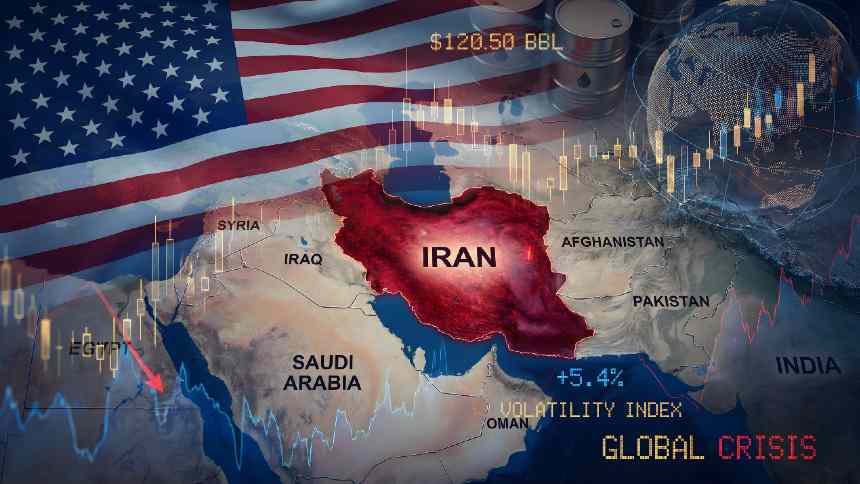
Miami - With the start of the third week of the conflict between the United States and Iran, the closure of the Strait of Hormuz, and calculations regarding the pressure on oil and natural gas prices, the clock seems to be ticking in favor of only one side.
“The world is racing against the clock. If [the conflict] continues into April, it’s a different game,” says economist Paulo Leme, chairman of the global allocation committee at XP Private Banking.
According to Leme, the market cannot underestimate the "time" variable. What is seen today as a passing peak could become a structural headache.
“What was initially thought to be a temporary spike in oil prices is becoming something that will cause problems and could affect inflation and GDP globally. And all asset classes will have to be repriced,” he added during the first edition of the XP Global Conference.
Leme's main concern is precisely the geographical aspect of the Strait of Hormuz, through which 20 million barrels of oil pass daily. In the economist's view, there is no infrastructure in the world capable of replacing that volume if the blockade persists.
"You can't replace the 20 million," he said, explaining that the prolonged crisis forces the closure of old wells that may never be reactivated.
The political landscape is also asymmetrical, especially on the American side. While Donald Trump races against the clock in the elections and his popularity – which Leme describes as "market-driven" by gasoline prices – the Iranian leadership plays a game of attrition, buying time in the "caves" while the Western economy bleeds.
Conflict Management

Leme outlined what he calls the "red scenario." According to him, the probability of a prolonged crisis is shifting dangerously to the right of the curve.
In this context, active management ceases to be a pursuit of extra gains and becomes a survival tool. In other words, for every positive alpha, there will be a tracking error during periods of high volatility.
If the stagflation or recession scenario is confirmed, Leme's guidelines for allocators are to reduce beta, resulting in lower systemic portfolio risk.
The increased probability of default should widen spreads , requiring caution in private fixed income as well. "Don't drown in micromanagement," he told an audience of fund managers and investment advisors.
For the managers, Leme spoke of his own experience and suggested that one cannot fall into the tendency to "invent" elaborate strategies under stress.
The secret is to keep a cool head and avoid the behavioral mistake of frantically churning your portfolio in search of market timing that's almost impossible to get right six times a year – even more so in an uncertain, conflict-ridden environment where each week a different asset class stands out as the hot one.
“The Brazilian client is very sensitive to the daily exchange rate, to the monthly market valuation,” said Leme. To weather the storm that may come from Hormuz, he believes the only “narrow passage” is portfolio diversification.