


Peru has experienced a contradiction over the past decade rarely seen in the turbulent recent history of Latin America. With the removal of interim president José Jerí for misconduct and unsuitability for the office, following a lightning-fast impeachment process, José Balcázar became the eighth president in ten years – four of whom are currently imprisoned.
The endless Peruvian political crisis, marked by corruption scandals, political polarization between the Executive and Legislative branches, and public distrust of politicians, does not, however, prevent the country's economy from following a trajectory of growth and stability that is the envy of neighboring countries. Peru's Gross Domestic Product (GDP) grew by 3.3% in 2025, and a further increase of 3.2% is projected for 2026.
From 2016 onwards, when the country began changing presidents at a breakneck pace, GDP maintained an average annual growth of 2.2%, despite the political chaos and the economic downturn of 11% in 2020 due to the pandemic.
Part of this contradiction is explained by the long period of economic stability experienced by the country, which predates the current political crisis. Since 1993, Peru's GDP has increased ninefold, with the economy registering growth in 30 of the last 33 years.
Peruvian macroeconomic stability is attributed to three factors, which were consolidated with the 1993 Constitution, approved during the government of Alberto Fujimori – the controversial right-wing leader who ruled the country in an authoritarian manner during the 1990s.
Despite Fujimori's troubled history—after winning the election, he staged a self-coup in 1992 and governed amidst allegations of corruption and human rights abuses until fleeing the country in 2000—the Constitution he approved in 1993 laid the groundwork for the subsequent economic growth, enabling a reduction in poverty levels in the country.
Article 62 of the Constitution, incidentally, is considered the first pillar of economic stability. It prevents contracts already signed from being modified by subsequent laws, which has a strong meaning in protecting foreign companies that invest in the country, thus guaranteeing that the conditions of their operations will not be altered.
According to some analysts, this allayed fears of the usual expropriations and nationalizations seen in other Latin American countries, allowing the country to attract large volumes of investment.
Another key point is found in Article 79, which stipulates that Congress does not have the power to create or increase public spending, something that had been decisively contributing to fiscal balance until the pandemic.
The Constitutional Court, however, approved two dangerous relaxations of the article in 2021 and 2022, opening the door for Congress to initiate spending, something that was previously clearly prohibited.
The other pillar of economic stability is the independence of the Central Reserve Bank of Peru (BCRP), the country's central bank, guaranteed by the 1993 Constitution.
“The independence that the 1993 Constitution gave to the BCRP allowed it to have a very technical and professional management, totally independent of the economic and political cycle,” says Carolina Trivelli, a researcher at the Institute of Peruvian Studies.
The BCRP's board of directors, composed of seven members elected by the government and Congress, operates completely independently. In a rare example of institutional continuity in Peru, director Julio Velarde – the chief executive of the Peruvian Central Bank – has been in office since 2006 and has served under governments of different political orientations, maintaining a focus on fiscal balance, inflation control, and the stability of the sol, the Peruvian currency.
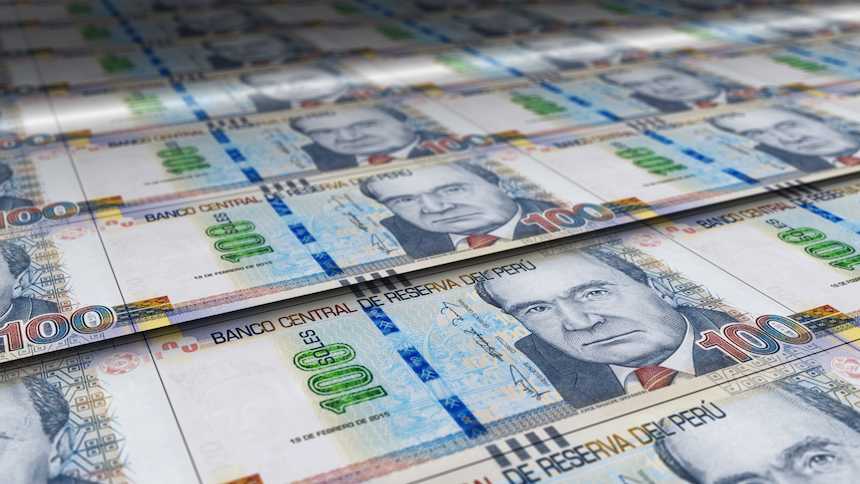
The monetary policy implemented by the BCRP (Central Bank of Peru) is considered the third pillar of Peruvian stability. Peru's exchange rate behavior is considered one of the least volatile in Latin America. The sol is one of the least volatile currencies against the dollar and rarely suffers sharp devaluations, thanks to the "dirty float" regime, in which the exchange rate fluctuates but with occasional interventions by the central bank—a model similar to that of Brazil.
The technical management of the BCRP (Central Bank of Peru) allowed Peru to end 2025 with US$89.7 billion in international reserves. This financial cushion helps explain why the country is among the least indebted in the region: its gross public debt is 33.7% of GDP, well below Argentina (84.65% of GDP) and Brazil (87.28% of GDP).
A series of embarrassing incidents
While the economy is doing well, Peruvian politics never ceases to be a disgrace. The swift fall of José Jerí exposed all the ills experienced by the country's political class in recent years. Jerí, only 39 years old, assumed the position on an interim basis in October to complete the remainder of the term of the last elected administration – which was ultimately ousted.
President Pedro Castillo , who took office in 2021, fell after a year and a half in office when he attempted a Fujimori-style self-coup, but was prevented by Congress. Castillo was arrested by police while trying to reach the Mexican Embassy and was eventually sentenced to 11 years in prison. His vice president and successor, the unpopular Dina Boluarte, was impeached and removed from office by parliamentarians amidst protests against corruption and a wave of violence linked to organized crime.
Jeri's policy of combating organized crime, incidentally, quickly raised his popularity to 60%, but allegations of corruption and his erratic governing style ruined everything.
The interim president faced up to seven motions of censure driven by the minority left-wing opposition and a bloc of right-wing parties seeking to remove him for "misconduct and lack of fitness" to hold office.
He was accused of holding unofficial meetings with Chinese businessmen, one of which triggered an investigation for influence peddling. He further tarnished his reputation by hiring seven young women for his government, in a selection process conducted in private nighttime meetings at the presidential palace.
His removal from office on Tuesday, the 17th, occurred by a simple majority in a motion of censure in the Peruvian Congress. There were 75 votes in favor, 24 against, and three abstentions. Unlike impeachment, which requires a supermajority of 87 votes in the 130-member legislature, a motion of censure requires a simple majority of 66 votes.
(Updated report with the name of the new interim president of Peru)