


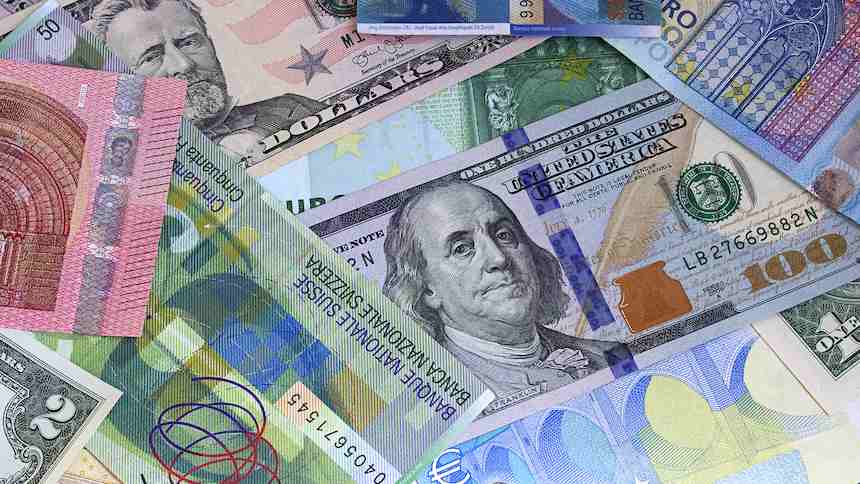
The increasing devaluation of the dollar , which this week hit a four-year low, is leading investors to seek refuge in countries with stable currencies. As a result, Switzerland has become the preferred destination in the global currency market.
The Swiss franc, the official currency of the Alpine country, registered its biggest appreciation against the dollar in the last decade on Wednesday, January 28th, accumulating a rise of over 3% this year alone.
Controversial statements by US President Donald Trump – who the day before, when asked if he thought the US currency had fallen too much, stated that the dollar's value was "great" – spurred a rush to the Swiss franc, which became the "last safe haven" for investors after theyen , another asset used as a refuge in complex market times, has shown strong volatility amid the continued sell-off of Japanese government bonds.
The positive – but not overwhelming – momentum follows an estimated 13% appreciation of the Swiss currency throughout 2025, which worries the Swiss National Bank (SNB), the central bank of the Alpine country, whose annual inflation rate is only 0.1%.
“The Swiss franc looks a bit like a gold nugget,” Daniel Kalt, head of investments for Switzerland at UBS Global Wealth Management, told the British newspaper Financial Times . “It doesn’t yield anything. But there’s an extremely solid economy behind it.”
According to Kalt, the market needs to observe the relationship between the franc and the euro, since a large portion of Swiss trade occurs with countries in the bloc. If the euro falls below 0.9 Swiss francs – compared to the current 0.918 – exporters could be placed under strong pressure, which would further complicate matters for the Swiss central bank.
In this situation, one of the options for the monetary authority would be to cut interest rates, currently at zero, to reduce the attractiveness of the currency. With the developments of the last few days, the market has begun to price in about a 10% chance of a 0.25 percentage point cut at its June meeting.
In the view of economists, however, a small cut would have little effect on the mission of reducing the difference between the Swiss currency and the eurozone, in addition to providing an undesirable stimulus to the economy.
The Swiss central bank had previously stated that it does not wish to resume its negative interest rate policy, which was maintained for eight years in the Alpine country.
Another alternative, which would involve direct intervention in the foreign exchange market, could also be problematic. Practiced during Trump's first term, this move led to Switzerland being accused of "currency manipulation" by a US watchdog.
This option would also go against an agreement made by the two countries last year, after the SNB carried out a minimal intervention in the second quarter, amid the volatility caused by the trade war. At the time, the United States and Switzerland issued a joint statement affirming that they would not intervene in currencies to gain a competitive advantage.
Creating a conflict with the United States is also not a good option, since, after months of struggle, Switzerland managed to reduce the import tariffs imposed by Trump from 39% to 15%.
Last week, Trump made it clear that he can be quite "spoiled" with his tariffs when he said, in his speech in Davos, that tariffs against Switzerland were increased to 39% because the then Swiss president, Karin Keller-Sutter, simply didn't please him.
Euro in sight
In the European Union , the situation is not very different. On Tuesday the 27th, the eurozone currency reached its highest level in four years against the dollar, trading above US$1.19, triggering similar warnings about the potential to put pressure on inflation.
“These moves represent a significant tightening of financial conditions in the eurozone, and the ECB will want to position itself against that,” said Tomasz Wieladek, chief European macroeconomic strategist at asset manager T Rowe Price.
The recent devaluation of the dollar stems from multiple factors: expectations of continued interest rate cuts by the Federal Reserve, uncertainty regarding tariffs, policy volatility, including threats to the Fed's independence, and growing fiscal deficits, factors that have eroded investor confidence in the economic stability of the US.
A weaker dollar may even benefit American exporters, although Trump has said he was not seeking a further drop in its value.
"I wish it would... simply find its own equilibrium," he said on Tuesday, the 27th, after stating that the dollar "is doing very well." Losses in the dollar index, which measures its strength against a basket of six major currencies, accelerated after Trump's comments, hitting a low of 95.566 and the lowest level since February 2022.