

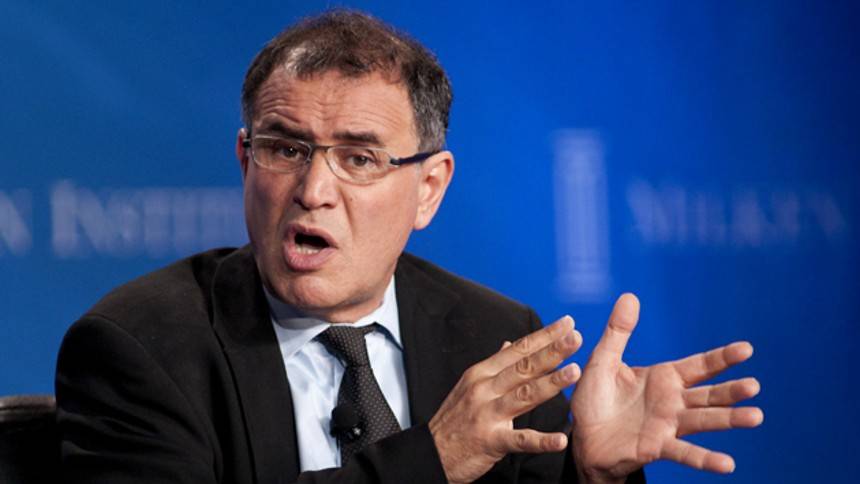
The world – and the markets – are hoping that the war between the United States and Israel against Iran will end as soon as possible, to put an end to the pressure on oil prices. But economist Nouriel Roubini believes that the situation will get worse before it gets better.
Against the backdrop of Donald Trump's threat to destroy Iran, the economist known as "Dr. Doom" calculates that the chance of the conflict escalating is around 75%, because Trump and the United States cannot emerge as losers in this war. The consequences would be very severe, both domestically and internationally.
“Now that they’ve started, stopping like this and allowing Iran to have a victory will be an economic, financial, and geopolitical disaster for Trump,” Roubini said on Tuesday, April 7, at the Brazil Investment Forum event, hosted by Bradesco BBI . “If Trump falters or chickens out now, things will get much worse.”
The first effect will be to grant Iran the ability to block the Strait of Hormuz whenever it wants, controlling the flow of oil and permanently imposing a premium on the price per barrel.
The second will be to encourage the Iranian regime to arm itself and acquire the resources to attack not only Israel , but also its neighbors in the Middle East and Europe, as well as to cause the country to resume its pursuit of a nuclear bomb with greater emphasis.
Known for his pessimistic economic predictions, to the point of earning the nickname "Dr. Apocalypse," Roubini also stated that a defeat, even a symbolic one, would bury any possibility of Trump maintaining control of Congress in the elections scheduled for November.
In geopolitical terms, the United States would lose ground to China and Russia , and this would raise doubts about the Americans' ability to protect their allies. "It will be a total disaster for the credibility of the United States," said Roubini.
The economist assigns a 55% probability to the United States escalating and winning the war against Iran, assessing that Trump should try to financially suffocate Iran by seizing Kharg Island, through which 90% of the country's oil production passes, and the exit from the Strait, in addition to preparing to withstand Iranian missiles and drones.
“If they manage to regain control of the Strait of Hormuz, defeat the leadership and destroy strategic assets, and minimize damage to the old facilities in Kharg, within two months, a de facto regime collapse is possible,” Roubini said. “By regime collapse, I mean a situation where Iran is so weak that, in practice, it surrenders and accepts the conditions imposed by the United States.”
According to Roubini, this two-month period should not harm the global economy, although the initial market reaction is expected to be negative, with falling stock prices and rising oil prices.
“As long as this war continues and doesn’t last more than two or three months at most, there will be a slowdown in global growth, but not a recession in the United States or the world. There will be some increase in inflation, but we won’t reach double-digit inflation or a de-anchoring of inflation expectations. Therefore, it will be more like a recession with moderate growth. A light stagflation,” he stated.
Roubini also pointed out that the world is much more resilient than in 1970. Even though the war resulted in the worst oil shock in history, countries are becoming less and less dependent on oil, there are many more producers in the world, and cleaner energy sources are more prevalent.
Furthermore, the shock of the 1970s was preceded by fiscal deficits larger than the current ones, the end of the Bretton Woods system, and a misguided reaction from the authorities.
This scenario, however, depends on an American victory. In case of defeat, the 1970 scenario would become a reality, according to Roubini. “That’s a nightmare. You have a global recession, inflation close to double digits, negative inflation expectations, and the market could fall 20%, 30%, and we saw that sad reality in the 1970s,” he warned.