

The location and timing were perfect for US President Donald Trump to announce, on Wednesday, January 21st, the guidelines for what would, in practice, be a new world order – presented in a piecemeal fashion, amidst back-and-forth movements, in the image and likeness of its creator.
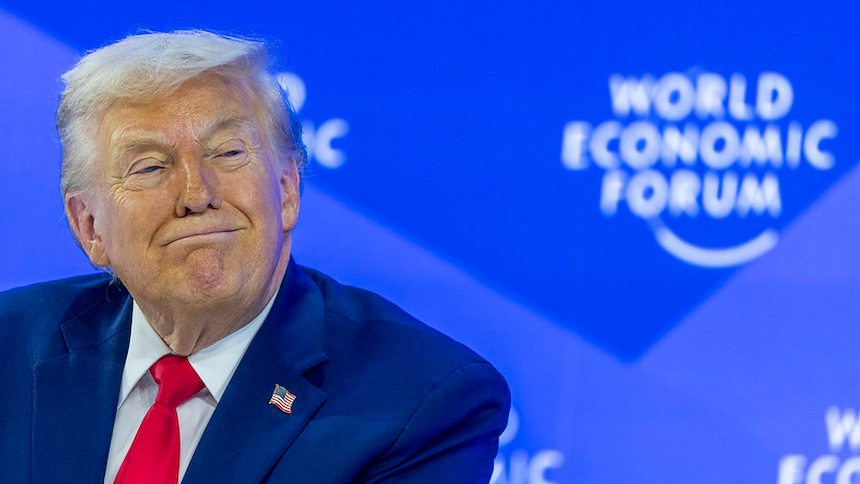
In a 71-minute speech at the 56th World Economic Forum in Davos, Switzerland, to a packed audience of business leaders, investors, and dozens of heads of state, Trump used the stage to review his first year in office, which had ended the previous day, and to reinforce the threats he had already been making to Europeans: the United States needs to annex Greenland for national security reasons.
The American president also defended his tariff policy, said that the world depends on the American economy, tried to downplay the importance of the North Atlantic Treaty Organization (NATO), and issued threats to European leaders. Between one statement and another, he made it clear that from now on he will use military power or the tariff bludgeon to reinforce American supremacy.
To cool expectations, he immediately ruled out military intervention in Greenland, "something that would frankly make us unstoppable," as he pointed out. "I don't want to use force. I'm not going to use force. All the US is asking for is a place called Greenland," he added, carefully choosing his words, before a visibly uncomfortable audience.
"You can say yes and we will be very grateful. Or you can say no and we will remember that," he added, getting the message across.
The American president struggled to present arguments justifying the need to seize Greenland, an Arctic island controlled by Denmark. But with each attempt, he found a way to belittle the European countries, which oppose the annexation and are due to decide on Thursday, the 22nd, how they will react.
First, Trump invoked the U.S. history in World War II as justification for his demand, recalling the Nazi invasion of Denmark and the subsequent American support. "Without us, you'd all be speaking German, or maybe a little Japanese," he said.
While elaborating on the subject, with a hint of irritation, the American president even confused Greenland with Iceland, stating that "Iceland" had caused a drop in stock prices on the American financial market on Tuesday the 20th, "which cost us a lot of money."
Addressing European leaders, Trump alternated words of respect for the Old Continent with aggressive remarks that left the audience stunned. First, he invoked his own European heritage, saying that his mother was from Scotland and his father from Germany.
“I love Europe and I want to see Europe prosper, but it’s not going in the right direction,” he stated, citing problems driven by what he defined as the largest wave of mass migration in human history. “Certain places in Europe are no longer even recognizable,” he lamented.
Trump mocked French President Emmanuel Macron , who the previous day gave a speech in Davos wearing aviator sunglasses due to an eye problem, and insulted the Swiss hosts, confirming that he imposed higher tariffs on Switzerland last year because of a phone call from the country's then-president, Karin Keller-Sutter , which he considered aggressive.
"She said, 'No, no, no, please, you can't do that,' repeating the same thing several times: 'We're a small country,'" Trump recounted, regarding the 30% tariff he had decreed. "And I got 39%," he said.
The American president reiterated that "tariffs are part of national security," justifying economic retaliation against countries that, according to him, "harm" the US.
Trump made references to Venezuela , stating that the new Venezuelan government will share oil revenue with the US. "Venezuela will generate more money in six months than in the last 20 years," he said, adding that countries that yield to US demands prosper, reinforcing his narrative of global strength and influence.
And it was clear that he will not tolerate resistance to his global leadership, reacting to the speech in Davos the previous day by Canadian Prime Minister Mark Carney , who had indirectly criticized the use of tariffs and economic coercion by major powers—a clear reference to the US—stating that "we are in the midst of a disruption, not a transition."
"Canada lives because of the United States," Trump said. "Remember that, Mark, the next time you make your statements."
New order
Part of Trump's speech in Davos was addressed to the American public, to whom he gave an overview of his first year in office.
Using catchy phrases, he said that the tariff increase reduced the US trade deficit by 77% and, thanks to cuts in public sector jobs and aggressive fiscal policies, decreased the federal budget deficit by 27%. And he celebrated the "virtually zero inflation".
“We ended the stagflation of the Biden administration,” he exaggerated. “Before, we were a dead country, now we are the most talked-about country in the world.”
The day before, to celebrate his first year in office, Trump had already delivered his longest speech since taking office at the White House, in which he aired old grievances, attacked imaginary enemies, and threatened allies during a 1 hour and 45 minute address. "I think God is very proud of the job I've done," he even stated.
As The New York Times summarized, the great truth of Trump's second term so far is that nobody has any idea what tomorrow holds.
For now, domestically, Trump has undermined the rule of law, fiscal stability, the independence of the Federal Reserve (and therefore monetary and financial stability), and the commitment to science. He has persecuted immigrants, sent troops to police Democratic cities, and turned Congress into a subservient power.
Internationally, the US is waging a war against almost all multilateral institutions, most notably the European Union. The World Trade Organization (WTO) has become irrelevant. Cooperation on climate and health issues has been revoked. In total, the government has announced its decision to withdraw from 66 international organizations, including 31 UN entities.
No ideological code can fully encompass the actions of the American president. His autocratic impulses stem more from vanity and insecurity than from a coherent belief system. Trumpism, in practice, is whatever he wants it to be, even when it contradicts itself.
Trump interpreted existing laws in a way that granted himself virtually unlimited discretion regarding tariffs. Changing these laws would require a two-thirds vote in both the Senate and the House of Representatives, and there are not enough Republicans, who control both houses, willing to support the proposal to reach that quorum.
Innovations in the economy
In the economic area, incidentally, Trump has resorted to two strategies never before seen in the White House. His recent threat to impose tariffs of 10%, possibly reaching 25%, on several European countries if they oppose the annexation of Greenland by the US represents a step beyond his tariff policy.
In practice, this would consolidate the use of tariffs against an ally for a strategic, rather than commercial, purpose – in a way similar to what happened with Brazil during the conviction of former President Jair Bolsonaro.
The second move, consolidated over the 12 months of his term, surprised analysts with its sophistication. It concerns a union between the White House and Wall Street, marked by the Trump administration's adoption of a strongly interventionist economic policy, which includes direct agreements with companies, state equity participation, and incentives targeted at sectors considered strategic.
This stance contrasts with the traditional expectation that a Republican administration would prioritize broad deregulation, a reduced role for the state, and encouragement of the free market. Instead, Trump consolidated a model of government-driven capitalism, in which the White House sets industry priorities and companies align themselves with them to secure benefits, contracts, and regulatory relief.
The analysts' surprise stems precisely from the intensity of this intervention: the government negotiated tariff reductions with Taiwan in exchange for approximately US$250 billion in investments, primarily in the expansion of TSMC in Arizona; acquired equity stakes in companies such as Intel , Trilogy Metals, and US Steel; and began controlling Venezuelan oil sales, transforming foreign policy instruments into industrial policy mechanisms.
Meanwhile, large financial institutions, such as JP Morgan , began advising their clients to invest in sectors favored by the White House—industry, materials, energy, and technology—which have become the main winners in the market in recent months.
The performance of these areas, driven by both public spending and corporate investments aligned with Trump's priorities, reinforces the perception that the government is directly shaping the allocation of private capital.
For some strategists, this amounts to "stimulus without bond issuance," since the presidential agenda is being financed through corporations, not the Treasury, which challenges classic free-market principles. Even so, investors seem to have embraced the model, betting that following the White House's directives will continue to be profitable.
Overall, Trump's economic policy was surprising for combining economic nationalism, direct intervention, and coordination with the private sector, producing an environment in which Wall Street not only reacts to White House decisions but also uses them as a compass for its own strategies.
The question is whether the results for the industrial sector and the financial market could encourage Trump to fully embrace the autocratic model, defying the courts, permanently bypassing Congress, and pursuing something that would mean the ruin of American democracy: a third term, which is expressly prohibited by the US Constitution.