


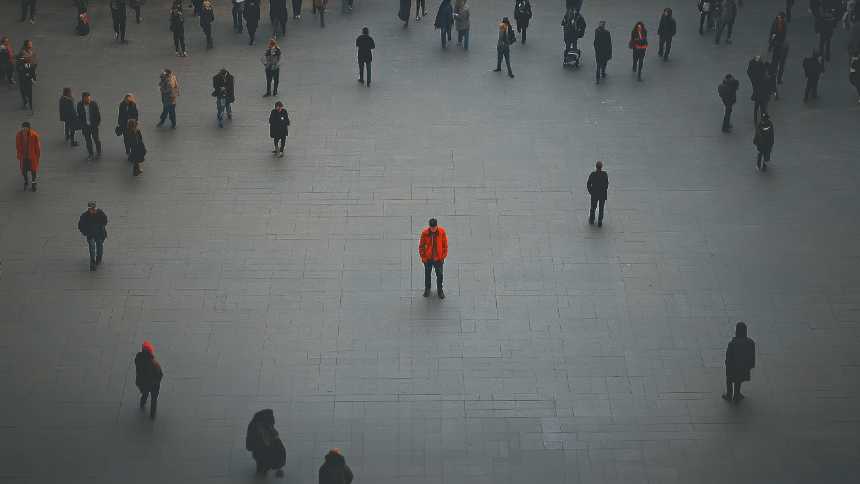
"No one would choose to live without friends, even if they could have all the other good things in their place."
Aristotle was one of the first thinkers to treat friendship as a central philosophical theme. In his Nicomachean Ethics , it appears as essential to a full life—both individually and collectively. Almost two and a half millennia later, never before have so many people lived without friends.
In the age of hyper-connectivity and hyper-productivity, voluntary bonds, based on trust, affection, and mutual care, seem to be dissolving at the speed of scrolling . The phenomenon has even been given a name: "friendship recession," a term coined by political scientist Daniel Cox, director of the Survey Center on American Life in the United States.
The metaphor is accurate. Like in an economic crisis, the erosion of emotional bonds doesn't result from a sudden collapse, but from a gradual process of disengagement. Friendships weaken when attention, presence, and reciprocity cease to "circulate." And, as happens in the economy, insecurity increases and the social fabric becomes impoverished.
Although subtle, the recession is fast enough to already be showing up in the statistics. Immersed in a slowdown in friendships, 25% of Brazilians don't feel close to anyone, reveals a survey by the Locomotiva Institute, with almost 1,700 people between 18 and 77 years old.
Among American adults, 12% say they have no close friends — four times the number compared to 1990, according to The American Perspectives Survey .
If, in the not-too-distant past, they spent 6.5 hours a week in close-knit relationships, today they spend, at most, four hours.
From everyday statistics, in the last two years in the United States, the number of people who dine alone has increased by almost 30%, according to the OpenTable platform. With the advent of video, CDs, and more recently, streaming , the average American now goes to the movies three times a year. But they spend 19 hours a week in front of the television—the equivalent of eight films in theaters.
“In entertainment, as in gastronomy, modernity has transformed a ritual of togetherness into an experience of seclusion at home and even loneliness,” writes editor Derek Thompson in an article for The Atlantic magazine. “Self-imposed isolation may well be the most important social fact of the 21st century in America.” There, here, and in much of the world.
It would be as simplistic as it is obvious to explain the emotional recession solely by the confinement of life to screens. "Technology is just a tool, and we express ourselves through the tools available to us," says psychiatrist and psychotherapist Nina Ferreira in an interview with NeoFeed . "Technology only amplifies a behavior that already resides within us as a society."
The roots of the breakdown of emotional bonds are deeper and older, especially in large urban centers. Violence has turned public spaces into territories of fear, and we have locked ourselves in heavily guarded condominiums. Designed for cars, cities have lost parks and gardens, quintessential areas for social interaction. With the rapid construction of skyscrapers, we have become more and more lonely.
There is also the old argument of a lack of time. Lately, work has become the "dominant social identity," defines American psychologist Carolyn Bruckmann in an article for the platform of the Leadership and Happiness Lab at Harvard Kennedy School.
"And friendship is no longer seen as an integral part of daily life, but rather as something we fit in when all other responsibilities have already been fulfilled," she says.
In the upper-middle and upper classes, performance has become almost a moral value, normalizing overwork in the office—which is praised on professional and social networks. "The obsession with this standard of success is, in reality, counterproductive," warns Nina, founding partner of the LuxVia clinic in São Paulo.
Sooner or later, the bill comes due. And the price is high. The body falls ill, the mind suffers, and productivity, of course, plummets.


The idea of self-sufficiency, so valued in the corporate world, still transforms vulnerability, essential to building genuine bonds of friendship, into social discomfort.
Acknowledging fears, doubts, limitations, and failures dismantles the logic of constant performance, creating a space where it's not necessary to "handle everything" all the time. It's no coincidence that, for Aristotle, a friend is "another self"—indispensable for self-knowledge.
Whether due to hyper-connectivity or the cult of high efficiency, younger generations are losing the ability to truly pay attention to others and to handle the (not always easy) challenge of face-to-face connection.
As Derek Thompson often says, "a socially underdeveloped childhood leads to a socially stunted adult life." In this vein, we, social animals by nature, are transforming ourselves into antisocial beings. And the consequences can be disastrous.
From an evolutionary standpoint, we've only gotten this far because we've established bonds with one another. Real contact with close friends protects us physically and emotionally, preventing the escalation of a vicious cycle—loneliness fuels insecurities and social fears that, ultimately, prevent the building of intimate and lasting bonds, explains Nina, creator of the recently launched Clube Potente Mente, a free app with content focused on personal development, mental health, and self-awareness.
Yes, technology has its uses. "If the tool is used to sustain friendships in the real world, the virtual world can be very helpful," argues the doctor. The problem is when virtual bonds steal the spotlight from real-life bonds.
Our brains weren't programmed to receive attention in the form of likes , shares, or emojis. The quality of digital interaction is infinitely poorer than that of face-to-face interaction. It's the paradox of contemporary friendships: we've never been so connected and, at the same time, so lonely.
In a world that fragments time, overvalues productivity, and pushes moments with friends to the periphery of daily life, creating genuine connections has come to require a methodical approach.
In early 2025, Stanford University in the United States, for example, launched the course Designing for Friendship , dedicated to thinking about how to create and sustain deeper and more lasting interactions based on the principles of design thinking .
Outside of academic circles, the answer is less sophisticated—and perhaps more complicated. Controlling the decline in friendships depends on intention. It's about choosing to make room in your schedule, protecting your time, and engaging in face-to-face meetings. As the psychiatrist says: "If affection is not reciprocated, it is, in some way, extinguished, forgotten."