


San Sebastián (Spain) - The title says it all. The greatest asset of "The Voice of Hind Rajab" is precisely the real recording of the six-year-old Palestinian girl on the phone, pleading for help in Gaza. The little girl's voice has a brutal emotional impact on the viewer, as they follow the reconstruction of the tragedy, which occurred on January 29, 2024, despite all efforts to rescue the child.
Releasing this week in Brazilian cinemas, "The Voice of Hind Rajab" is one of the rivals of " The Secret Agent " in the race for the Oscar for best international film. Competing for Tunisia, the film boasts heavyweight executive producers in its credits, such as Brad Pitt, Spike Lee, Michael Moore, Alfonso Cuarón, Joaquin Phoenix, Jonathan Glazer, and Rooney Mara.
Everyone was touched by the project, which is a testament to the atrocities of modern times. What the film does, distancing itself from other political productions about the Gaza War, is simply to stick to an undeniable fact: the assassination of Hind Rajab.
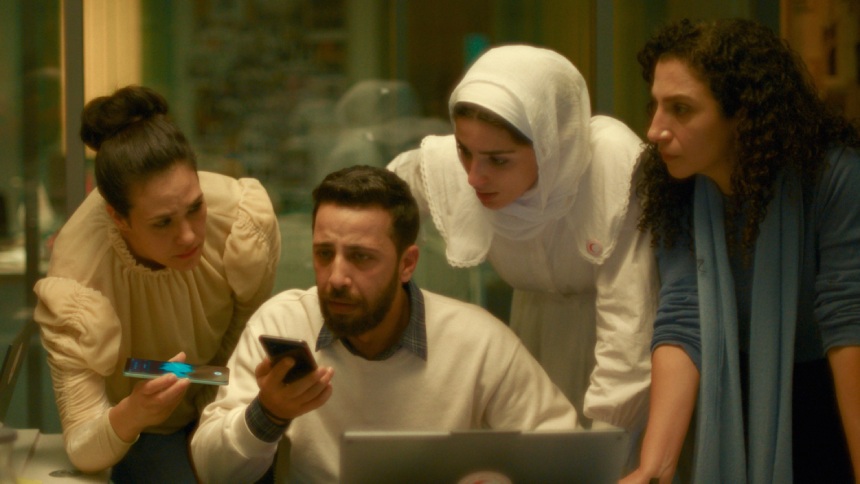
There is no intention in the script to understand the armed conflict between Israel and Hamas by contextualizing it. Everything is reconstructed from the point of view of the humanitarian organization called the Palestinian Red Crescent Society.
More specifically, from the volunteers who were working at the emergency center at the time of the first phone call. The teenager Layan Hamadeh, Hind's cousin, was the one who initially asked for help, explaining that they were survivors from a family whose vehicle had been bombed by Israeli tanks while trying to flee Gaza.
After her cousin died in the car, Hind stayed on the phone, pleading for help, but rescue arrived too late. All the conversations were recovered by the film's director, Tunisian Kaouther Ben Hania, who chose to use the original audio in the film, which inevitably breaks the audience's heart.
“We knew we would be acting opposite the actual recording, but we didn’t hear Hind’s voice until the director yelled ‘action’ on the film set,” actress Saja Kilani told NeoFeed during the 73rd San Sebastián Film Festival in northern Spain, where “The Voice of Hind Rajab” was one of the featured films.
Kilani plays one of the volunteers who spends the most time with the child on the phone, often trying to calm and comfort her, while the details and risks of the rescue are analyzed. The action unfolds over 24 hours, set solely within the humanitarian organization's building. The viewer only learns what is happening outside through the conversation with the girl.
“Hind’s voice was revealed to us during the day-to-day filming, which was done chronologically. We didn’t hear the recording from the following day, only the one from the day in question,” the actress comments, agreeing with the director’s decision. “In this way, our reaction was almost a real reaction of someone hearing a cry for help for the first time,” she added.
Only excerpts of the recording had been released to the media at the time of the girl's death. "But never the complete recording. And it's important to let the world audience hear the conversation, with all the details. Only then will this material remain as a historical record," said Kilani.
The actress shares the scene with Motaz Malhees, cast to play another volunteer who establishes an emotional connection with Hind over the phone. “The filming gives us the false impression that she is still alive, which contributes to an even more devastating effect. At times, I even had to ask to stop filming. I couldn't finish the scene,” said the actor, who gave an interview alongside Kilani at the Spanish festival.
Since “The Voice of Hind Rajab” had its world premiere at the Venice Film Festival, where it won the Grand Jury Prize, the use of the original recording has sparked some controversy, raising primarily ethical questions. Among them, whether the director actually had the right to use the conversation of the dead little girl.
“I contacted Hind’s mother because I could never have made this film without her approval and blessing,” the filmmaker stated during an online panel about “The Voice of Hind Rajab,” which was covered by NeoFeed .
“Although that mother was still grieving, she gave me permission. She said she wanted me to make the film because she was afraid that her daughter’s memory would end up buried with all the other children’s corpses in Gaza,” added Hania, who is nominated for an Oscar for the third time.
She has already competed for the Academy Award for Best International Film with "The Man Who Sold His Skin" (2020), and for Best Documentary with "Olfa's Four Daughters" (2023).
The first title tells the story of a Syrian refugee who agrees to be tattooed by an artist in order to travel to Europe. The second recounts the drama of a Tunisian family who lost two teenage daughters recruited to fight for the Islamic State.
“I see cinema as a tool for change and impact,” she said, noting that “The Voice of Hind Rajab” is not only about the death of the little girl who gives the film its title.
“Cinema is so great because, through a single story, you can imagine others. We don’t know how many thousands of other children were killed in Hind’s conditions. And if it’s painful to hear one story, imagine the suffering multiplied. That’s beyond what humanity can bear,” she said.