


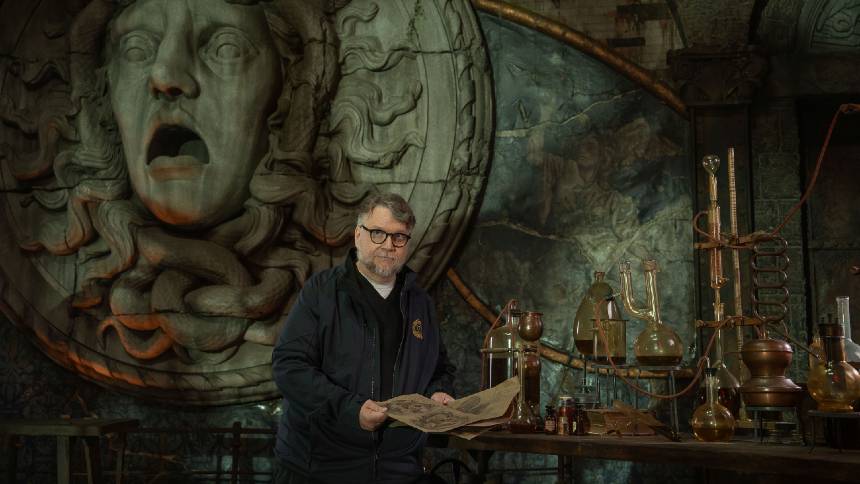
Marrakech – “Considering immortality a curse, I’m a fan of death,” said Guillermo del Toro, attempting to explain how he succeeded in Hollywood without compromising his obsession with monsters and his taste for the macabre. “I seek to see the human experience as beautiful and horrible at the same time, without judgment,” stated the 61-year-old Mexican.
While his focus on terror in everything he does might have confined him to the independent film scene, it's what secured his commercial success. He has grossed over US$6.4 billion worldwide, considering the more than 30 films he has written, produced, or directed, always captivating viewers with the horrors of the world and dark narratives.
And the global revenue doesn't even reflect the success of his latest film, Frankenstein , released globally on Netflix, which meant a brief run in theaters. Still, his reimagining of Mary Shelley's gothic novel ended 2025 as one of the most popular films of the year on the platform and a leading contender for the season's awards.
At the Golden Globe Awards, the foreign film awards ceremony to be held on Sunday, January 11th in Los Angeles, "Frankenstein" is nominated in five categories, including best drama and best director. There is also a strong chance of Oscar nominations, particularly in the best picture category, with the announcement to be made by the Academy on January 22nd.
With the perspective of the monster itself made from scraps of corpses, Frankenstein is yet another testament to del Toro's "intimate relationship" with death, which he attributes to being Mexican. "We grow up seeing the beauty and the misfortune of the world on the same day, at the same instant. On the day you give your first kiss or witness the birth of your first child, someone is being murdered or a house is on fire," del Toro told NeoFeed during his visit to the 22nd edition of the Marrakech International Film Festival, known as FIFM.
The filmmaker, honored with an honorary award in Morocco for "mixing horror, fantasy, and exuberant visual imagery," also used the Day of the Dead in Mexico to illustrate how his people transform mourning into a celebration of life. Far from the heavy atmosphere of All Souls' Day in Brazil, there the date calls for a party. It's like their Carnival. The population wears costumes, decorates their homes with flowers, candles, incense, and even prepares the favorite treats of the dead, believing that the souls would be allowed to visit family and friends on that occasion.
“The moment of grace only happens when we surrender to all the rhythms of our experience on the planet. It’s always very suspicious when someone advocates a single path in life, wanting to make everything equally beautiful. For me, that’s where terror is born. I love monsters so much because they represent permission for imperfection,” stated del Toro, one of the great admirers of Kintsugi.
Even before discovering this Japanese art of repairing broken ceramics by piecing together the fragments and highlighting the seams with gold dust, the filmmaker was already celebrating Kintsugi in his cinema. "I realized this connection while reading about Japanese philosophy during the preparation for 'Pacific Rim'," said the director, referring to the 2013 film. This film depicts an epic battle between monsters and mechas, as the giant, human-controlled robots that are icons in Japanese pop culture are called.
“When people ask me why I include so many autopsies in my films, I always answer: if something is dead and decaying, it’s because it was alive before. And Kintsugi is nothing more than the narration of a past story, which we can apply to ourselves. We are broken as children, living the rest of our lives trying to rebuild ourselves with the stories we tell ourselves, putting a golden veneer on them,” said del Toro.
Scene from the movie "Frankenstein" - Credit: Netflix
And what else could explain the public, critical, and industry acclaim his works have received? Among the highlights of his filmography is The Shape of Water (2017), a subversive romance about a mute cleaning lady and an amphibious man that earned del Toro the Oscar for best director and best picture (as producer).
His third Oscar came with Guillermo del Toro's Pinocchio (2022) for best animated feature, by giving an anti-fascist tone to the journey of the wooden puppet who wanted to be a real boy. Instead of setting his journey in the 19th century, as in the original, the action was transported to 1930s Italy, under the rule of Benito Mussolini.
“We Mexicans can be very untamed. That’s why I’ve always identified so much with my countrymen, Alejandro and Alfonso, rebels from a very young age like me,” commented del Toro, referring to Alejandro González Iñárritu and Alfonso Cuarón, with whom he forms the group Three Amigos. That’s how they became known in Hollywood.
“Each one managed to stand out in their own way. In my case, it was really by immersing myself in genre cinema, often mixing horror films and fairy tales,” said del Toro, who ended the interview with a witty definition of success. “It’s managing not to work for three, four, or five years without anyone noticing. That, yes, means having won in life,” he said, laughing.