

Upon entering the Mendes Wood DM gallery in São Paulo, a path flanked by San Jorge swords on one side and Santa Bárbara swords on the other unfolds. At the end of the path, two tree trunks surrounded by nails—reminiscent of pillories—guard an offering to Exu, guardian of crossroads. This is Situação terreiro: descansa (2025), the work that opens the exhibition Nascimento , by Antonio Obá, welcoming visitors and offering them the journey.
Obá already knew that the solo exhibition would be called Nascimento (Birth) even before seeing everything set up in the gallery. After looking upwards in Revoada (Flight of Flight) (Pinacoteca de São Paulo, 2024) and stepping onto the ground in Finca Pé: Estórias da Terra (Story of the Earth) (Centro Cultural Banco do Brasil, with touring exhibitions in Brasília, Minas Gerais and Rio de Janeiro), the artist now turns to what happens between heaven and earth.
“It’s the unfolding of research I’ve been doing since that moment of genesis. And, above all, of the developments that occur from the moment you arrive in the world subject to blessings and hardships, burdens and benefits,” Obá explains to NeoFeed .
“This place isn’t necessary. At times, it sounds to me like a great stroke of luck, thinking of luck in a broad sense — not only as something fortunate, but also as its opposite,” he adds.
In the 39 works, the artist addresses the notion that being born and existing is a journey between choices, unforeseen events, and also a stroke of luck — all enveloped in an aura of mystery and storytelling.
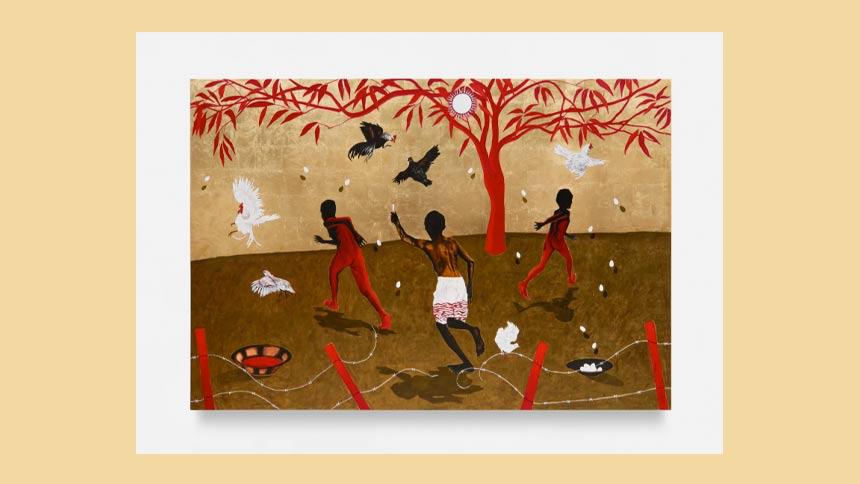
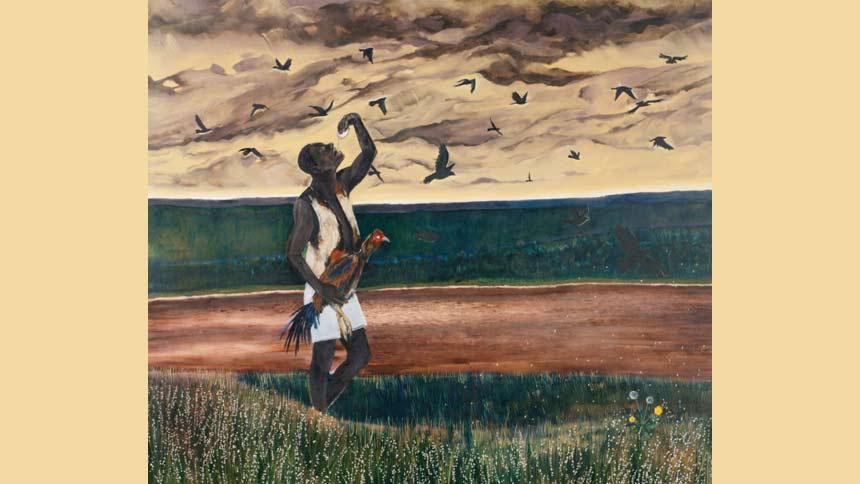
The exhibition features prosaic scenes, such as boys chasing chickens and breaking through a fence towards a golden sky, in Situação terreiro: estripulia (2025); and reflections on chance, as exemplified by the installation Situação terreiro: Acesse (2025), in which cowrie shells are thrown into the air before falling and pointing to a possible interpretation of destiny.
This investigation into the imponderable would gain an unexpected layer a few days after the vernissage. His work Alvorada — Música Incidental Black Bird (2020) was auctioned off at Sotheby's in New York for US$1.02 million (approximately R$5.4 million).
“It was a very intense few weeks. It’s wonderful to see a work taking on a life of its own and following such beautiful paths. But, on the other hand, these are situations beyond the artist’s control,” says Obá, noting that what remains real is dealing with the inconveniences that creation imposes: the white walls that remain in the studio after setting up an exhibition.
“The path is made by walking. That’s the reality, a reality that imposes a certain humility on you. In the sense of [seeing the empty studio] admitting to yourself: 'Man, I don’t know where I’m going now',” comments the artist, who, at 43, has already forged a solid path, with works in the collections of Tate Modern, Reina Sofía, MASP, Pinacoteca, Pinault Collection, Inhotim and Pérez Art Museum Miami.
"Go back and get what was left behind"
Born in Ceilândia, 35 kilometers from Brasília, Obá found his path in the visual arts while still in high school. His evident talent for drawing led him to be referred to the Multifunctional Resource Room — a public policy that offers specialized support in state schools for students with disabilities, disorders, or high abilities, as was the case with Obá. It was there that he had his first contact with the paints that would seal his destiny.
Early in his career, the artist looked to great European names, including the painter Francis Bacon, whose technical excellence he recognized as a possible horizon. But, over time, he realized that he needed to turn inward, to his own origins, to find a truly unique language. One of the practices that led him to this return was capoeira angola.
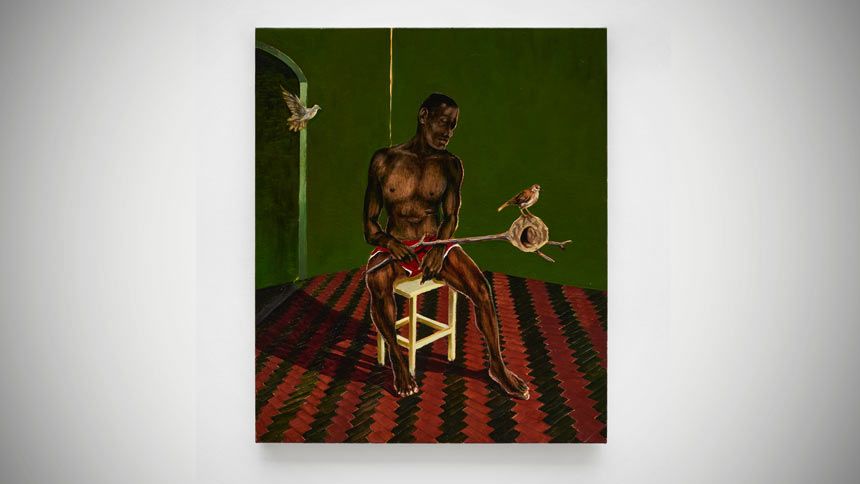
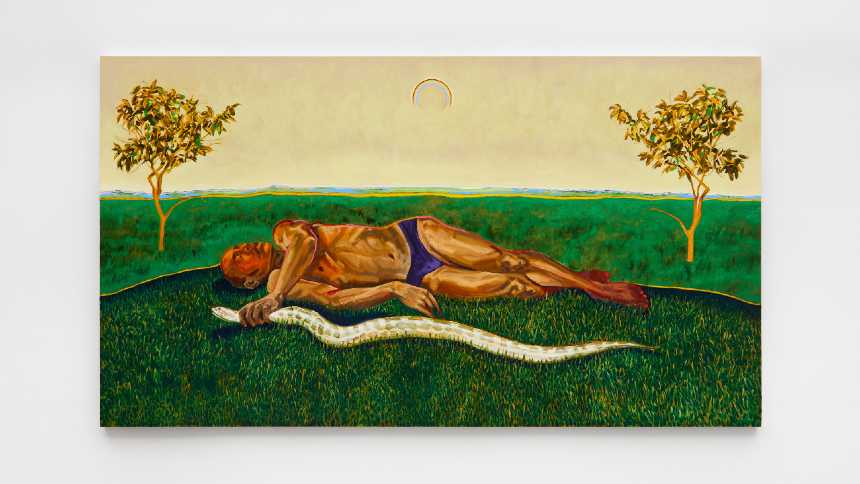
“I ended up having encounters that placed me in situations where certain perceptions reached me, and that weren't exactly related to a visual issue. For example, a smell that brought back a memory and put me in a very conscious place about what I wanted to do,” he explains. “These references found a place in this Brazilian historiography, in this kind of personal genealogy, in which I placed myself in a process of wandering.”
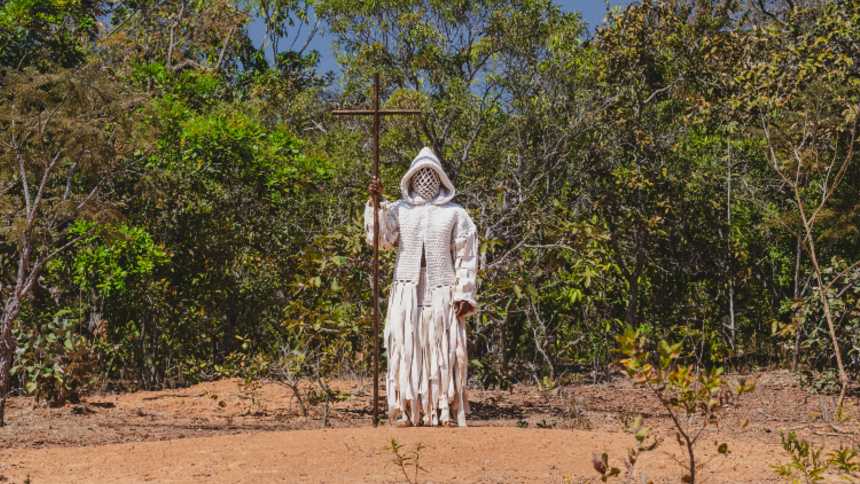
This movement of return — intimate, wandering, and guided by sensory memories — echoes in Encantado , a 2024 video performance. In it, a figure wears a raw cotton suit reminiscent of armor and walks under a strong sun through a landscape of low vegetation.
The pilgrim carries a staff marked with a sankofa, the African symbol that reminds him that “it’s never too late to go back and retrieve what was left behind.” He walks until he reaches a path where a river flows among verdant trees. There, he sheds his clothes and staff and merges with nature.
Sweeping the floor, walking the dog
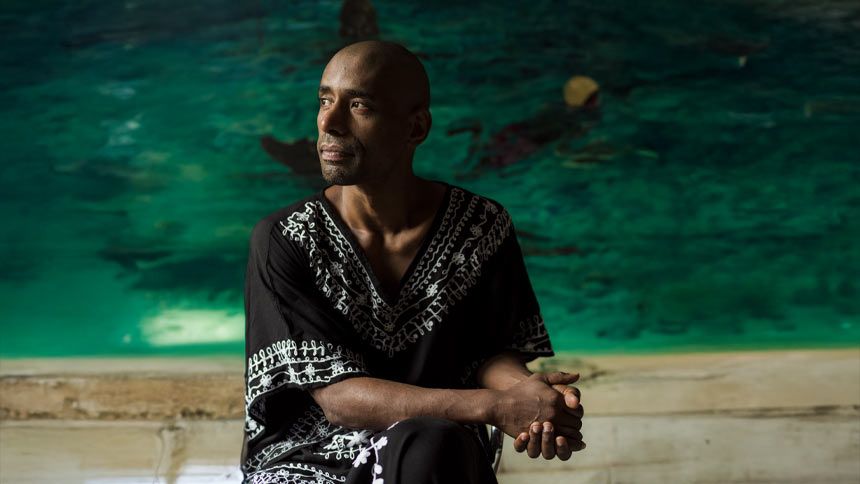
In his studio in Brasília, where he now works full-time, Obá appears for the interview framed by the light from a large window overlooking a garden in the background. The artist even flirted with moving to São Paulo in 2023, but realized that his work also draws inspiration from the light and landscape of the Central-West region.
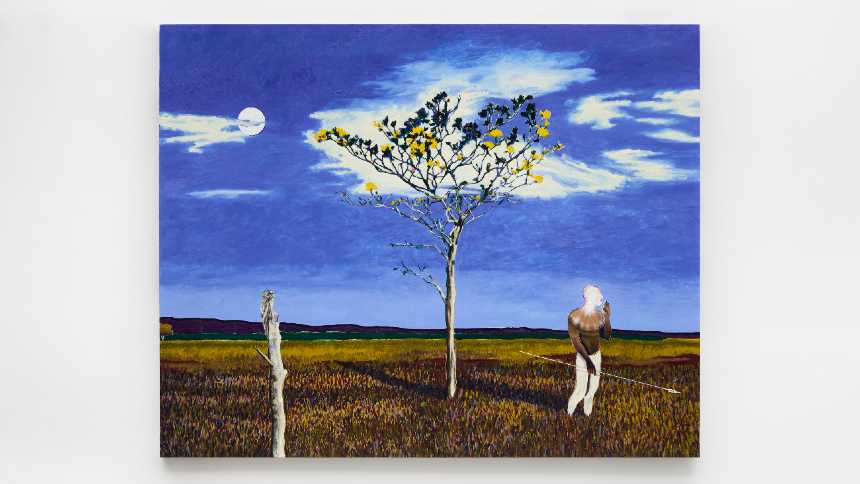
The wide horizon and the sky that weighs down on the low vegetation of the Cerrado, always illuminated by the strong sun, permeate the palette and the construction of forms in his paintings, such as Lumiar – Paisagem Sertaneja (2025). "It is a light that imposes itself in a very preponderant way," he states.
For years, he divided his time between teaching and artistic production. Only recently has he allowed himself the radical gesture of dedicating himself entirely to his own work—and, in doing so, giving himself "time to make mistakes."
There are days when he goes to his studio, but doesn't touch a pencil or brush. He spends hours there reading, in silence, or sweeping the floor. "Creation demands this," he says. "The work itself forces you to delve deeper. Whether technical, conceptual, or poetic—it all requires time."
It is an active meditation, a moment of processing. When he needs to “return to reality,” as he describes it, he resorts to the most ordinary things, like walking with his dog Cherrie at the end of the afternoon. These activities pave the way for the poetic gesture that materializes in his paintings, such as What I Learn When I Walk My Dogs (2025).
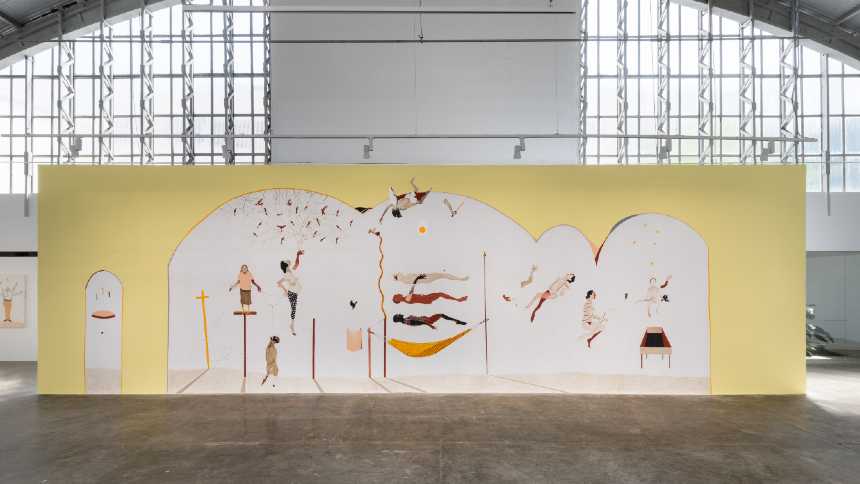
Obá is not afraid of the risk he needs to take in front of the white wall. Four days before the opening, he painted a thirteen-meter mural for which he had not made any prior sketches. "It's this conditioning of having your pores open, your body offered to the idea," he says. Being open to the birth of the new, to chance and to the crossroads.