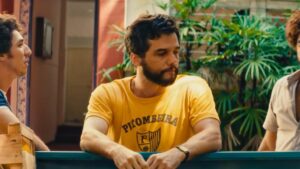


Brazilian cinema is experiencing a unique moment. After years without international recognition, the films *Ainda Estou Aqui* (I'm Still Here) , winner of the 2025 Academy Award for Best International Feature Film, and *Agente Secreto* (Secret Agent ), recently chosen as the Best Foreign Language Film at the Golden Globes and with four Oscar nominations this year – Best Picture, Best International Feature Film, Best Actor for Wagner Moura, and Best Ensemble Cast – have brought the spotlight back to the talent and national capacity to produce works that equal – or even surpass – expensive Hollywood productions.
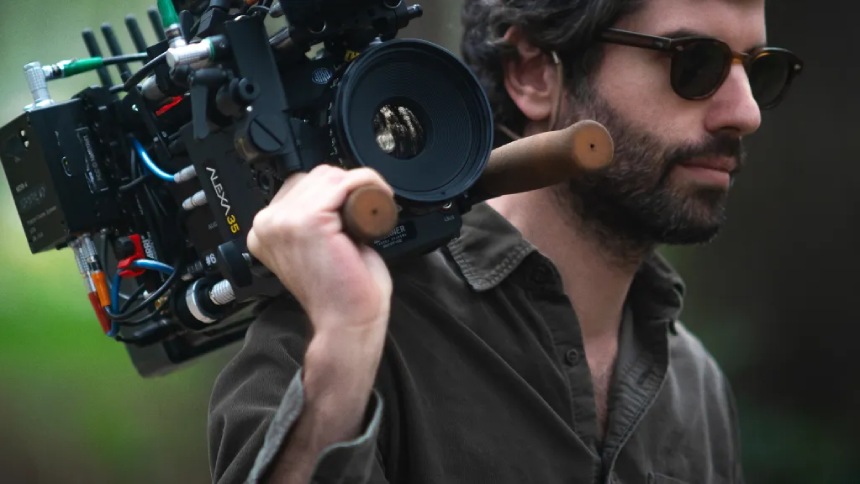
In this context, another Brazilian, unaffected by the buzz surrounding the two films, is also being recognized by the upper echelons of cinema. Adolpho Veloso, a 36-year-old from São Paulo, is another Brazilian representative vying for the statuette. He is nominated in the Best Cinematography category for his work on Train Dreams, an American film written by Denis Johnson and directed by Clint Bentley.
If he takes home the Oscar, this will be Veloso's second award for the film. At this year's Critics Choice Awards, he was recognized in the same category (best cinematography), beating out big names in the industry such as Autumn Durald, for Sinners , and Claudio Miranda, for F1 .
"Brazilian cinema and its professionals have always been incredible, and I think this recognition is even overdue," says Veloso, in an interview with NeoFeed .
“But it’s good that this is happening, that Brazilian cinema is becoming fashionable in a way, and that we are showing that it’s not something sporadic, that happens every 20 years, but rather that we have award-winning productions for two consecutive years, which is incredible,” he adds.
Veloso is an essential part of this movement. His dream of working in film emerged early, when he was just a child. For him, watching movies was almost like therapy – even though he didn't yet know the meaning of that word.
The act was a true way to transport oneself to other universes and be touched by them, a sensation that I would like to be able to transmit to people in the future.
It was this ambition that led him to film school, where he seized every opportunity that came his way, holding positions such as production assistant and director. His first project as a cinematographer was a music video made for a friend, followed by a short film and then several other jobs, mainly in advertising.
Gradually, his name became known in the national market and also abroad, which led him to live in Lisbon , Portugal, where he would be within easy reach of any project developed in the northern hemisphere.
The turning point that brought Veloso into the spotlight of the film world came after his participation in the documentary On Yoga: Architecture of Peace , released in 2017. It was his work, among many other productions, that caught the attention of American director and screenwriter Clint Bentley, who was looking for a professional capable of moving seamlessly between fiction and documentary.
“I remember that I didn’t want to make this documentary, because I always thought my first feature film would be fiction, and I thought that, with that invitation, despite being incredible, I would be going down the wrong path,” says Veloso. “I couldn’t have been more wrong, since it was he who led me to Clint and to fiction.”
With this connection, Veloso was invited to direct the cinematography for Jockey , a Clint Eastwood film released in 2021, and was selected again for Train Dreams , a work that should still bring him many awards.
The next one, who knows, might come soon, with the long-awaited Oscar statuette.
The challenges of filmmaking
Despite recent evidence of his success, Veloso still feels, more often than not, that he is doing everything wrong.
“Making films is very difficult. I usually say that either you won’t sleep because you’re working too much or because you’re anxious about not having work; there’s no middle ground,” he says. “So it’s very difficult to feel like you’re really succeeding in your career.”
He says that, in practice, projects go wrong more often than right, since you don't always have a film that people like or that gets you into festivals and wins awards. "At the end of the day, it's much more sweat, blood, and tears than anything else, you know?!" he adds.
He emphasizes, however, that this doesn't mean it's not worthwhile – quite the opposite. When he receives messages about people who have been touched by works he's participated in, as happened with Train Dreams , the problems become just a detail.
It is for this feeling that Veloso works so hard, the feeling his childhood self experienced when watching films years ago. And it is in pursuit of this feeling that he has become so selective about the projects he decides to participate in. For him, either the story is truly incredible, or it's not worth it.
“One thing I’ve learned throughout my life is that if you undertake a project you truly believe in and identify with, the chance of it being successful and turning out well is much greater,” says Veloso. “Finding those projects takes time.”
Looking to the future, the director states that there are still many dreams to be fulfilled – and one of them would be to direct a Brazilian film.
One thing Veloso is certain of: he is still far from reaching his full potential. And the public is grateful for that.