

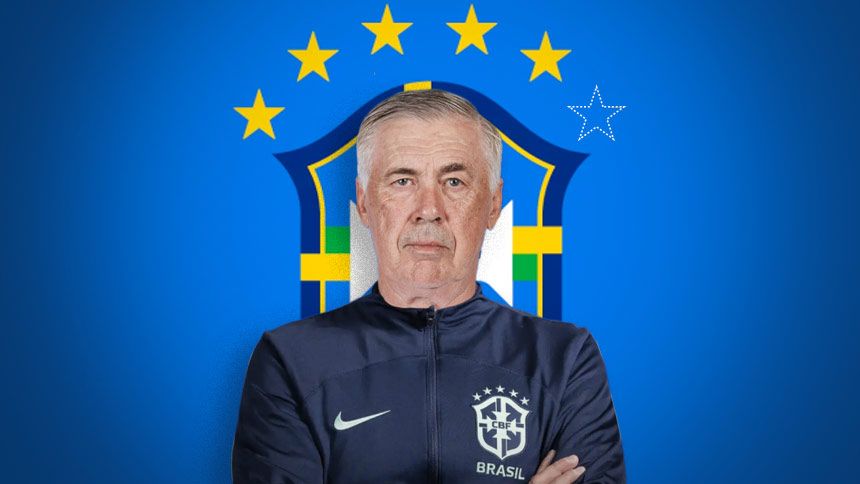
Brazilian fans can — and should — trust that the 65-year-old Italian coach, Carlo Ancelotti , will do everything he can to help Brazil win the 2026 FIFA World Cup. And not just because he is one of the most competent and successful coaches of all time: the World Cup title is his obsession, the only one missing from his resume.
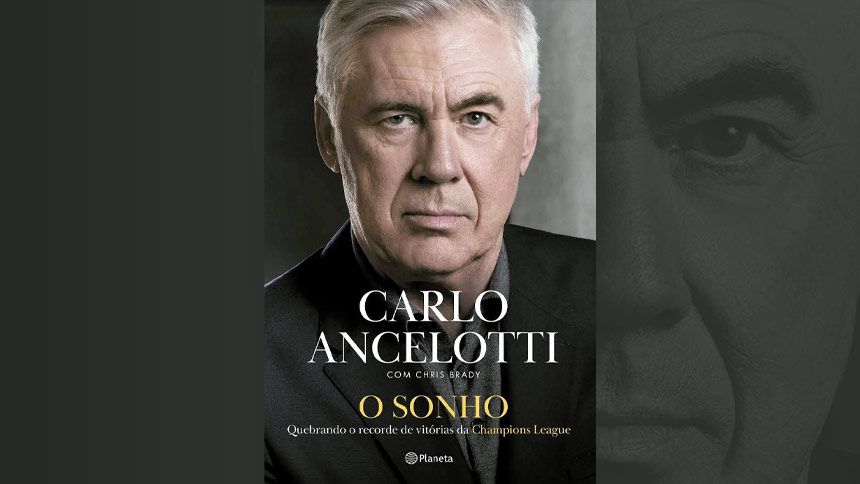
This certainty arises when reading the excellent book *The Dream – Breaking the Rules of Winning in the Champions League *, which arrives in Brazilian bookstores this December from Planeta publishing house. In just over 250 pages, the work delves into the mind of the greatest living coach of our time and offers the unique perspective of a great strategist in action.
Ancelotti has won the Champions League, the European club cup contested by the elite of world football, five times: twice with Milan, in 2003 and 2007, and three times with Real Madrid , in 2014, 2022 and 2024 — not counting the two times he won the title as a midfielder for Milan, in 1989 and 1990. Behind him, tied with three titles each, are the Englishman Bob Paisley, in the 1970s and 1980s, and, more recently, the Spaniard Pep Guardiola.
In The Dream , the Italian goes beyond detailed accounts of his challenges. With sensitivity, empathy, and emotion, he blends football memories with lessons in management and leadership: his work methods, his mentors, his challenges, the disagreements and pressures he faced throughout his career as coach of some of the greatest teams in history—in addition to Milan and Real Madrid, he coached Paris Saint-Germain, Chelsea , Juventus, Parma, and Bayern Munich, among others.
Written in partnership with English sports journalist Chris Brady, the autobiography isn't just about glory. Ancelotti recounts the story of all the occasions—far more numerous—when his dream slipped through his fingers. “Football isn't so far removed from real life. The truth is, most of the time, we don't win. And I hope to be humble enough to recognize that defeat can also be a great teacher,” he writes.
Born in Reggiolo, Italy, before becoming a coach, Ancelotti played as a midfielder for Roma and Milan, and also played for the Italian national team in the 1990 World Cup. He begins The Dream with a marvelous account.
When he was 15 years old, in 1975, he was training as a youth center forward for Parma. He was called up to participate in a sui generis football match. Film directors Bernardo Bertolucci and Pier Paolo Pasolini were feuding. Their production teams organized a local amateur game to make peace between them.
Since Bertolucci's team didn't have enough players, someone had the idea to fill in with local kids. And that's how Ancelotti helped the team of the director of Last Tango in Paris win and received his thanks. "To be honest, the directors' names didn't mean much to me. But I didn't care. It was a match and I just wanted to play. Football was already my life," he says.
Some setbacks
One of the toughest moments of his career was his "merciless" dismissal from Bayern Munich—the most ruthless, authoritarian, and irrational, as he describes it. More than the German team's 3-0 defeat to PSG, the coach points to interference from the board and the power structure as decisive factors in his departure. At Bayern, he recalls, he had to answer to "several important people at the same time," such as shareholders and influential former players.
The focus of the autobiography is not his new professional challenge, but Ancelotti ends up reinforcing his "connection" with Brazil by recalling experiences he had with about 50 Brazilians with whom he worked and led.
The coach recalls, for example, the friction with Rivaldo at the beginning of the Pernambuco native's time at Milan. The striker, fresh from winning the 2002 World Cup, reacted badly to being benched—something unprecedented for him.
“‘All right,’ I told him, ‘there’s always a first time, and now is the right time to be the first,’” Ancelotti writes. “I was the boss and I had to remind him of that.” Indignant, the player simply got up and went home. The two eventually reconciled, and Rivaldo was “an important part of winning the Champions League in 2003.”
The most serious disagreement occurred with Leonardo, the left-back in the 1994 World Cup and an old friend of Ancelotti's from their time together at Milan in the late 1990s. In the mid-2010s, the Rio native was the executive director of PSG and, in the match against Porto, even with the team already qualified for the Champions League, he issued an ultimatum: if they didn't win, the Italian coach would be fired.
Victory came, but the strain made Ancelotti's continued stay at the club untenable. Shortly after, he left the French club, also ending his relationship with Leonardo.
"What a wonderful challenge!"
In the book, the coach shares behind-the-scenes stories from his experiences with several other Brazilian players. Some of them even influenced his career.
Regarding his time playing for Roma, between 1979 and 1985, Ancelotti recounts: “The 1983-1984 season team had two Brazilians who greatly influenced me: Toninho Cerezo, who was a warrior and an indefatigable engine, and Paulo Roberto Falcão, who was brilliant in playmaking and a true leader on the field. When he arrived, I didn't understand why we trained so much without the ball (...) it was at Roma that, for the first time, I was directly influenced by a Brazilian genius.”
Midfielder Kaká was another remarkable figure. “When I first saw Kaká in 2003, well-dressed upon his arrival in Milan, he looked like a university student, wearing glasses. But when I saw him play, I was speechless,” says the author.
“In his first training session, he faced Gattuso and then Nesta, and neither of them could stop him. We took away his schoolgirl glasses, put him in a football uniform, and he became a phenomenon. It was like Superman coming out of a phone booth.”
He also mentions his time with Ronaldo, Marcelo, Cafu, Casemiro, Richarlison and, more recently, Rodrygo, Militão, Endrick and Vinícius Jr. “Every Brazilian dreams of seeing Brazil become champions again. Now that’s my dream too, and I will try to make it a reality by giving it my all,” says the Italian.
The World Cup, he comments, is different from the Champions League because it involves the passion of an entire country — “and that’s why it has always caught my attention.” When that country is Brazil, the only five-time FIFA champion, the responsibility increases. As Ancelotti defines it, “what a wonderful challenge — winning the World Cup with Brazil.”