



The Brazilian asset management market suffers from a kind of chronic scarcity of shared knowledge. Managers communicate with their investors via monthly or quarterly letters. But we rarely see someone sit down and break down how they really think about allocation, risk analysis, or portfolio construction.
In the United States, it's different. Howard Marks of Oaktree Capital wrote "What Matters Most to Investors"; Joel Greenblatt of Gotham Capital has "The Magic Formula for Beating the Stock Market"; and Ray Dalio of Bridgewater is the author of the bestseller "Principles".
These are just a few examples from a much larger library of American managers. There, it seems that sharing knowledge doesn't diminish competitive advantage. The result appears to be that knowledge attracts more sophisticated capital.
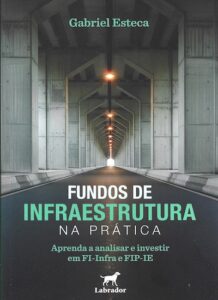
Here in Brazil, Gabriel Esteca, a partner at Bocaina Capital , is doing something rare by launching "Infrastructure Funds in Practice." In the book, the FI-Infra manager shows how he thinks when building a portfolio, what metrics he uses, and how he weighs risks.
The most interesting part is that Esteca experiences the management of infrastructure funds daily and stays far away from academic theorizing. His work involves structuring issuances, analyzing projects, and building portfolios. This credibility is reflected in the book's 176 pages.
Those operating in this market hold a potential of R$ 4 trillion. This is the amount that Brazil needs to invest in infrastructure in the coming years just to reach minimally adequate levels of sanitation, logistics, and energy.
However, the FI-Infra asset class is still a "grain of sand" - billion-dollar, yes, but small. The net worth of FI-Infra listed on the B3 grew from practically zero in 2020 to more than R$ 15 billion in 2025.
But the most valuable element of the book is not the large market figures, but rather how a manager thinks technically.
At a certain point in the book, Esteca dismantles the structure of an infrastructure project and shows who the participants are (shareholders, builders, operators, regulators), what the risks are in each sector (power generation, transmission lines, sanitation, highways, ports), and how to analyze each layer of risk.
Regarding portfolio construction, the expert creates five theoretical funds with different strategies (high yield, beta, short duration, diversification, and weighted) and analyzes each one using real metrics, namely duration , average rating, return, and the Herfindahl-Hirschman Index (HHI) to measure concentration.
Another example is the discussion about hedging. He explains not only the "how" (using DAP contracts to transform IPCA+ into CDI+), but also the "when" and "why". Esteca shows that total hedging eliminates the potential gain from closing the real interest rate curve, but that partial or dynamic hedging requires timing (and timing is difficult).
Esteca divides the content into regulatory aspects of FI-Infra and FIP-IE (it seems bureaucratic, but it's essential to understand the rules of the game), the fundamentals of fixed income and valuation, and project and risk assessment.
It's clear that this isn't a book for investment beginners. You need some prior knowledge of finance to understand what duration or discounted cash flow is. Those in the "Treasury Direct" module will need to pause their reading to look up these concepts – although it's best to finish one stage before moving on to the next. The author didn't intend this book to be an introductory manual on the subject.
But investors who allocate to REITs, CRIs, debentures, or private credit funds will be able to take advantage of the content. And fixed income and credit professionals in the financial market will have a (different) perspective on how to analyze infrastructure projects.