


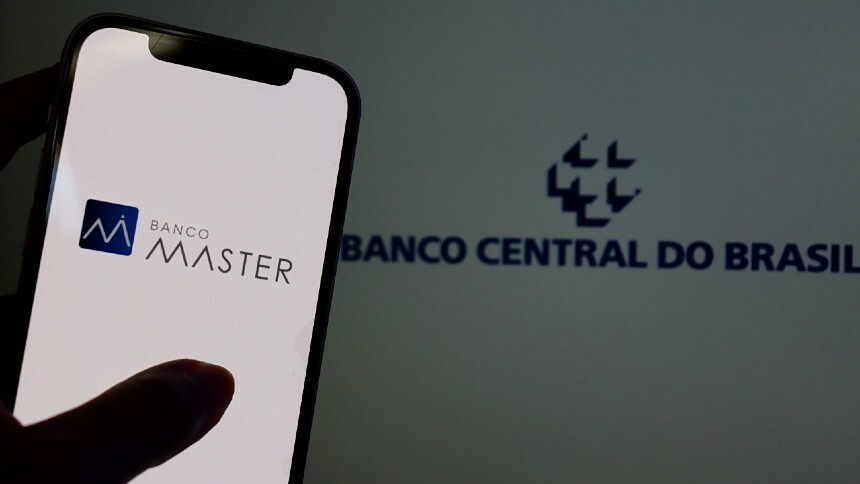
The phrase "in Brazil, even the past is uncertain" is attributed to former Finance Minister Pedro Malan. The Banco Master case, it seems, is an example proving that the former head of the Brazilian economy during Fernando Henrique Cardoso's presidency in the 1990s was right.
Following the extrajudicial liquidation, in November of last year, of the bank headed by Daniel Vorcaro by the Central Bank (BC), an exclusive prerogative of the body responsible for overseeing the financial market, there are several signs coming from Brasília that there is an attempt to suspend and even review the liquidation.
In a recent ruling, the Minister of the Federal Court of Accounts (TCU), Jhonatan de Jesus, stated that, in order to assess the "regularity of the decision-making process" of the Central Bank, it is essential to conduct a more in-depth "inspection" with the aim of reconstructing the "path of decisions" and verifying whether they were "motivated, coherent, and proportionate."
The minister made it clear that the adoption of a precautionary measure against the Central Bank is not ruled out, should the decisions taken during the liquidation compromise the investigation of the case or produce "irreversible damage." In the same order, he emphasizes that the TCU (Federal Court of Accounts) does not intend to "replace" the Central Bank in the technical judgment of the liquidation, but wants to verify whether the process was well conducted, according to a CNN report.
There is no shortage of technical arguments to support the liquidation of Banco Master by the Central Bank. There was an acute liquidity crisis, a significant deterioration in the economic and financial situation, and serious violations of the rules of the National Financial System.
This was not a bank temporarily pressured by an adverse macroeconomic scenario, but an institution that had lost the ability to honor its commitments and which, according to ongoing investigations, resorted to fraudulent operations to artificially sustain its activity.
Investigations by the Federal Police, in the so-called Operation Compliance Zero, accuse Banco Master of leading a financial fraud scheme estimated at R$ 12 billion. The bank is suspected of creating and selling non-existent or unsecured credit portfolios to BRB (Banco de Brasília).
This type of practice is not just an administrative infraction; it is a direct attack on the trust that underpins the financial system. Banks exist to allocate savings responsibly. When this function is corrupted, the risk ceases to be individual and becomes collective.
The case also brought Daniel Vorcaro's relationships with politicians and members of the three branches of government in Brasília into sharp focus. The newspaper O Globo revealed the contract between Banco Master and the law firm of Viviane Barci de Moraes, wife of Supreme Court Justice Alexandre de Moraes, which stipulated payments of up to R$ 129 million over three years.
It is also strange that the investigation ended up in the hands of the Supreme Federal Court (STF), under the command of Minister Dias Toffoli, who placed it under absolute secrecy. The justification for the case going to the STF is the fact that there are people with privileged jurisdiction involved in the inquiry. A minister revealed to columnist Mônica Bergamo of Folha de S. Paulo and BandNews that Brazil would not be prepared to know everything about Master and his relationships.
Vorcaro was a frequent figure at corporate events attended by politicians and Supreme Court justices. The newspaper O Estado de S. Paulo revealed in a report that Banco Master sponsored several events in Brazil and abroad between 2022 and 2025, attended by Supreme Court justices and other authorities from the justice system. This included ministers from the Federal Court of Accounts (TCU), who are now indicating they will resort to the infamous "tapetão" (a term used to describe legal maneuvering to describe a situation where judges are willing to take advantage of the system to manipulate the rules).
Among those attending these events were Supreme Court Justices Dias Toffoli, Gilmar Mendes, Alexandre de Moraes, and Luiz Fux, as well as former Justices Luís Roberto Barroso and Ricardo Lewandowski (currently Minister of Justice). Authorities such as the Attorney General of the Republic, Paulo Gonet, and the Solicitor General of the Union, Jorge Messias (nominated to the Supreme Court by President Lula), also participated in these events.
It must be made clear that there is nothing illegal about sponsoring, much less attending, such events. But this shows the close relationship between the owner of Banco Master and powerful authorities in the Brazilian Republic.
Trade associations have been doing what is within their role, positioning themselves against interference by the Supreme Federal Court (STF) and the Federal Court of Accounts (TCU) in the Central Bank. A statement signed by the Brazilian Association of Banks (ABBC), the National Association of Credit Institutions (Acrefi), the Brazilian Federation of Banks (Febraban), and the association representing companies in the financial and payment methods sector (Zetta), emphasizes that "the regulator has the legal mandate and the inescapable duty to act in favor of resilience, structuring resolution regimes to protect the financial system and minimize the risk of systemic contagion."
It adds that "the mere possibility of reviewing or potentially reversing the Central Bank's technical decisions, especially those that concern the regulator's focus on preserving financial stability, leads to entering a sensitive area of regulatory and operational instability, generating legal uncertainty and compromising the predictability of decisions and confidence in the functioning of the market, in addition to adverse impacts on depositors and investors, especially individuals, who have less capacity to absorb risks and uncertainties arising from abrupt changes."
Reversing the extrajudicial liquidation of Banco Master at this stage of the process would represent a severe blow to the independence of the Central Bank, one of the country's most significant institutional achievements in recent decades. It would signal that technical decisions, made based on data, prudential standards, and the interest of financial stability, can be reviewed under political pressure or circumstances external to regulatory merit.
The effect of this would extend far beyond a single bank: it would cast doubt on the predictability of the rules, weaken the regulator's authority, and raise the perceived risk premium for investors. In a financial system based on trust, few messages are more damaging than the idea that banking supervision can be relativized. The cost of this insecurity would be paid by the entire market – and, ultimately, by society.