

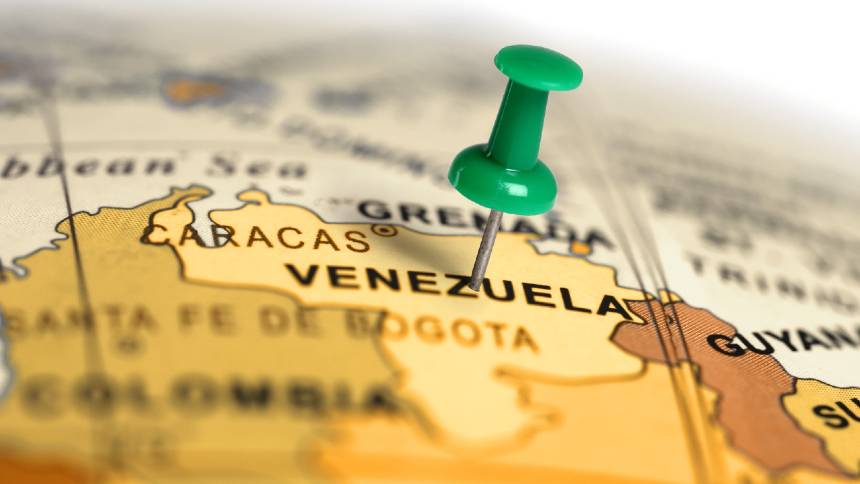
Venezuelan President Nicolás Maduro was arrested and taken to the United States, where the U.S. Attorney General announced he will face charges of drug trafficking and narcoterrorism.
But whether the capture and removal of Maduro will lead to regime change in the oil-rich Latin American country remains unclear.
In his first statements, US President Donald Trump said that the country will administer Venezuela, but did not give details on how this will happen.
"We are there now and we will stay until a proper transition happens. We will stay until then. We will essentially govern the country until a proper transition can happen," Trump stated.
At the same time, Trump made it clear that American companies will enter the country to tamper with the structure of the oil sector. And, on more than one occasion, he mentioned that Venezuela will make a lot of money from the raw material.
"They weren't pumping almost any oil compared to what they could pump. We're going to bring in our biggest U.S. oil companies. They're going to come in, spend billions of dollars, fix the oil infrastructure, and start making money for the country," the American president said.
Chevron, the only American oil company currently operating in Venezuela, is the best positioned company to benefit from this new scenario.
History, however, shows that in recent decades it has been extremely difficult to dictate the political future of foreign countries by military force.
The Trump administration could have learned this lesson from Libya, whose dictatorial government the U.S. and its allies overthrew in 2011. The country descended into chaos soon after, inflicting widespread suffering on its citizens and creating problems for its neighbors.
In the case of Venezuela, it is unlikely that the American military strikes, by themselves, will be enough to fatally undermine its government. Maduro may have left power, but the vast majority of the country's governmental and military apparatus remains intact.
If the Trump administration dreams of establishing a stable, pro-American government in Caracas, it will have to do more than just arrest Maduro.
Promoting lasting regime change typically involves occupying the country with ground troops and undertaking “nation-building.” The U.S. has attempted this with decidedly mixed results in Iraq and Afghanistan.
In almost no recent US military intervention has the American government set out to build nations from the outset. The perceived need to bring a new government into existence generally only arises when the limits of what can be achieved by military force alone become apparent.
The war in Afghanistan, for example, began as a war of revenge for the terrorist attacks on the US on September 11, 2001. The issue has transformed into a 20-year commitment to national reconstruction.
In Iraq, the Bush administration believed it could depose Saddam Hussein and leave within a few months. The U.S. ended up staying for almost a decade.
It's difficult to imagine Trump following the same path, especially since he has always portrayed national reconstruction as a waste of American lives and resources.
But this still leaves him without a plausible way to achieve the divergent political outcomes that he, his supporters, and the American foreign policy establishment desire with the tools at their disposal.
Meanwhile, the US president will face pressure from various groups, ranging from hardline Republicans to conservative Hispanic voters, to force radical regime change in Venezuela.
How Trump responds to this pressure will determine the future of American foreign policy toward the country.
(With information from The Conversation )