


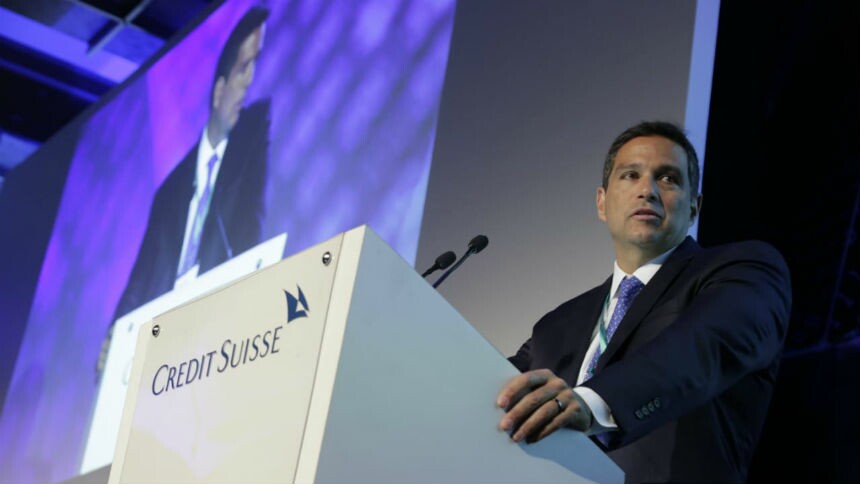
A meeting between the two most recent presidents of the Central Bank marked the opening of the Latin America Investment Conference, an event being held this week by Credit Suisse in São Paulo.
The chairman of the board of Credit Suisse in Brazil, Ilan Goldfajn, former president of the Central Bank during the Michel Temer administration, was responsible for moderating the presentation of the current president of the Central Bank, Roberto Campos Neto.
For almost 60 minutes, Campos Neto gave a technical presentation, talking about China, interest rates, inflation, and economic growth. At the end, Goldfajn asked some questions from the audience.
As time was running out, the former president of the Central Bank asked the million-dollar question – which perhaps could be the theme of the entire presentation.
"What is your vision for the evolution of banking competition in the future, and what role will the Central Bank play in this process?" Goldfajn asked, reading a question from the audience.
In his response, which was short but not so brief, Campos Neto made clear the Central Bank's commitment to the issue of open banking and instant payments.
Check out what the current president of the Central Bank replied:
"The banking world has several pillars. These include barriers to entry, such as having a fragmented branch system. It also has a significant advantage in that it was a closed system until recently. In other words, the bank could sell all its internal products to the client within a closed platform system. And it was also a fairly vertically integrated structure. So, there are several factors working together that make the banking system have a high barrier to entry."
One barrier I haven't mentioned yet, saving it for last, is the issue of information. The bank has a lot of information about all its clients. We see, for example, that financial platforms prefer to operate in credit modalities where the problem of asymmetric information is smaller, where there are more guarantees.
It's no coincidence that credit platforms are quite large in the home equity market. There are even people now offering loans secured by automobiles. The more asymmetric information I have, the more expensive my credit becomes. If I'm competing with someone who has more information than me, I need to be in a type of credit where asymmetric information has less weight.
When we look at the barriers: having a lot of branches and having capillarity has ceased to be valuable, because the world has gone digital. I think that today nobody can survive with a closed platform anymore. What remains, and is very important, is the issue of information. That's why the open banking process is so important to us.
How do I see the system in the future? Exactly as I described at the end: I see something instantaneous, interoperable, and open. What does that mean? It means greater financial inclusion, lower financial intermediation costs, and greater specialization. Banks in the future won't do everything. Because the platform will be open, there will be an app or a fintech company that will occupy that space. But my vision is that the role of financial intermediation will increase significantly, and in the end, there will be a much larger pie, but perhaps the big banks will have a smaller slice.”