


French food retail giant Carrefour announced an extensive plan this Wednesday, February 18th, detailing its goals and focus areas until 2030. Among these, one of the highlights is its Brazilian operation, which went private on the B3 stock exchange in May of last year.
"Carrefour is today adopting a new and ambitious strategic plan radically focused on growth and improving profitability," said Alexandre Bompard , the group's global CEO, in a statement.
Right from the start, the executive highlighted which markets will be the company's priority on this journey. "First and foremost, the group confirms its new focus on three main markets – France, Spain, and Brazil – where we hold leading positions and the greatest potential for value creation."
Contrary to the emphasis placed on the trio, Carrefour has been divesting assets as part of a broad restructuring process. Last week, for example, it sold its Romanian operations to Paval Holding for €823 million. Previously, in July 2025, it divested its Italian portfolio in a €1 billion deal with NewPrinces.
In this context, in the opposite direction, there are many paths and destinations mapped out for Carrefour Brazil , which, in turn, largely summarizes the global guidelines established by the retailer for the next five years.
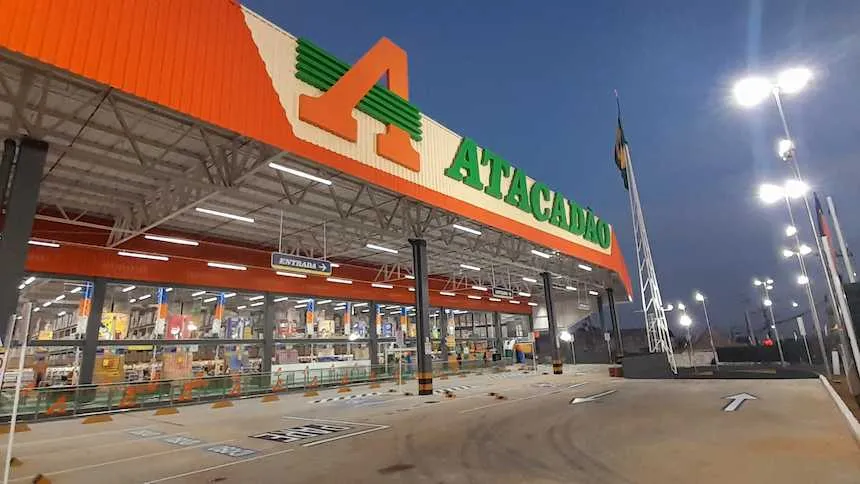
Among the goals set for Brazil is to achieve a 20% market share. And, to achieve this, one of the driving forces will be the expansion of Atacadão , the cash & carry banner of the French chain in the country and, for some time now, the flagship of the operation.
Carrefour plans to open more than 70 Atacadão stores during this period, which would bring the chain to a base of 455 stores. The group also highlighted its plan to strengthen its business model based on areas such as a greater presence of fresh products, price, financial services, and private label brands.
In this last segment, the company announced the launch of its own entry-level brand, Bulnez, at Atacadão, which will have more than 500 SKUs by 2028. Globally, the chain noted that its own-brand products will represent approximately 40% of food sales this year.
At the same time, another milestone to be reached is the projected doubling of Atacadão's gross merchandise volume (GMV). In this endeavor, which is not limited to Brazil, Carrefour emphasized its pursuit of greater integration between digital channels and physical stores.
Other tools that will guide these efforts will be artificial intelligence – with an annual global investment of €100 million – and the intensive use of data, which will also fuel the expansion of the Nosso Clube loyalty program and the goal of doubling the volume of personalized promotions.
The group also highlighted its goal of expanding its Retail Media arm and data monetization strategy, as well as setting targets such as having 50% of food sales come from healthier products by 2030.
In the other two target markets, in addition to "local versions" of these initiatives, Carrefour plans, for example, to open more than 1,500 convenience stores. In France, one of the steps will involve accelerating the transfer of the chain's supermarkets to the franchise model.
In its domestic market, the chain also announced a partnership with Vusion, which, with an investment of €150 million, will implement a system with features such as electronic labels and cameras in all its stores, seeking, among other things, to reduce stockouts by 20%.
As part of this package, the retailer highlighted that it will continue reducing costs with the goal of achieving €1 billion in annual cost reductions by 2030. The group also projects net free cash flow of €5 billion between 2026 and 2028, and an operating margin of 3.5% in five years, compared to 2.6% in 2025.
In other words, Carrefour noted that the annual investment volume will initially be set at €1.8 billion and will steadily increase to €2.0 billion by the end of the plan in 2030.
According to the group, these resources will be primarily directed towards customer experience, through store modernization; expansion, particularly in Brazil; innovations related to artificial intelligence, technology and data; and decarbonization projects.
Finally, Carrefour highlighted its real estate portfolio in Brazil, France, and Spain, valued at €14.2 billion. The strategy here will be to continue developing projects to increase the value of these assets, such as mixed-use properties.
Carrefour shares were down 5.36% in Paris at around 5:20 pm (local time), trading at €14.57, giving the group a market value of €10.2 billion. Over the past twelve months, the shares have appreciated by 5.6%.