

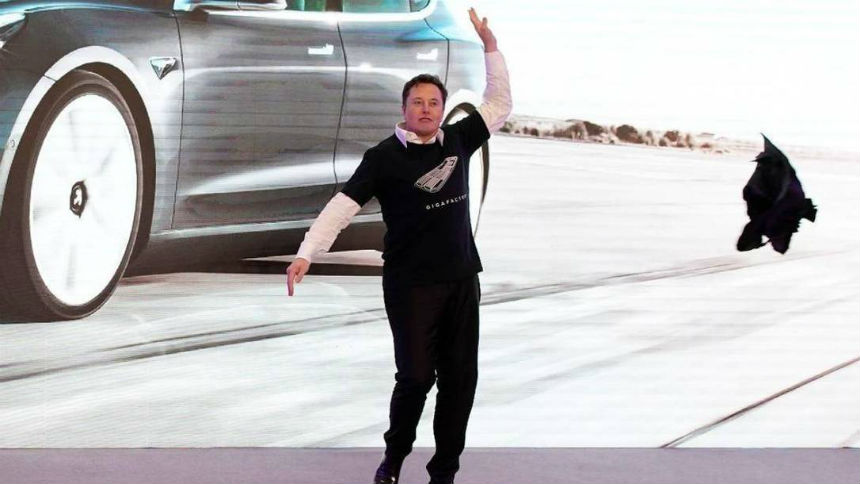
Known for his knack for attracting attention, businessman Elon Musk once again drew attention on Tuesday the 7th. In a video posted on Twitter, as usual, the billionaire CEO and founder of Tesla danced awkwardly. On stage, he took off and threw away his jacket, as if in a striptease.
For some critics of his style, the scene that unfolded that same day could be seen as just another symbol of the mismatch between the promises and deliveries of the entrepreneur at the helm of Tesla. But, aside from the awkward steps, Musk seems to have finally found the right rhythm to please investors.
The episode took place at the company's new factory in Shanghai, China. The event celebrated the start of deliveries of electric vehicles produced at the plant, the company's first outside the United States. This important step was not, however, the only reason for Musk's chaotic dance.
The day before, at the close of trading on the Nasdaq, Tesla reached a market value of US$81.39 billion. With this figure, the company became the most valuable American automaker of all time, surpassing the peak achieved by Ford in 1999 of US$80.81 billion.
Throughout the week, the company's shares continued to rise. On Wednesday the 8th, the shares closed at US$492.14, valuing the company at US$88.7 billion. On Thursday, it fell back to US$87 billion. For comparison, the market values of the also American companies General Motors and Ford, on the same date, totaled US$80 billion.
The current level also takes on extremely positive dimensions when compared to the end of July 2019. At that time, Tesla reported a loss of US$408 million. And in a single day, it lost approximately US$6.5 billion in market value, falling to US$40.98 billion, according to the consulting firm Economatica.
Since then, the automaker's shares have risen by 115%. In addition to reflecting the market's positive reception to a series of events during this period, the index signals a more consistent outlook for the company and its electric cars to definitively gain traction.
China Business
Announced in January 2019 and located on an 865,000 square meter site, the Shanghai factory is one of the factors behind this rise. The result of a US$2 billion investment, the facility charts a promising course for Tesla to consolidate its operations outside the United States, reinforcing its presence in the world's largest electric vehicle market.
According to the Swedish consultancy EV Volumes, China recorded sales of 645,000 units in the first half of 2019, a 66% increase compared to the same period a year earlier. With this figure, the country accounted for 57% of the total 1.13 million electric cars sold between January and June of last year. During that period, sales in the American market grew by 23%, to 149,000 vehicles.
With the factory, the idea is to reduce current costs related to vehicle shipments and import taxes in the Chinese market. According to initial estimates, the project is expected to bring savings of 13% in the price of the brand's vehicles sold in the country.
Initially focused on manufacturing the Model 3 sedan, the plant has an annual production capacity of 150,000 units. During the event, however, Musk announced plans to expand this volume to 250,000 vehicles, including the Model Y compact SUV. "We will continue making significant investments in China, manufacturing these two lines and other future models," the CEO stated.
The Model Y will be one of Tesla's big bets in 2020.
Presented in March 2019 and expected to hit the market in the first half of this year, the Model Y is one of Tesla's biggest bets. At the ceremony, Musk highlighted that the vehicle should attract "greater demand than all other Tesla cars combined."
The new line provides further evidence that the company is prepared to pursue a more solid path. The Model Y shares much of the Model 3's structure. With this approach, the expectation is that its production will be less traumatic compared to the problems faced with the previous model, one of the symbols of Tesla's succession of failed goals and deliveries, and of the market's distrust of the company.
The Model 3 began production in early July 2017. At the time, Tesla's market value was around US$52 billion. The projection was that the company would deliver 500,000 units of the model in 2018. The reality was a volume of 145,800 vehicles, along with a series of adjustment measures in the following months. Among them was a 9% reduction in the workforce.
“Today, Tesla is in a different situation,” says Milad Kalume, an analyst at the consulting firm Jato Dynamics. “They already master the manufacturing process and have proven they can deliver. Everything they do from now on is incremental and tends to have a more positive response.”
He also highlights the prospect of expanding production capacity outside the United States, based on the plan announced by Musk in November to build a factory in Germany.
Deliveries
The automaker's positive momentum is also supported by some recent indicators, exceeding market estimates. In early January, Tesla reported record production of 104,800 vehicles and record sales of 112,000 units in the fourth quarter.
“We believe that this solid new quarter of deliveries may further alleviate investor concerns regarding reduced demand for Tesla models,” wrote Emmanuel Rosner, an analyst at Deutsche Bank, in a report.
The automaker also reported total sales of 367,500 cars in 2019, within the previously projected range of 360,000 to 400,000 units. This figure represented a 50% increase over 2018.
Tesla's biggest challenge, perhaps, is taming Musk's propensity for creating controversy.
The numbers reinforced the positive – and unexpected – context opened with the release of the third-quarter results. During this period, Tesla returned to profitability, with a gain of US$143 million on the bottom line. Revenue, however, fell 8% year-over-year to US$6.3 billion.
This more encouraging scenario doesn't hide the need to overcome some challenges. Among them, achieving annual profitability, as well as accelerating operations outside the American market and facing growing competition with the entry and expansion of investments by traditional automakers in electric vehicles.
The biggest challenge, however, may be taming Musk's propensity for controversy. The executive has a history of controversial actions and incidents that, from time to time, are reflected in the company's operations. In August 2018, for example, he hinted, via Twitter, at the possibility of taking the company private if its shares reached a price of US$420.
With the post, Musk was accused of attempting to manipulate the market and of corporate fraud. In addition to resigning as chairman of Tesla's board of directors, the case resulted in a $20 million fine imposed by the Securities and Exchange Commission (SEC).
The SEC also determined that any communication from the billionaire, especially those made through social media, must first be reviewed by the agency. In February of last year, the agency accused Musk of violating the agreement. At the time, he tweeted that Tesla would produce approximately 500,000 cars that year.
“In reality, Musk knows how to manipulate the media to draw attention to the company,” says Kalume. “But I believe that, from now on, he will act more sensibly, since he no longer needs to be so forceful to show himself to the market.”
Follow NeoFeed on social media. We're on Facebook ,LinkedIn , Twitter , and Instagram . Watch our videos on our YouTube channel and subscribe to our newsletter to receive daily news.